Tag: AEO

  • How to Use Reddit to Get Cited by ChatGPT & Perplexity in 2026

    How to Use Reddit to Get Cited by ChatGPT & Perplexity in 2026

    There’s a counterintuitive fact about AI search in 2026 that most SEO strategies still ignore: Reddit is one of the single most-cited sources across major AI engines, especially Perplexity. Citation pattern analyses across 2024–2026 consistently show Reddit threads ranking among the top sources Perplexity uses to answer questions, and showing up routinely in Google AI Overviews. ChatGPT pulls from Reddit through web search results indirectly.

    This means a Reddit thread can drive AI visibility for your brand more reliably than a polished page on your own website. It also means that not having any meaningful Reddit presence in your category is leaving real AI search traffic on the table.

    But — and this is the catch — Reddit punishes bad actors brutally. The fastest way to torch a brand’s AI visibility on Reddit is to spam it with marketing. Real Reddit strategy is slower, weirder, and more authentic than most marketers want to hear.

    Here’s how to actually do it.

    TL;DR — Reddit for AI visibility, in one paragraph

    Reddit is heavily cited by Perplexity, Google AI Overviews, and (indirectly) ChatGPT. Building a Reddit presence that earns AI citations means contributing genuine, useful answers in subreddits where your customers ask questions, having users mention your brand organically over time, and occasionally — sparingly — sharing your own content when it truly fits the discussion. Avoid: marketing-speak, posting your own content as a new account, asking your team to upvote you. Embrace: long-form value, transparency about who you are, contributing for months before mentioning your brand.

    Why does Reddit matter for AI citations specifically?

    Citation pattern research from Profound, Tryprofound, and academic studies consistently shows Reddit at or near the top of Perplexity’s most-cited sources, with notable weight in Google AI Overviews as well. Three reasons this happens:

    1. Reddit threads contain real human consensus. When a question like “what’s the best CRM for a 10-person sales team” has 47 upvoted answers from people who actually use various CRMs, that’s exactly the kind of structured human judgment AI engines want to surface. It’s harder to fake than a blog post.

    2. Reddit is heavily indexed and authoritatively-cited. Domain-level authority signals strongly favor Reddit, and AI engines weight high-authority domains heavily.

    3. Reddit answers are usually structured. Top comments tend to be lists, comparisons, or direct answers — exactly the formats AI engines extract well.

    The implication: a strong organic Reddit presence in your category can drive your brand into AI-generated answers more reliably than dozens of blog posts on your own site. And it works alongside the on-site work covered in our AI citation playbook and our breakdown of AEO vs SEO vs GEO vs LLM Optimization.

    The four ways a brand can show up on Reddit

    Not all Reddit presence is equal. Four distinct patterns, in roughly increasing order of AI citation value:

    1. Your own posts (own brand account). Lowest value. AI engines and users both treat brand-account posts as marketing.
    2. Customer-posted reviews and comparisons. Higher value. Posts like “We tried 5 SEO agencies — here’s what we learned” carry weight, especially when discussion is active.
    3. Third-party recommendations in answer threads. High value. When someone asks “best Dallas SEO agency” and a real user replies with your name, that’s the gold standard.
    4. Your own contributions in non-promotional contexts. Highest indirect value. Build credibility as an expert, get cited by others over time.

    A healthy Reddit strategy mixes all four — but heavily weighted toward #4 (your authentic contributions) and #3 (earned third-party mentions). Trying to manufacture #1 and #2 is what gets brands banned.

    Step 1: Map your category’s subreddits

    Before you post anything, spend a week reading. The fastest way to fail on Reddit is to show up swinging without understanding the community.

    For most businesses, the relevant subreddit map includes:

    • Your category’s primary subreddit (e.g., r/SEO, r/marketing, r/SaaS, r/smallbusiness)
    • Adjacent professional subreddits (e.g., r/entrepreneur, r/freelance, r/digital_marketing)
    • Geographic subreddits if you have local relevance (e.g., r/Dallas, r/DFW)
    • Customer-segment subreddits (e.g., r/ecommerce for an eComm tool, r/lawfirm for legal SaaS)
    • Adjacent skill subreddits (e.g., r/webdev, r/PPC, r/copywriting)

    For each one, check: posting frequency, comment volume, community rules (especially around self-promotion), top posts of the year, and what gets downvoted into oblivion. Some subreddits ban any self-promotion outright. Others tolerate it within specific rules (90/10 rule — 90% non-promotional contributions before any self-promotion is allowed).

    Step 2: Build genuine credibility (the slow part)

    This is the part most marketers want to skip and the part that makes everything else work. For 60–90 days, contribute only useful answers to questions in your category, with zero brand mention.

    Pattern: someone asks a question you genuinely know the answer to. You write a long, useful reply. You don’t mention your company. You don’t link to your site. You just help.

    Repeat dozens or hundreds of times. Build comment karma. Develop a recognizable handle. Get to the point where moderators of relevant subreddits know your username.

    This sounds tedious because it is. It’s also what works. There is no shortcut.

    Counterintuitive tactic: link out to other people’s content when relevant. Including competitor content. Reddit users (and the algorithm) reward genuine helpfulness regardless of source. Brands that link out generously build credibility faster than brands that only ever link to themselves.

    Step 3: Disclose, then occasionally mention

    After you’ve built genuine credibility — comment karma, recognizable handle, demonstrated expertise — you can occasionally mention your own work. The structure that works:

    • Always disclose your affiliation. “I work for OptiSEOn, but speaking generally…” Reddit doesn’t punish disclosure; it punishes the lack of it.
    • Make the disclosure prominent. Top of comment, not buried.
    • Make sure the mention is genuinely useful. If someone asks “best AI search tools” and you sell one, fine — but only mention yours if it’s actually a good fit for their stated use case, and mention competitors honestly.
    • Don’t link if you don’t have to. A brand mention without a link reads more authentically.
    • Aim for less than 10% of your activity being any kind of self-mention.

    Done correctly, your contributions over time get quoted by other users. That’s the magic moment — when someone asks “best SEO agency in DFW” and a stranger replies “I’ve seen good things from [your company], they’re active in this sub.” That’s the citation flywheel turning.

    Step 4: Create reference-worthy posts (sparingly)

    Once you have credibility, you can occasionally create your own posts. The pattern that works:

    • Original data or research. “I analyzed 200 B2B websites — here’s what I found about [X].” Reddit loves original research.
    • In-depth case studies with real numbers, including failures.
    • Honest comparisons including competitors, with disclosure.
    • AMA-style posts (“I run an SEO agency in Dallas — ask me anything”) if you have enough credibility built up.

    What doesn’t work: anything that reads like a blog promotion. “5 ways to improve your SEO in 2026 [LINK TO MY BLOG]” gets downvoted into the negative within an hour.

    The AI citation flywheel (how it actually compounds)

    Here’s how a Reddit-driven AI visibility strategy compounds over 6–12 months:

    1. You contribute genuine answers in relevant subreddits.
    2. Some of those answers get upvoted highly and become the top comments.
    3. AI engines (especially Perplexity) cite those threads when answering similar user questions.
    4. Other Reddit users start referencing you by name in their own answers.
    5. Your brand becomes part of the consensus in your category’s Reddit discussions.
    6. AI engines now cite Reddit threads where your brand is recommended by others — the gold standard citation.

    This takes time. It’s not 30 days. It’s 6–12 months minimum. But it’s also a moat — competitors can’t easily displace a brand that’s been consistently helpful in a community for a year.

    The strategic context for why this matters is in our post on how LLMs are replacing traditional search. The off-site authority signals AI engines weight aren’t just Reddit — they include industry publications, review sites, and Wikipedia presence. Reddit is just often the most accessible starting point.

    What about other community platforms?

    A quick note on adjacent platforms, ranked by AI citation value as of 2026:

    • Reddit: Highest AI citation weight, especially on Perplexity. Worth the effort.
    • Hacker News: Strong weight in tech-focused queries. Smaller audience but high-influence.
    • Quora: Diminishing relevance. Heavy AI-generated content has reduced trust signal.
    • Stack Exchange (Stack Overflow et al.): High weight for technical/developer queries.
    • LinkedIn: Moderate weight, mostly for B2B queries about people and companies.
    • YouTube comments and X/Twitter: Lower weight but rising for real-time queries.

    Reddit dominates the AI citation landscape today because it’s a community-driven platform with strong moderation, real human consensus, and clean data structure. Putting Reddit effort ahead of other community work is the right call for most businesses.

    What not to do (the bans-and-shadowbans list)

    A few things that will get your account and brand torched:

    • Posting your own content from a brand-named account. Almost universally treated as spam.
    • Brigading or asking your team to upvote. Reddit detects coordinated voting and shadowbans aggressively.
    • Buying upvotes or paying for placements. Common, easily detected, and devastating when caught.
    • Sock-puppeting (running multiple accounts to appear like organic conversation). Reddit’s anti-abuse team is very good at finding these patterns.
    • Removing negative comments or trying to manipulate threads on your own brand. Streisand effect, every time.
    • Disclosure-light marketing. Even disclosed self-promotion in subreddits that ban it gets you banned.

    If you wouldn’t want a journalist writing about your Reddit behavior, don’t do it.

    Where Reddit fits in OptiSEOn’s LLM strategy

    Reddit and community signal work is part of OptiSEOn’s LLM Optimization service, but with a caveat: we don’t post on Reddit for clients. Brand-account posting doesn’t work, and we won’t pretend otherwise. What we do is help map your category’s communities, identify where your team should contribute, train your subject-matter experts on authentic engagement, and monitor where your brand is mentioned (and how) so you can respond appropriately.

    That’s the difference between an agency selling “Reddit marketing” as a quick-win service and an agency doing it the way it actually works. We’re the latter.

    Frequently Asked Questions

    Can I post my company’s blog posts on Reddit? Almost never directly. Most relevant subreddits have anti-self-promotion rules. The right approach is to share content only when it directly answers a question being asked, with full disclosure of your affiliation, and not as a new account.

    How long does Reddit AI visibility work take? Realistically, 6–12 months to build the kind of authentic presence that leads to organic third-party mentions of your brand. Faster results from Reddit are usually fake — bought upvotes, sock-puppets, or coordinated brigading — and they don’t last.

    Should I create a brand account or use my personal account? For thought leadership, your personal account (with company disclosed) usually performs better than a brand account. Reddit users trust individuals far more than logos. Many successful brand presences on Reddit are actually built by founders or senior employees posting under their real names.

    What if my industry doesn’t have an active subreddit? Look for adjacent communities — the customer-segment subreddits, the professional-skill subreddits, the geographic subreddits. Most niches have some community presence; finding the right tangent often matters more than finding the perfectly-named subreddit.

    Is Reddit AI visibility a substitute for SEO? No. It’s complementary. The work covered in our 2026 SEO ranking factors guide and our AI citation playbook is foundational. Reddit is one of several external authority signals that compound on top of that foundation.


    Want a Reddit + community signal audit for your brand? OptiSEOn maps your category’s community landscape, identifies the subreddits and threads that matter for AI citation, and builds a sustainable engagement plan that doesn’t get your brand banned. Book a free audit and we’ll show you where you currently are (or aren’t) mentioned across the communities your customers actually use.
  • Should You Implement llms.txt in 2026? The Honest Answer

    Should You Implement llms.txt in 2026? The Honest Answer

    If you’ve spent any time reading SEO blogs in the last 18 months, you’ve seen the headlines: “Why every website needs an llms.txt file in 2026.” “How to dominate AI search with llms.txt.” “The new robots.txt for the AI era.”

    I’m going to make an unpopular argument: most of those posts are wrong, or at least dangerously incomplete. The actual adoption data, real citation studies, and statements from the major AI vendors themselves tell a very different story than the breathless marketing copy.

    This post is the version with the marketing varnish removed. What llms.txt actually is, what the real-world data shows, what the major AI engines have said about it (and not said), and — critically — what you should focus on instead if your goal is being cited by ChatGPT, Perplexity, and Gemini in 2026.

    TL;DR — The honest answer

    llms.txt is a community-proposed file format for telling AI tools which parts of your website to read. It’s a Markdown file placed at your domain root (yoursite.com/llms.txt). It was proposed in September 2024 and has gained moderate adoption among developer-focused sites.

    Adoption data through early 2026 shows:

    • Roughly 9–10% of websites have published an llms.txt file
    • One large study analyzing 94,000+ AI-cited URLs found llms.txt in less than 1% of citations
    • An XGBoost model trained on AI citation data found that the llms.txt variable added noise rather than predictive value
    • No major AI vendor (OpenAI, Google, Anthropic, Perplexity, Meta) has officially confirmed honoring the spec
    • Google’s John Mueller publicly confirmed that AI crawlers haven’t claimed to extract via llms.txt

    The honest recommendation: llms.txt is low-effort to implement, so the downside is minimal — but treating it as a primary AI visibility lever is misguided. Spend the same hour on robots.txt user agents, schema markup, or content structuring for AI extraction and you’ll see far more impact.

    What is llms.txt, exactly?

    llms.txt is a community-proposed standard, originally pitched in September 2024 by Jeremy Howard (of fast.ai). It’s a Markdown file placed at the root of your website (/llms.txt) that gives AI tools a curated, hand-picked list of your most important pages with one-line descriptions.

    A minimal example looks like this:

    # YourCompany

    > One-line description of what your company does.

    ## Documentation

    – [Getting Started](https://yoursite.com/docs/getting-started): Setup walkthrough for new users.

    – [API Reference](https://yoursite.com/docs/api): Complete REST API documentation.

    ## Blog

    – [How LLMs Are Replacing Traditional Search](https://yoursite.com/blog/llm-search): Strategic overview of AI-driven discovery.

    The idea makes intuitive sense. Crawlers and AI models often have to guess at which pages on a site matter most. A curated index, structured for machine consumption, could in theory solve that problem.

    In practice, the major AI vendors haven’t agreed to use the file. And the citation data hasn’t moved in measurable ways for sites that adopt it.

    What does the real adoption and impact data actually show?

    This is the part most SEO blogs don’t cover, because it makes the topic less exciting. The studies that have been done in 2025 and early 2026:

    SE Ranking — 300,000-domain study (2025): Found adoption around 9–10% of domains, evenly distributed across low-, mid-, and high-traffic tiers. No correlation between llms.txt presence and improved AI citation rates.

    ALLMO citation analysis (January 2026): Analyzed 94,614 AI-cited URLs from 11,867 AI responses. Found llms.txt files on 1 of those 94,614 cited URLs. If llms.txt were a meaningful citation factor, you’d expect roughly 9–10% of cited URLs to have one. Instead the number was essentially zero.

    Ahrefs analysis of top brands: None of the top 50 German brands publish an llms.txt file. Top brands rank fine on ChatGPT without it.

    Search Engine Land case studies: Reported 8 out of 9 sites saw no measurable change in traffic or citations after llms.txt implementation.

    Google’s John Mueller (publicly, on Reddit): Confirmed that none of the major AI crawlers have claimed to extract information via llms.txt, and that Google’s own systems do not use it as a ranking factor.

    Major AI vendor positions:

    • OpenAI: no public commitment to honor llms.txt
    • Google: explicitly stated llms.txt is not part of Google Search; Google uses its own “AI Web Publisher Controls” via robots.txt user agents
    • Anthropic: hosts an llms.txt on its own site (anthropic.com/llms.txt) but has not committed to honoring others’ files
    • Perplexity: no public statement on llms.txt usage
    • Meta: no public statement

    This is, candidly, not the picture painted by most articles selling llms.txt as essential.

    What actually controls how AI engines treat your site?

    If llms.txt isn’t doing the work, what is? Three things actually move the needle in 2026:

    1. robots.txt with AI user agents. Most major AI crawlers respect User-Agent-specific rules in your existing robots.txt file. This is the lever that actually controls AI access today. Major AI crawler user agents:

    # Allow AI crawlers but disallow training data scraping

    User-agent: GPTBot

    Disallow: /

    User-agent: Google-Extended

    Disallow: /

    User-agent: ClaudeBot

    Disallow: /

    User-agent: CCBot

    Disallow: /

    # Still allow on-demand fetches for live citation

    User-agent: ChatGPT-User

    Allow: /

    User-agent: Claude-User

    Allow: /

    User-agent: PerplexityBot

    Allow: /

    The distinction matters: GPTBot is OpenAI’s training crawler. ChatGPT-User is OpenAI’s live retrieval agent when ChatGPT fetches a page in real time to answer a user. Most businesses want to block training while allowing live retrieval (so you can still get cited without your content training future models).

    2. Schema markup (JSON-LD). AI engines use structured data heavily to understand page content. This is the bridge between traditional SEO and AI visibility — and we cover the specifics in our 10 schema markup types every business needs in 2026.

    3. Content structure and entity authority. AI engines pull citations from content that’s clearly structured, directly answers questions, and comes from sources with real third-party authority signals. This is the heart of our AI citation strategy post — and it’s where 95% of the visibility difference is created.

    llms.txt isn’t on this list because, based on current data, it isn’t moving the needle. That could change — community standards do sometimes get adopted — but as of mid-2026, it hasn’t.

    “Then why are companies like Anthropic and Stripe publishing llms.txt files?”

    Fair question. A few of the more visible adopters:

    • Anthropic (anthropic.com/llms.txt): Anthropic builds AI models, so publishing one is symbolic — like a software company eating its own dogfood. It doesn’t mean Anthropic’s own AI tool (Claude) preferentially uses other sites’ llms.txt files.
    • Stripe (stripe.com/llms.txt): Developer documentation–focused. Their llms.txt curates dev docs for AI assistants that help developers write code. The use case is narrow and pragmatic.
    • Cloudflare, Cursor, and similar developer-focused brands: Same pattern. Developer tools whose users frequently ask AI assistants for code examples.

    What you’ll notice: none of these are general consumer or B2B companies betting on llms.txt for marketing visibility. They’re developer-tool companies serving a specific use case where AI coding assistants might benefit from curated docs. That’s a different problem than getting your business cited in a ChatGPT recommendation answer.

    Should you implement llms.txt anyway?

    Pragmatically? Maybe — but with realistic expectations.

    Arguments for implementing:

    • It’s very low effort. A basic llms.txt for a typical business website takes 30–60 minutes to write.
    • It might become a standard. If major vendors do adopt it in 2027+, you’ll be ahead.
    • It’s a good forcing function to audit your most important pages.
    • The downside is essentially zero — no penalty for having one.

    Arguments against (or against prioritizing it):

    • It won’t measurably move your AI citations today.
    • The same hour of work spent on robots.txt user agents, schema markup, or content structuring delivers far more impact.
    • Treating it as a primary AI visibility lever distracts from work that actually matters.

    If you implement, do it correctly:

    • File must be named exactly llms.txt (not llm.txt or anything else).
    • Place at the root: yoursite.com/llms.txt.
    • Use UTF-8 encoding.
    • Don’t link to gated, JavaScript-heavy, or noindexed pages.
    • Keep it focused — 10–30 most important pages, not your entire site map.

    What to do instead (the actual high-impact list)

    If your time is limited, the priority order for AI visibility in 2026:

    1. Audit your robots.txt for AI user agents. Decide explicitly which AI training crawlers you allow vs. block, and which live retrieval agents you allow.
    2. Implement core schema types — at minimum Organization, Article, FAQPage, and LocalBusiness if applicable. We cover the full list in 10 schema markup types every business needs in 2026.
    3. Restructure your top 10 pages for AI extraction — question-format H2s, 40–60 word direct answers, comparison tables. See how to get cited by ChatGPT, Perplexity & Gemini for the playbook.
    4. Build external entity signals — get mentioned on Reddit (our Reddit-for-AI-citations post is up next on June 23), in industry publications, on review sites. This is the slow-compounding work that actually moves the needle long-term.
    5. Establish a quarterly content refresh cadence — AI engines (Perplexity especially) favor recently-updated pages.
    6. Then implement llms.txt if you want, as a nice-to-have. Not as the main play.

    The broader strategic context — how AI search is reshaping discovery and what businesses should actually focus on — is in our earlier piece on how LLMs are replacing traditional search and our breakdown of AEO vs SEO vs GEO vs LLM Optimization.

    Frequently Asked Questions

    Is llms.txt a Google ranking factor? No. Google has publicly stated that llms.txt is not used in Google Search ranking. Google uses its own “AI Web Publisher Controls” through robots.txt user agents (Google-Extended for AI training, Googlebot for search).

    Do ChatGPT and Perplexity use llms.txt? Not officially, as of mid-2026. Neither OpenAI nor Perplexity has publicly committed to honoring llms.txt. Citation data analysis shows no measurable correlation between llms.txt presence and AI citation rates.

    Will llms.txt eventually become a standard? Possibly. Community-proposed standards sometimes do get adopted (robots.txt itself started as a 1994 community convention). But there’s no current momentum from major AI vendors toward formal standardization of llms.txt, and competing approaches like Google’s AI Web Publisher Controls may end up displacing it.

    What’s the difference between llms.txt and robots.txt? robots.txt grants or denies access to crawlers at the URL level. llms.txt provides editorial curation — a hand-picked list of your most important pages with descriptions. They don’t compete; they address different problems. robots.txt is universally respected; llms.txt is not.

    If llms.txt doesn’t work, why are major companies publishing them? Most public llms.txt files are from developer-tool companies (Anthropic, Stripe, Cursor, Cloudflare) whose users frequently ask AI coding assistants for help. The use case is narrow. For most business websites, llms.txt isn’t a meaningful lever.

    What should I focus on instead? robots.txt with AI user agents, schema markup, content structuring for AI extraction, and external entity signals (third-party mentions). See our AI citation playbook for the full priority list.


  • 10 Schema Markup Types Every Business Needs in 2026 (For Both Google and AI)

    10 Schema Markup Types Every Business Needs in 2026 (For Both Google and AI)

    Schema markup might be the single most underused technical SEO lever in 2026. Most businesses either don’t have it, have it implemented incorrectly, or have it on one or two pages and missed the rest of the site. And the cost of getting it right has dropped to almost zero — there are free tools and plugins that handle 90% of the work.

    The payoff has gotten bigger, not smaller. Schema isn’t just for Google rich results anymore. It’s now a primary signal for how AI engines understand your website. ChatGPT, Perplexity, Gemini, and Claude all use structured data to figure out what your content is about, who you are as an entity, and whether you’re a credible source worth citing.

    Here are the 10 schema types every business should implement in 2026, what each one does, and where it matters.

    Wait — what is schema markup, exactly?

    Schema markup is structured data added to your website’s HTML that tells search engines and AI tools, in a machine-readable format, what your content is. The format almost universally used today is JSON-LD — a small block of code dropped into the <head> or <body> of your page.

    Without schema, a search engine has to guess what a page is. Is “$199” the price of a product, the cost of a service, or just a number that appears in the text? Schema removes the guessing.

    The benefits in 2026:

    • Rich results on Google — star ratings, FAQ accordions, recipe cards, event details, product carousels
    • AI engine extraction — ChatGPT and Gemini cite schema-equipped pages disproportionately often
    • Voice search compatibility — voice assistants pull answers from schema-tagged content
    • Clearer entity recognition — your business gets understood as a thing, not just text

    You can validate any schema implementation with Google’s free Rich Results Test or Schema.org’s validator. Test before you publish.

    1. Organization schema

    What it does: Identifies your business as an entity — name, logo, social profiles, contact info. Where to put it: Sitewide, typically in the homepage or in a global template. Why it matters: Foundation of entity authority. Tells Google and AI engines who you are and connects your various web properties (LinkedIn, social, Wikidata, etc.) into a single recognized entity.

    Every business should have Organization schema, even if you have nothing else. It’s the bedrock signal for everything from Knowledge Graph eligibility to AI citation.

    2. LocalBusiness schema

    What it does: A more specific version of Organization schema for local businesses, including address, geo coordinates, hours, and service area. Where to put it: Contact page (and homepage if you’re a single-location business). Why it matters: Critical for local SEO and Map Pack rankings. Google and Apple Maps both consume this data, and it’s how voice assistants (“near me” queries) match locations to results.

    LocalBusiness has dozens of subtypes (Restaurant, MedicalBusiness, AutomotiveBusiness, etc.) — pick the most specific one that fits.

    3. Article schema

    What it does: Identifies blog posts and news articles, including author, publish date, headline, and image. Where to put it: Every blog post and article page. Why it matters: Directly affects whether your content shows up in Google’s “Top Stories” section, gets pulled into Discover, and gets cited by AI engines. The publish date and author fields specifically feed E-E-A-T signals.

    This schema also has subtypes (NewsArticle, BlogPosting, TechArticle) — use BlogPosting for most marketing content.

    4. FAQPage schema

    What it does: Tells search engines that a page contains questions and answers, formatted for direct extraction. Where to put it: Any page with an FAQ section (which, in 2026, should be most of your important pages). Why it matters: This is one of the most powerful schemas for AEO. FAQ schema makes content extractable for featured snippets, voice search, and AI Overviews. It’s also one of the most-cited schemas in ChatGPT and Perplexity answers because the Q&A structure is exactly what AI engines extract.

    A note: Google narrowed when FAQ rich results display in 2023, but the schema is still consumed for AI extraction and voice search even when no rich result shows. Implement it anyway.

    5. HowTo schema

    What it does: Marks step-by-step instructional content with discrete steps. Where to put it: Tutorial pages, instructional content, recipe-like processes. Why it matters: HowTo schema gets pulled into voice answers and AI engines for “how do I do X” queries — and these queries are explosive in volume, especially via voice. It also paired well with featured snippets historically.

    Don’t force it onto content that isn’t genuinely procedural — schema spam gets penalized.

    6. Product schema

    What it does: Identifies a product, including name, price, availability, brand, ratings, and reviews. Where to put it: Every product page on an eCommerce site. Why it matters: Powers Google Shopping appearances, rich results with star ratings and prices in regular search, and AI engine extraction when users ask about products. For SaaS, Service, or Software Application schema is the equivalent.

    7. Review and AggregateRating schema

    What it does: Marks individual reviews and aggregate review scores (e.g., “4.5 stars, 247 reviews”). Where to put it: Anywhere you display reviews — product pages, service pages, business pages. Why it matters: Star ratings appearing directly in search results dramatically increase click-through rates. AI engines also use review data when summarizing categories (“highly-reviewed options include…”).

    A note: Review schema must reflect real, verifiable reviews. Self-reviews and review markup without actual displayed reviews violate Google’s policy and get manual penalties.

    8. Person and Author schema

    What it does: Identifies an individual person (typically content authors), including credentials, employer, social profiles, and expertise. Where to put it: Author bio pages and within Article schema as the author property. Why it matters: Author schema has become much more important in the AI era. AI engines are increasingly weighing who wrote something alongside what was written — which is the entire E-E-A-T (Experience, Expertise, Authoritativeness, Trust) framework. Establishing your authors as credible Person entities feeds both Google’s quality signals and AI citation patterns.

    This also pairs with sameAs properties pointing to LinkedIn, ORCID, X profiles — connecting the person across the web.

    9. BreadcrumbList schema

    What it does: Represents the navigational breadcrumb trail of a page (Home > Blog > Schema Markup Guide). Where to put it: Sitewide on internal pages. Why it matters: Cleaner-looking URLs in Google search results (breadcrumbs replace the URL string), better internal navigation signals, and improved site architecture understanding by AI engines.

    This is one of the easiest wins because most modern WordPress and Webflow sites can output BreadcrumbList schema automatically with minimal configuration.

    10. Service or SoftwareApplication schema

    What it does: Identifies a specific service offering (for service businesses) or a software product (for SaaS). Where to put it: Each service page or product page. Why it matters: This is the schema that helps AI engines correctly answer “what does [your company] do” questions. Without it, the AI is inferring from your homepage copy. With it, the AI has structured information about each individual offering, with descriptions, prices, and details — and that gets used in citations.

    For OptiSEOn’s own SEO, AEO, GEO, and LLM service pages, each individual service should have its own Service schema with a clear name, description, and provider attribution.

    How to actually implement schema markup

    A few realistic options, ranked by effort:

    Easiest — plugins and CMS features:

    • WordPress: Yoast SEO, Rank Math, or Schema Pro plugins handle 80%+ of common schemas automatically
    • Shopify: built-in product schema, plus apps for additional types
    • Webflow: native schema settings for common types, plus custom JSON-LD embed blocks
    • Wix: built-in basic schema, with custom HTML blocks for advanced use

    Medium — generators and manual JSON-LD:

    • Use a free tool like Schema.org’s Markup Generator or Merkle’s Schema Markup Generator
    • Paste the generated JSON-LD into your page’s <head> or use a code-injection feature
    • Validate with Google’s Rich Results Test before publishing

    Highest leverage — full audit and implementation:

    • A proper schema audit identifies missing types, errors, and conflicts, and prioritizes by traffic and conversion impact
    • Implementation is integrated with your broader SEO, AEO, and LLM Optimization work
    • This is what we do for OptiSEOn clients — schema isn’t sold as an add-on; it’s part of the foundation

    Whichever path you take, validate every implementation. Schema with errors can do more harm than no schema at all — Google has confirmed it ignores broken structured data, and incorrect schema can trigger manual review penalties.

    How schema connects to AI citation strategy

    Schema isn’t just for Google anymore. The work covered in our post on getting cited by ChatGPT, Perplexity, and Gemini leans heavily on structured data — because AI engines use schema as one of their primary signals for understanding what a page is, who created it, and whether it’s authoritative.

    In other words, schema markup is the bridge between traditional SEO and AI search. The same JSON-LD that earns you a rich result in Google also earns you a citation in ChatGPT. Doing the work once pays you twice.

    This is also why our breakdown of AEO vs SEO vs GEO vs LLM Optimization emphasizes how interconnected these disciplines now are. Schema cuts across all four. There’s no version of modern search optimization that doesn’t depend on it.

    For a deeper look at the broader factors moving rankings this year, see our piece on the 2026 SEO ranking factors that actually matter.

    Frequently Asked Questions

    What is schema markup in simple terms? Schema markup is a type of structured data added to your website’s code that tells search engines and AI tools what your content is — for example, that a number is a price, a date is an event date, or a paragraph is the answer to a specific question. It’s written in JSON-LD format and lives in the page’s <head> section.

    Does schema markup help with SEO rankings? Indirectly, yes. Schema doesn’t directly increase rankings, but it makes pages eligible for rich results (which improve click-through rate) and helps AI engines understand and cite your content. Both effects compound into better visibility and traffic over time.

    What’s the most important schema type to add first? Organization schema (sitewide) and either Article schema (for content sites) or LocalBusiness schema (for local businesses) are the highest-ROI starting points. After those, the FAQPage schema offers the biggest AEO leverage.

    Can I have too much schema markup? You can have incorrectly applied schema — using HowTo for content that isn’t a how-to, or marking up content that isn’t actually visible to users. Google explicitly penalizes that. Multiple correctly applied schemas on a single page are fine and often beneficial.

    How do I check if my schema is working? Use Google’s Rich Results Test (free) and Schema.org’s validator (free). Both will identify errors, missing required fields, and warnings. If you see errors, fix them before pushing live — broken schema is worse than no schema.

    Do AI engines like ChatGPT use schema markup? Yes. AI engines use structured data as a primary signal for understanding page content, identifying entities, and selecting citations. Schema implementation is one of the highest-leverage parts of LLM Optimization in 2026.


    Schema markup, AEO content structure, AI citation work, local SEO — they all sit on the same foundation, and they all compound. That’s why OptiSEOn doesn’t sell them separately. Book a free SEO + AI visibility audit, and we’ll show you exactly which schemas you’re missing, where you’re invisible to AI, and how to fix it in the next 90 days.

  • The Modern Search & AI Visibility Glossary (2026 Edition)

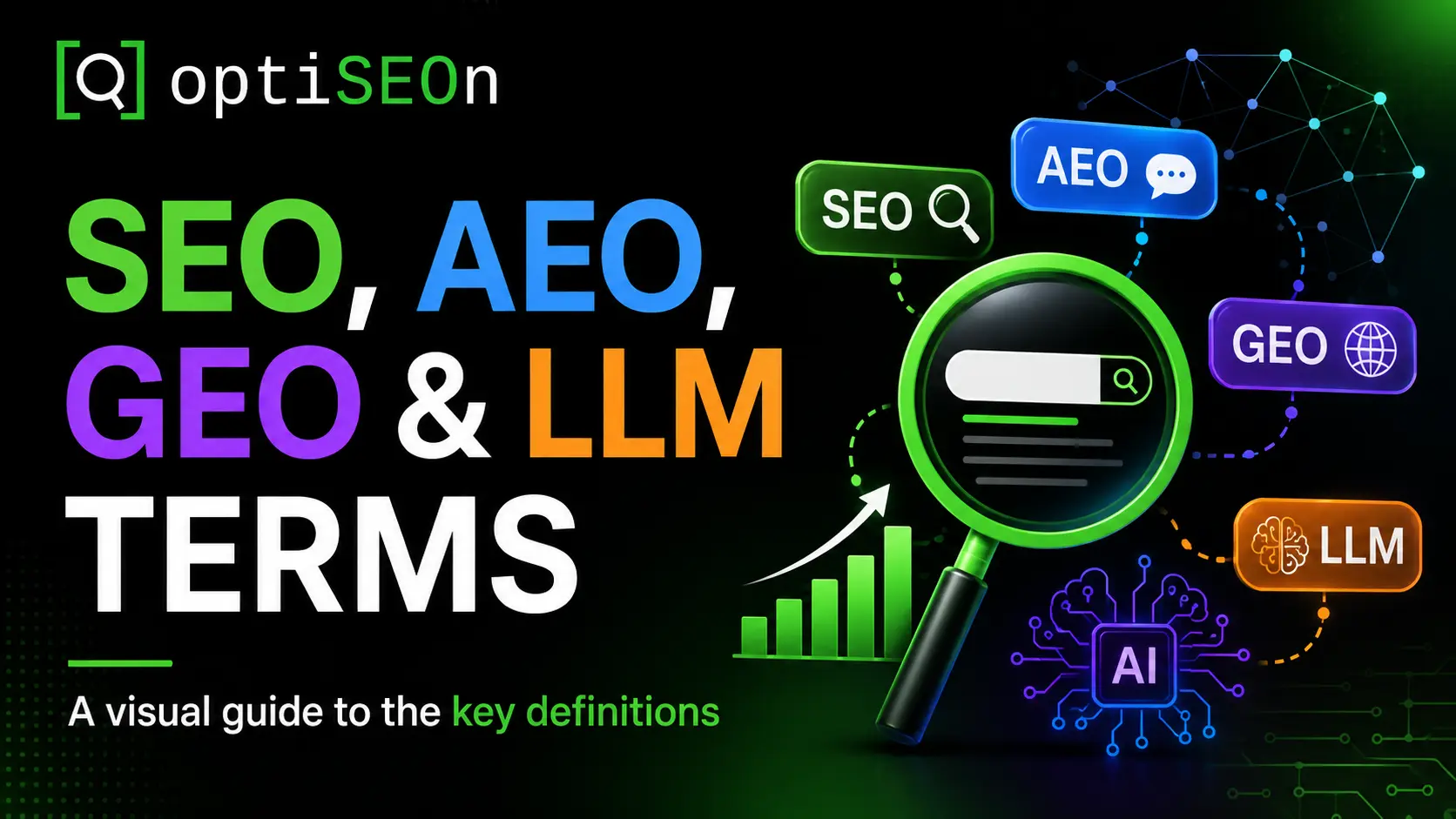
    The Modern Search & AI Visibility Glossary (2026 Edition)

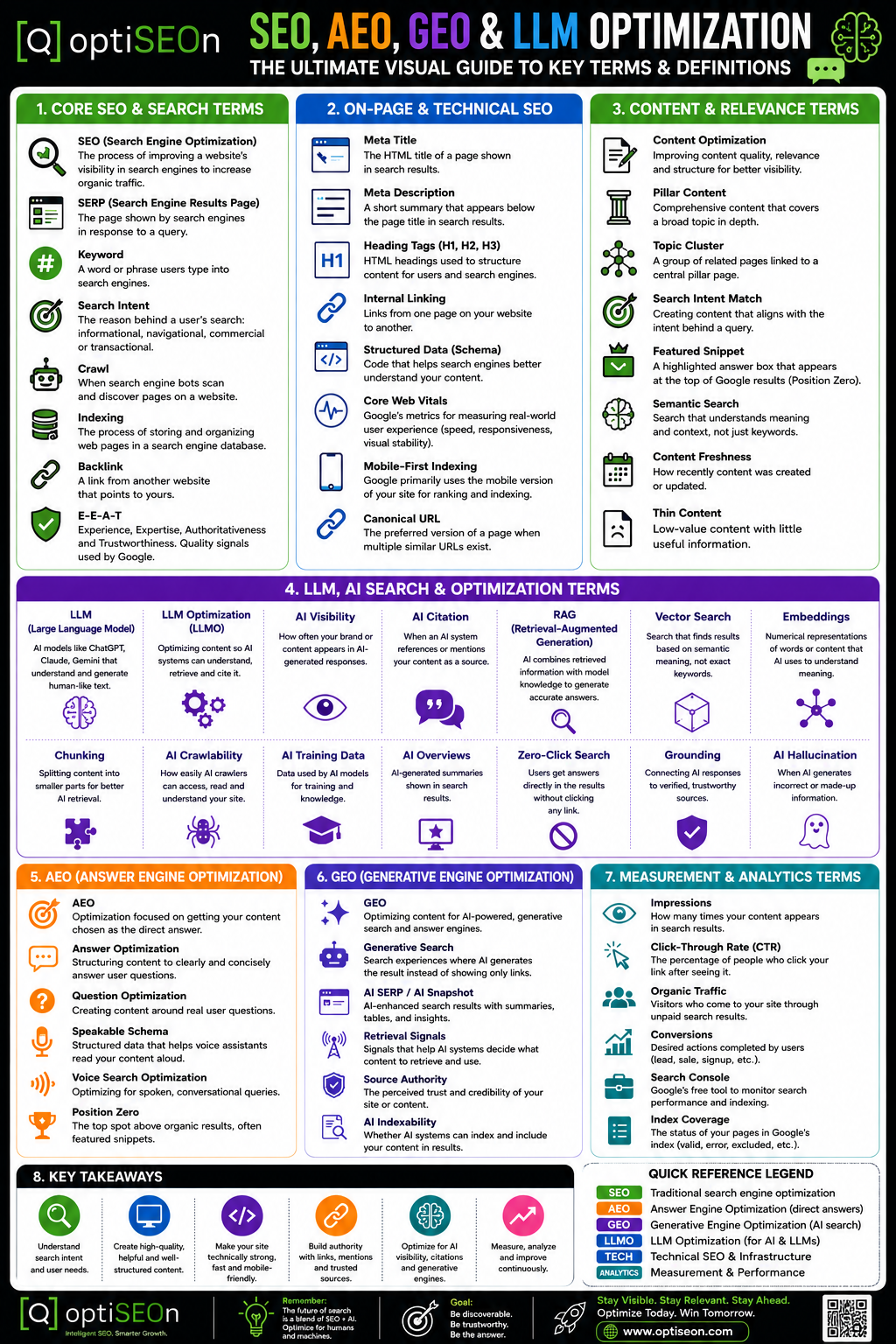
    SEO · AEO · GEO · LLMO · Entity Optimization

    A reference for marketers, content strategists, and technical practitioners working across the full discovery ecosystem — traditional search engines, AI assistants, generative answer engines, and everything in between.


    How to use this glossary

    The lines between SEO, AEO, GEO, and LLMO blur in practice. A single piece of content can be crawled by Googlebot, retrieved by Perplexity, cited by ChatGPT, and summarized in Google’s AI Mode — all from the same URL. Terms are grouped by their primary domain, but most concepts cross over. Where a term has a common abbreviation, it is shown in parentheses.


    1. Foundational Search Concepts

    TermDefinition
    Search Engine Optimization (SEO)The discipline of improving a website’s visibility in search engines (Google, Bing, etc.) to earn unpaid, organic traffic.
    Search Engine Results Page (SERP)The page returned after a search query, now often a mix of links, AI summaries, ads, maps, videos, and rich features.
    Organic TrafficVisitors who arrive from unpaid search listings, as opposed to paid ads, social, email, or direct visits.
    Ranking FactorAny signal a search engine or AI system uses to decide the order or eligibility of results.
    KeywordA word or phrase users type or speak when searching. Still useful, but increasingly secondary to intent and entities.
    Search IntentThe underlying goal of a query, typically classified as informational, navigational, transactional, or commercial investigation.
    QueryThe exact phrase entered into a search engine or AI assistant.
    Long-Tail QueryA longer, more specific query (often 4+ words). Long-tail queries dominate AI assistant usage because users speak more naturally.
    Zero-Click SearchA search where the user’s need is satisfied directly on the results page (snippet, AI Overview, map pack) without clicking any website.
    Click-Through Rate (CTR)Percentage of users who click a given result after seeing it.
    Bounce RateThe share of sessions that end without further interaction. Less emphasized today than engagement metrics.
    Dwell TimeHow long a user remains on a page before returning to the SERP. A rough proxy for content satisfaction.
    Search SatisfactionWhether the user’s underlying need was met. The end goal that most modern ranking signals try to approximate.

    2. Crawling, Indexing & Infrastructure

    TermDefinition
    CrawlThe process of a bot fetching pages from the web.
    IndexingStoring and organizing crawled pages so they can be retrieved in response to queries.
    DeindexingRemoval of a URL from a search engine’s index, intentionally or otherwise.
    Crawl BudgetThe number of URLs a search engine is willing to crawl on a site within a given period. Matters mainly for very large sites.
    Bot / CrawlerAutomated software that fetches web pages. Includes traditional search crawlers and AI/LLM crawlers.
    GooglebotGoogle’s primary web crawler.
    BingbotMicrosoft Bing’s crawler, which also feeds ChatGPT Search and Copilot.
    GPTBotOpenAI’s crawler used for training and retrieval.
    ClaudeBotAnthropic’s crawler.
    PerplexityBotPerplexity’s crawler.
    Google-ExtendedA user-agent token Google uses to let publishers opt out of Gemini and Vertex AI training without affecting search rankings.
    SitemapAn XML file listing a site’s important URLs to help crawlers discover content.
    Robots.txtA plain-text file at the root of a site that tells crawlers which paths they may or may not access. Honor depends on the bot.
    llms.txtA proposed plain-text file at the root of a site that gives LLMs a curated, structured map of the site’s most important content for retrieval and citation.
    Canonical URLThe preferred version of a page when duplicates or near-duplicates exist.
    HTTP Status CodesServer responses such as 200 (OK), 301 (permanent redirect), 302 (temporary), 404 (not found), 410 (gone), 500 (server error).
    301 RedirectA permanent redirect that passes ranking signals to the destination URL.
    404 ErrorA response indicating the requested page does not exist.
    Soft 404A page that returns a 200 status but offers no real content, often misclassified by Google.
    JavaScript SEOThe practice of ensuring JS-rendered content can be crawled, rendered, and indexed correctly.
    RenderingThe step where a crawler executes a page’s JavaScript to see the final DOM.
    Server Response TimeHow quickly a server begins returning a page; a component of Core Web Vitals.
    Render-Blocking ResourcesCSS or JS that delays the browser from showing visible content.
    Lazy LoadingDeferring the load of images, videos, or scripts until they are needed.
    CDN (Content Delivery Network)A geographically distributed network that caches and serves assets closer to users.
    Edge SEOApplying SEO changes (redirects, headers, A/B tests, schema injection) at the CDN edge rather than in the origin application.
    Headless CMSA content management system that exposes content via API, with the front end built separately.
    APIAn interface that lets systems exchange data programmatically.
    Log File AnalysisReviewing server logs to study how bots crawl a site — what they hit, what they miss, what they waste.
    SSL / TLS CertificateEncryption that enables HTTPS. A baseline trust and ranking signal.
    Core Web VitalsGoogle’s set of user-experience metrics: LCP (loading), INP (interactivity, replaced FID in 2024), and CLS (visual stability).
    Mobile-First IndexingGoogle’s standard practice of using the mobile version of a page as the primary basis for indexing and ranking.
    Page ExperienceA composite signal covering Core Web Vitals, HTTPS, and absence of intrusive interstitials.

    3. On-Page, Content & Semantic Optimization

    TermDefinition
    On-Page SEOOptimization applied directly to a page: content, headings, internal links, metadata, schema.
    Off-Page SEOExternal factors influencing rankings: backlinks, brand mentions, citations, reputation.
    Technical SEOOptimization of the underlying infrastructure: crawlability, indexing, performance, rendering, architecture.
    Meta Title (Title Tag)The HTML <title> element, used as the clickable headline in most SERP listings.
    Meta DescriptionA short summary in the page’s <meta> tag, often shown beneath the title in results.
    Heading TagsHTML elements <h1> through <h6> that signal content structure to both users and machines.
    Alt TextThe alt attribute describing an image — important for accessibility and for AI/image understanding.
    URL SlugThe human-readable portion of a URL identifying the page.
    Internal LinkingLinks between pages on the same domain, used to distribute authority and signal topical relationships.
    Pillar ContentA comprehensive, central piece of content covering a broad topic in depth.
    Topic ClusterA pillar page plus interlinked supporting pages, designed to demonstrate topical depth and authority.
    Evergreen ContentContent that remains relevant and accurate over long periods.
    Thin ContentPages with little original or useful information — a known risk for demotion.
    Duplicate ContentSubstantially similar content on multiple URLs, on the same site or across sites.
    Content FreshnessHow recently a page has been meaningfully updated. Important for time-sensitive topics.
    Content DecayThe gradual decline in traffic and rankings as content ages or competitors improve.
    Helpful ContentGoogle’s framing (since the 2022 Helpful Content Update) for content created primarily for people, not search engines.
    ReadabilityHow easily a human reader can understand a piece of content. Often measured with formulas like Flesch-Kincaid.
    NLP OptimizationStructuring writing — clear subjects, plain syntax, defined entities — so natural language processing systems can parse and reuse it.
    Semantic SearchSearch that interprets meaning and context rather than matching exact keywords.
    Semantic RelevanceHow closely a piece of content aligns with the meaning and intent behind a query, not just its words.
    LSI Keywords“Latent Semantic Indexing” terms — a popular but largely debunked SEO concept. Google has stated it does not use LSI. The useful underlying idea is “topically related terms.”

    4. Authority, Trust & E-E-A-T

    TermDefinition
    BacklinkAn inbound link from another website pointing to yours. Still a core authority signal.
    Anchor TextThe clickable text of a hyperlink, which gives search engines context about the destination.
    Domain Authority (DA)A third-party score (originally from Moz) estimating a domain’s ranking strength. Not used by Google itself.
    Domain Rating (DR)Ahrefs’ equivalent metric, based on backlink profile.
    Topical AuthorityThe degree to which a site is recognized as expert across a defined subject area.
    E-E-A-TGoogle’s quality framework: Experience, Expertise, Authoritativeness, and Trustworthiness. The first “E” (Experience) was added in 2022.
    YMYL (“Your Money or Your Life”)Google’s classification for topics that can materially affect health, finances, safety, or wellbeing — held to a higher E-E-A-T standard.
    Brand MentionAn unlinked reference to a brand. Increasingly important as an authority and entity signal for both search and LLMs.
    Citation (Local)An online listing of a business’s name, address, and phone number.
    NAP ConsistencyKeeping Name, Address, and Phone identical across directories and platforms.
    Reputation SignalsReviews, ratings, press coverage, and discussion across the web that shape both human and AI perception.

    5. Structured Data & Entities

    TermDefinition
    Structured DataMachine-readable code that explicitly labels what a page is about.
    Schema MarkupThe structured data vocabulary maintained at Schema.org, typically implemented as JSON-LD.
    JSON-LDThe recommended format for adding schema, embedded in a <script> tag.
    Rich ResultsEnhanced SERP listings — stars, FAQs, product info, recipe cards — driven by structured data.
    Featured SnippetA highlighted answer box at the top of Google’s results, extracted from a ranking page.
    Position ZeroCommon name for the featured snippet position, above the standard “blue links.”
    Knowledge GraphGoogle’s database of entities (people, places, things, concepts) and the relationships between them.
    Knowledge PanelThe branded info box appearing on the right side of Google results, drawn from the Knowledge Graph.
    EntityA distinct, identifiable concept — a person, organization, place, product, or idea — that search engines and LLMs can recognize.
    Entity SEOOptimizing for clearly defined entities and their relationships, not just keyword strings.
    Brand EntityThe cluster of signals — name, descriptions, mentions, schema, Wikipedia/Wikidata presence — that establishes a brand as a recognized entity to machines.
    Entity-Based OptimizationBuilding content and signals around concepts and their connections, often validated via knowledge graphs.
    Wikidata / Wikipedia PresenceStrong external signals used by both Google and LLMs to verify and disambiguate entities.
    Speakable SchemaA schema.org property designed to flag content suitable for voice assistant readout.
    FAQ SchemaStructured data marking up question/answer pairs (note: Google has reduced FAQ rich result eligibility since 2023).

    6. Local & Multi-Channel Search

    TermDefinition
    Local SEOOptimization for geographically targeted queries and map-based results.
    Google Business Profile (GBP)Google’s business listing platform (formerly Google My Business), powering Maps and local pack results.
    Map Pack / Local PackThe block of local business results shown with a map in Google search.
    Local CitationA mention of a business’s NAP information on a third-party site.
    Search Everywhere OptimizationThe practice of optimizing for visibility across every place users discover information — Google, Bing, YouTube, TikTok, Reddit, Amazon, Apple/Google Maps, and AI assistants.
    Omni-Search VisibilityA brand’s combined presence across all of these discovery surfaces.
    Platform SEOOptimization tailored to a specific platform’s algorithm — YouTube, TikTok, Amazon, Pinterest, App Store, etc.
    Forum / Community OptimizationBuilding presence and helpful contributions on Reddit, Quora, Stack Exchange, and niche communities — increasingly important because LLMs heavily cite these sources.

    7. AI Search, LLMs & Generative Optimization

    This section covers the overlapping disciplines often labeled AEO (Answer Engine Optimization), GEO (Generative Engine Optimization), and LLMO (LLM Optimization). The boundaries between them are fuzzy; in practice they describe the same goal — being surfaced and cited by AI-mediated discovery — from slightly different angles.

    7a. Core AI search vocabulary

    TermDefinition
    Large Language Model (LLM)A neural network trained on massive amounts of text to understand and generate language. Examples: OpenAI’s GPT, Anthropic’s Claude, Google’s Gemini, Meta’s Llama.
    Generative AIAI systems that produce new content (text, images, audio, video) rather than only classifying or retrieving.
    AI SearchA search experience powered primarily by generative AI, which synthesizes an answer from multiple sources rather than listing links.
    AI AssistantA conversational AI product such as ChatGPT, Claude, Gemini, Copilot, or Perplexity.
    Answer EngineA system designed to deliver direct answers (Perplexity, ChatGPT Search, Google AI Mode) rather than ten blue links.
    AI SERPA search results page enhanced or replaced by AI-generated content.
    AI OverviewGoogle’s AI-generated summary block that appears above traditional results for many queries (the successor to “Search Generative Experience” / SGE).
    AI Mode (Google)Google’s dedicated generative search experience offering full conversational answers, launched broadly in 2025.
    ChatGPT SearchOpenAI’s search feature inside ChatGPT, which retrieves and cites live web sources.
    PerplexityA standalone answer engine that combines retrieval, citation, and conversation.
    Copilot (Microsoft)Microsoft’s AI assistant, integrated with Bing search results.
    AI SnapshotA generic term for any AI-generated summary appearing in a search interface.
    Conversational SearchSearch expressed in natural, often multi-turn dialogue rather than terse keywords.
    Multimodal SearchSearch combining text, images, voice, and/or video inputs and outputs.
    Voice SearchSearch performed by speaking, typically through a phone, smart speaker, or in-car assistant.
    Agentic SearchSearch performed by an autonomous AI agent that can browse, compare, and take actions (book, buy, summarize) on the user’s behalf.

    7b. How AI systems find and use content

    TermDefinition
    Retrieval-Augmented Generation (RAG)An architecture where an LLM retrieves relevant external documents at query time and uses them to generate a grounded answer.
    AI RetrievalThe lookup step in which an AI system gathers supporting documents before generating an answer.
    Vector SearchRetrieval based on semantic similarity in an embedding space, rather than exact keyword matching.
    EmbeddingA numerical vector that represents the meaning of text, an image, or another input — the unit of comparison in vector search.
    ChunkingSplitting long documents into smaller, semantically coherent segments so they can be embedded and retrieved efficiently.
    GroundingAnchoring an AI’s response in verified, retrievable source material to reduce hallucination.
    AI HallucinationConfidently stated but incorrect or fabricated AI output.
    Source AttributionThe AI system identifying which sources it used to construct an answer.
    AI CitationA specific in-response reference (link, footnote, badge) pointing to a source.
    AI MentionAny reference to a brand, product, or person inside an AI-generated response, with or without a link.
    Knowledge RetrievalThe general process of an AI system locating and extracting information from indexed sources.
    Context WindowThe maximum amount of text an LLM can consider in a single request — relevant to how much content a system can ingest before answering.
    PromptThe input given to an AI model.
    Prompt EngineeringThe craft of writing prompts to reliably produce useful outputs.
    Prompt InjectionAn attack in which hidden instructions in a webpage or document attempt to manipulate an LLM’s behavior. A real risk for AI-readable content.
    AI Training DataThe corpus used to train a model. Distinct from retrieval data, which is fetched at query time.
    Fine-TuningAdditional training applied to a base model to specialize its behavior or knowledge.

    7c. Optimizing for AI visibility

    TermDefinition
    Answer Engine Optimization (AEO)Structuring content so that answer engines and AI assistants can extract a direct, accurate response. Heavy on clear question-answer formatting, schema, and concise lead-ins.
    Generative Engine Optimization (GEO)The broader practice of optimizing content to be retrieved, synthesized, and cited by generative AI search systems.
    LLM Optimization (LLMO)Optimizing so that LLMs — both at training time and at retrieval time — can understand, attribute, and reproduce information about a brand or topic.
    AI VisibilityHow often, and how favorably, a brand or source appears inside AI-generated answers. The AI-era equivalent of share-of-voice.
    AI DiscoverabilityHow easily an AI system can find a brand or piece of content when it would be relevant.
    AI CrawlabilityWhether AI bots can technically access a site (robots.txt, authentication, rendering).
    AI IndexabilityWhether a site’s content can be parsed, chunked, and stored by AI systems for later retrieval.
    Machine ReadabilityHow cleanly a system can interpret a page — clear HTML, semantic markup, plain language, accessible structure.
    AI-Friendly ContentContent explicitly structured for machine consumption: clear claims, direct answers, defined entities, attributable statements.
    Citation OptimizationWriting and structuring content to maximize the chance of being cited by AI systems (concrete facts, unique data, clear attribution, stable URLs).
    Citation GraphThe network of who cites whom across the web — increasingly used by AI systems to weight authority.
    Citation AuthorityThe likelihood that a given source will be referenced by AI systems on a given topic.
    Contextual AuthorityAuthority that comes from covering the entire ecosystem of a topic, not just a single page.
    AI Trust SignalsSignals — author bios, citations, schema, consistent brand entity, third-party validation — that lead AI systems to treat a source as reliable.
    Retrieval SignalsWhatever cues a retrieval system uses to select content: freshness, relevance, authority, structure, embeddings quality.
    AI Ranking SignalsThe factors that determine whether and how prominently an AI system features a source.
    Source AuthorityThe perceived overall trustworthiness of a source as judged by an AI system.
    Question OptimizationWriting content around the actual questions users ask, often in their own phrasing.
    Conversational ContentContent that reads as if it directly answers a question, in the register of a knowledgeable conversation.
    FAQ OptimizationStructuring FAQs (both on-page and in schema) for snippet and AI retrieval.
    Knowledge EntityA clearly defined entity that AI systems can recognize and reason about.
    Trust Layer OptimizationBuilding credibility signals — reviews, mentions, authorship, third-party validation — across the wider web, not just on-site.
    Machine-First SEODesigning for machine consumption and human consumption simultaneously, rather than treating them as competing goals.
    Parasite SEO / AI Parasite MarketingThe practice of ranking or being cited via high-authority third-party platforms (Reddit, LinkedIn, YouTube, major publications) rather than your own domain.
    Digital Entity FootprintThe total picture of a brand across the web — owned, earned, and third-party — that defines it as an entity.
    AI Search EcosystemThe combined environment of traditional engines, AI assistants, and answer engines that now shapes discovery.
    Human + AI Search JourneyThe reality that a single buying or research journey now spans Google, ChatGPT, Reddit, YouTube, and others before a decision is made.

    8. Analytics & Measurement

    TermDefinition
    ImpressionsThe number of times a piece of content has appeared in a results interface.
    SessionsVisits to a website, as tracked in analytics.
    UsersUnique visitors over a given period.
    Engagement RateThe share of sessions considered meaningful (by duration, depth, or conversion). The metric that largely replaced bounce rate in GA4.
    Conversion RateThe percentage of visitors who complete a defined goal.
    Organic ConversionsConversions attributable to unpaid search traffic.
    AttributionThe methodology used to assign credit for a conversion across the channels that touched it.
    Key Performance Indicator (KPI)A specific, measurable metric tied to business outcomes.
    Google Search Console (GSC)Google’s free tool for monitoring crawl, index, and search performance.
    Bing Webmaster ToolsMicrosoft’s equivalent, also useful for understanding how content surfaces in Bing, Copilot, and ChatGPT Search.
    Crawl ErrorsIssues — server, redirect, blocking, or not-found — that prevent crawlers from accessing content.
    Index CoverageA report in Search Console showing which pages are indexed, excluded, or in error.
    Share of AI VoiceAn emerging metric estimating how often a brand is named in AI-generated responses to relevant prompts.
    AI Citation TrackingMonitoring which AI systems cite a brand or page, for which queries, with what framing.

    Quick reference: the four “O”s

    AcronymStands forPrimary focus
    SEOSearch Engine OptimizationRanking in traditional search results (Google, Bing).
    AEOAnswer Engine OptimizationBeing chosen as the direct answer in snippets and AI assistants.
    GEOGenerative Engine OptimizationBeing retrieved, synthesized, and cited inside AI-generated answers.
    LLMOLLM OptimizationBeing understood and reproduced correctly by large language models, both via training data and live retrieval.

    In practice, the same well-structured, authoritative, machine-readable content tends to win across all four. The acronyms describe emphasis, not separate disciplines.


    Last updated: 2026.

  • How to Get Your Business Cited by ChatGPT, Perplexity & Gemini in 2026

    How to Get Your Business Cited by ChatGPT, Perplexity & Gemini in 2026

    Two years ago, most people searched Google when they needed a service provider. Today, a growing number are asking AI tools like ChatGPT, Perplexity, or Gemini instead. Instead of scrolling through pages of search results, they get a direct answer with a few recommended brands.

    If your business is not one of those recommendations, you are likely missing the lead.

    This shift has created a new discipline often called AI citation optimization or LLM Optimization. The goal is simple: help AI platforms recognize, trust, and recommend your business. Here’s what is actually working in 2026, based on real-world results.

    What Does It Mean to Be “Cited” by AI?

    There are two ways AI tools typically reference brands:

    • Mention: Your brand name appears in the response.
    • Citation: The AI links directly to your website as a source.

    Citations matter more. A mention shows the AI knows your business exists. A citation shows the AI considers your content trustworthy enough to use as a source.

    Each platform handles this differently:

    • Perplexity almost always displays source links and sends measurable referral traffic.
    • ChatGPT sometimes includes citations, especially when web search is enabled.
    • Gemini and Google AI Overviews blend citations into Google’s search experience.
    • Claude increasingly shows citations when using web-enabled search.

    The real objective is not just getting mentioned once. It’s becoming a trusted entity that AI systems consistently reference across different types of searches.

    The Three Signals AI Engines Care About Most

    Most “AI SEO” advice online can be simplified into three core signals.

    1. Clear, Structured Content

    AI systems prefer content that is easy to extract and summarize.

    Pages that perform well usually include:

    • Question-based headings
    • Direct answers near the top of each section
    • Bullet points and numbered lists
    • Comparison tables
    • Short summaries or TL;DR sections

    A concise, useful answer beats long, unfocused writing almost every time.

    2. Strong Entity Authority

    AI tools want confidence that your business is legitimate and trustworthy.

    That authority comes from:

    • Consistent business information across the web
    • Schema markup
    • Mentions on reputable websites
    • Reviews and citations
    • Author profiles and E-E-A-T signals
    • Presence on trusted platforms

    The stronger your entity signals, the more likely AI tools are to recommend you.

    3. Diverse Source Presence

    Different AI platforms rely on different data sources.

    For example:

    • ChatGPT frequently references Wikipedia and authoritative editorial content.
    • Perplexity often pulls from Reddit and community discussions.
    • Google AI Overviews uses a broader mix of search-indexed sources.

    If your business only exists on your own website, your visibility ceiling is limited.

    Step 1: Structure Content for AI Extraction

    This is one of the easiest and highest-impact improvements you can make.

    The format that performs best usually looks like this:

    • An H2 that matches a real question
    • A direct answer within the first 40–60 words
    • Supporting details afterward
    • Lists or tables where useful

    Examples:

    • “What Is LLM Optimization?”
    • “How Do AI Citations Work?”
    • “Why Is Schema Markup Important?”

    This approach overlaps heavily with Answer Engine Optimization (AEO). The same content structure that wins featured snippets in Google often performs well in AI-generated answers too.

    Step 2: Implement Schema Markup Properly

    Schema markup helps AI systems understand exactly what your content represents.

    At minimum, most businesses should implement:

    • Article schema
    • FAQPage schema
    • HowTo schema
    • LocalBusiness schema
    • Organization schema
    • Author schema
    • Product or Service schema

    Without structured data, AI systems have to guess. With it, they can classify your content far more accurately.

    In 2026, schema is not optional anymore. It is foundational infrastructure.

    Step 3: Build Authority Beyond Your Website

    Your website alone is usually not enough.

    AI engines evaluate your reputation across the broader web.

    High-value authority signals include:

    • Industry publications
    • Podcasts and interviews
    • Reddit discussions
    • G2, Trustpilot, and review platforms
    • LinkedIn and YouTube content
    • Brand mentions on trusted websites

    Wikipedia and Wikidata are powerful signals too, although most smaller businesses will not qualify for a Wikipedia page due to strict notability standards.

    This kind of authority building takes time, but it compounds.

    Step 4: Monitor AI Visibility

    Most companies have no idea whether AI tools are recommending them.

    A simple tracking process includes:

    1. Build a list of 20–40 customer questions.
    2. Test those prompts weekly in ChatGPT, Perplexity, Gemini, and Claude.
    3. Record whether your business is:
      • Mentioned
      • Cited
      • Missing entirely
    4. Track which competitors appear most often.

    Dedicated platforms like Profound, Otterly, and Semrush AI Visibility Toolkit can automate much of this process.

    Step 5: Keep Content Updated

    Freshness matters more than many businesses realize.

    Older content often loses visibility over time, even if the information is still accurate.

    A strong refresh process includes:

    • Updating statistics
    • Revising examples
    • Adding new FAQs
    • Refreshing case studies
    • Updating timestamps visibly on-page

    Start with your highest-intent pages first.

    What Not to Do

    There is a lot of bad advice circulating around AI optimization right now.

    Avoid these mistakes:

    • Keyword stuffing for AI engines
    • Paying for “guaranteed AI citations”
    • Ignoring traditional SEO
    • Optimizing for only one AI platform

    AI visibility still depends heavily on strong technical SEO and crawlable content.

    The Reality About Timelines

    This is not an overnight process.

    Most businesses start seeing early improvements within 60–90 days after improving structure, schema, and technical foundations.

    Consistent visibility across multiple AI platforms usually takes 6+ months because it depends on long-term authority building.

    The companies dominating AI visibility today started investing in it years ago.

    Frequently Asked Questions

    How long does it take to get cited by ChatGPT?

    Many businesses begin seeing early mentions within 2–3 months after restructuring content and implementing schema. Consistent citations across multiple AI platforms generally take longer because authority signals build gradually.

    Are AI citations more important than Google rankings?

    No. Traditional SEO still drives most traffic for many industries. AI visibility is an additional discovery channel that is growing quickly and often produces highly qualified leads.

    What’s the difference between a mention and a citation?

    A mention includes your brand name in an AI-generated answer. A citation links directly to your website as a source.

    Do I need a Wikipedia page?

    No. It helps, but most businesses can still build strong entity authority through schema, third-party mentions, reviews, and consistent branding.

    Can this be handled in-house?

    The technical work can often be managed internally if your team understands SEO and structured data. Ongoing authority building and AI visibility monitoring typically require more time and specialized expertise.

    How can I track whether AI tools recommend my business?

    Create a list of customer search prompts and test them regularly across ChatGPT, Perplexity, Gemini, and Claude. Track when your business appears and compare your visibility against competitors.

    Want to know where your business currently appears in AI-generated answers and where competitors are outranking you? OptiSEOn can run a full AI visibility audit and build a focused 90-day roadmap to improve your presence across ChatGPT, Gemini, Perplexity, and other AI platforms.

  • AEO vs SEO vs GEO vs LLM Optimization: What’s the Difference (and Which Do You Need)?

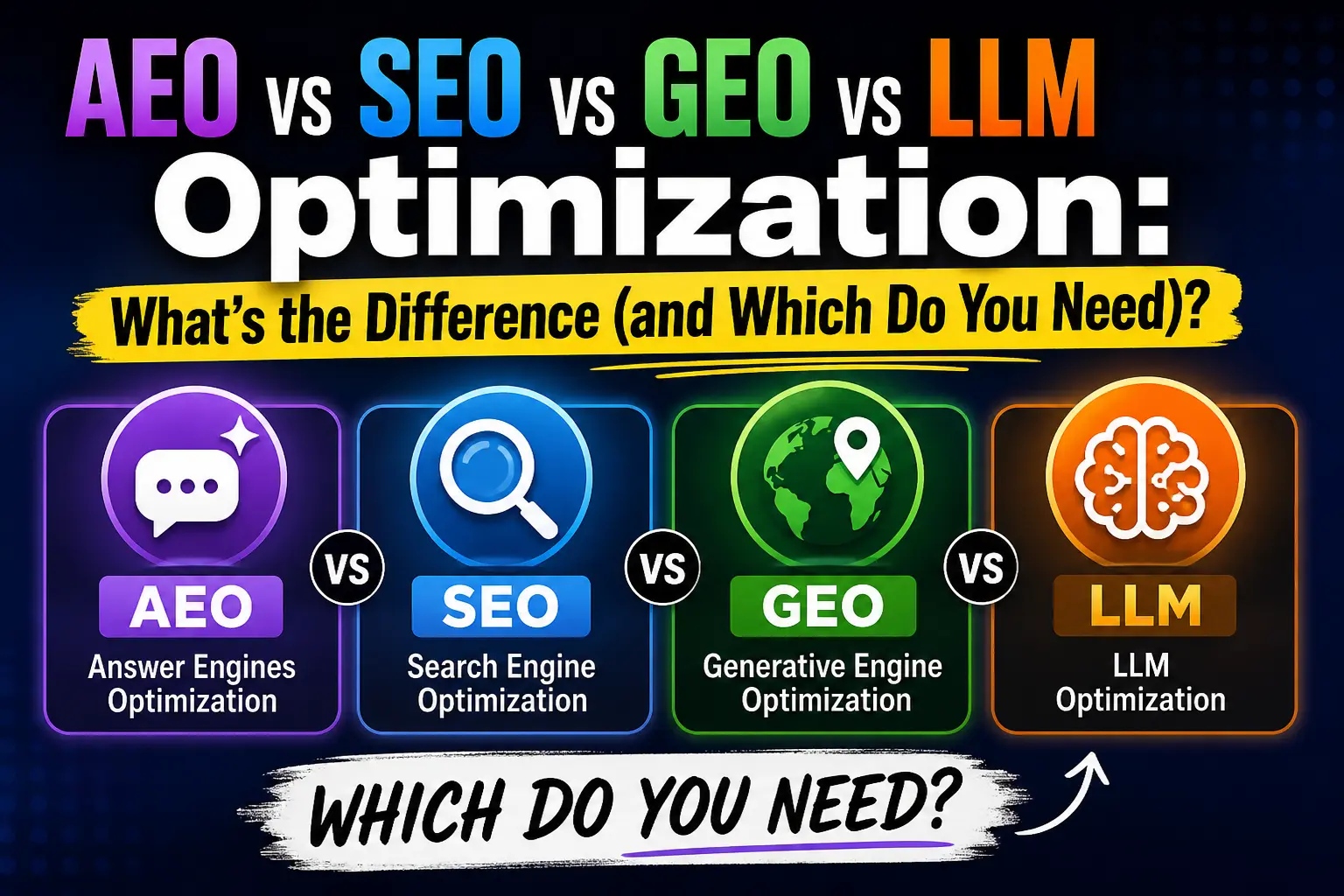
    AEO vs SEO vs GEO vs LLM Optimization: What’s the Difference (and Which Do You Need)?

    If you’ve spent any time researching how to make your business more findable online lately, you’ve run into an alphabet soup of three-letter acronyms: SEO, AEO, GEO, LLM. They all promise more visibility. They all sound like the same thing. And most articles you’ll find treat them as if they are.

    They’re not.

    Each one targets a different kind of search, on a different kind of platform, with a different kind of optimization work behind it. Get the difference right and you’ll know exactly where to spend. Get it wrong and you’ll pay an SEO agency in 2026 with a 2018 playbook — and stay invisible everywhere except Google.

    Here’s the plain-English breakdown.

    TL;DR — the four-line answer

    • SEO gets you ranked on Google and Bing for keyword searches.
    • AEO gets you featured in answer boxes, voice results, and “People Also Ask.”
    • GEO has two meanings in 2026: Geographic SEO (local map pack) and Generative Engine Optimization (showing up in ChatGPT/Perplexity answers). Yes, really. Same acronym, two meanings.
    • LLM Optimization is the umbrella term for getting recommended by AI tools like ChatGPT, Gemini, Claude, and Perplexity.

    You probably need a combination — and the right combination depends on whether your customers are clicking blue links, asking voice assistants, walking in off Google Maps, or asking ChatGPT for a recommendation. Most businesses now need all four.

    CTA box: Want a free audit of how you’re showing up across all four? Book a free SEO + AI visibility audit.

    What is SEO (Search Engine Optimization)?

    SEO is the original. It’s the work of getting a website to rank highly on traditional search engines — Google primarily, then Bing, DuckDuckGo, and Yandex. When someone types “best plumber in Dallas” or “marketing automation software for small businesses” into a search bar and hits enter, SEO is what determines whether your business shows up on page one.

    The core ingredients of modern SEO:

    • On-page SEO — keyword-optimized titles, headings, body copy, image alt text, and meta descriptions
    • Technical SEO — site speed, mobile responsiveness, crawlability, structured data, internal linking
    • Off-page SEO — backlinks from authoritative sites, brand mentions, digital PR
    • Content SEO — publishing useful, original content that earns rankings naturally

    If you want a deeper look at what’s actually moving rankings this year, our breakdown of the 2026 SEO ranking factors that actually matter goes into the specifics. SEO still works in 2026, and Google still drives the majority of search traffic for most businesses — but it’s no longer the only discovery channel that matters.

    You can read more about how OptiSEOn handles SEO specifically on our services page.

    What is AEO (Answer Engine Optimization)?

    AEO is what happens when search stops returning ten blue links and starts returning a single answer.

    Open Google today and search “what’s the best time to post on Instagram.” Notice what shows up at the top — it’s not a list of links. It’s a featured snippet pulling a direct answer from somebody’s blog post. That’s an answer engine result. AEO is the practice of structuring your content so that your answer is the one that gets pulled.

    Where SEO targets the search results page, AEO targets:

    • Featured snippets (the “position zero” answer box at the top of Google)
    • People Also Ask (the expanding question boxes)
    • Voice search results (when someone asks Siri, Alexa, or Google Assistant)
    • Google AI Overviews (the AI-generated summaries now appearing on a growing share of queries)

    The work behind AEO is mostly content structure: writing in question-and-answer format, using FAQ and HowTo schema markup, keeping answers between 40–60 words (the sweet spot for snippet extraction), and making sure your most important facts are in the first paragraph of every section, not the last.

    If you want AEO done for you, OptiSEOn’s AEO service includes featured snippet targeting, FAQ schema, and voice search optimization.

    What is GEO? (Both meanings explained)

    This one’s frustrating because the SEO industry collectively agreed to use the same acronym for two completely different things. Here’s how to tell them apart in 2026.

    Meaning 1: Geographic SEO (local SEO)

    Geographic SEO — sometimes called Local SEO — is what you do to rank in location-based searches. The Google Map Pack (those three local listings with the map at the top of search results), “near me” searches, voice queries like “find a coffee shop near me,” and Google Business Profile rankings.

    Geographic SEO is critical for any business with a physical location or a defined service area: dentists, plumbers, restaurants, law firms, multi-location retailers. The core work involves:

    • Google Business Profile optimization — complete profile, accurate categories, regular posts, photos
    • Local citations — consistent name/address/phone (NAP) across directories
    • Local landing pages — one optimized page per service area or city
    • Reviews — both quantity and velocity matter for ranking

    Meaning 2: Generative Engine Optimization

    Generative Engine Optimization is the newer, AI-native meaning. It’s the practice of optimizing your content and brand signals so that you appear in answers generated by AI tools — ChatGPT, Google Gemini, Claude, Perplexity, Microsoft Copilot.

    A traditional Google search returns links. A generative engine returns a generated answer with citations. GEO (in this sense) is what gets your business cited inside that answer.

    Some of the techniques overlap with AEO and LLM Optimization, but Generative Engine Optimization specifically focuses on:

    • Building strong entity signals — Wikipedia, Wikidata, structured data, brand mentions across the web
    • Creating citation-worthy content — original data, statistics, expert quotes
    • Earning third-party authority — getting mentioned on Reddit, in industry publications, on review sites that AI engines weight heavily

    The confusing part: at OptiSEOn we offer both meanings of GEO, because both matter. Our Geographic SEO service covers map pack rankings, and our LLM Optimization service covers generative engine work.

    What is LLM Optimization?

    LLM Optimization is the umbrella term for everything that gets your business recognized, trusted, and recommended by Large Language Model–powered AI tools.

    When someone asks ChatGPT “what’s the best B2B SEO agency in Dallas,” LLM Optimization is what determines whether you’re in the answer or not.

    We’ve covered the strategic shift in detail in How LLMs Are Replacing Traditional Search, and What You Can Do About It, and we’ll dig into the tactical side in our next post on how to get cited by ChatGPT, Perplexity, and Gemini (publishing May 13).

    The short version: LLM Optimization combines AEO content structure, GEO entity signals, and a few new techniques like llms.txt files, schema markup tuned for AI extraction, and consistent brand presence on the platforms AI tools cite most heavily.

    Side-by-side: SEO vs AEO vs GEO vs LLM

    DisciplineWhere it gets you visiblePrimary tacticBest for
    SEOGoogle, Bing search resultsKeywords, backlinks, technical SEOEvery business with a website
    AEOFeatured snippets, voice, People Also AskQ&A content, FAQ schema, structured answersService businesses, publishers, B2B
    Geographic SEOGoogle Maps, Map Pack, “near me”Google Business Profile, local citations, reviewsLocal businesses, multi-location brands
    Generative Engine OptimizationChatGPT, Gemini, Perplexity answersEntity signals, citation-worthy contentBusinesses competing for AI recommendations
    LLM OptimizationAll AI tools (umbrella term)Combined AEO + GEO + AI-specific techniquesAny business that wants to be AI-discoverable

    Which one does your business actually need?

    Here’s the honest answer: in 2026, most businesses need a combination, and trying to pick one is the wrong frame.

    But if you’re starting from scratch and have a limited budget, here’s the order I’d prioritize:

    1. Start with SEO and AEO together. They reinforce each other. You can’t earn featured snippets without solid SEO fundamentals, and you can’t earn AI citations without first being indexable and structured well.
    2. Add Geographic SEO next if you’re a local or service-area business. The map pack converts at higher rates than organic blue links for local intent.
    3. Layer LLM Optimization on top once you have the foundation. AI engines pull from already-authoritative sources, so the work you do for SEO and AEO directly feeds your AI visibility.

    Trying to skip the foundation and jump straight to “ranking on ChatGPT” rarely works. The AI engines are pulling from the same web your SEO is optimizing — they just present it differently.

    How OptiSEOn handles all four in one system

    Most agencies sell you one of these and call the rest an “upgrade.” That’s how you end up with a pretty website that ranks on Google but is invisible to ChatGPT, or a strong AI presence with no map pack visibility.

    OptiSEOn integrates all four pillars into one monthly engagement. SEO builds the foundation, AEO captures the answer-box opportunities, Geographic SEO owns your local market, and LLM Optimization gets you recommended where buyers are increasingly looking. See how the four pillars work together, or check out our pricing — month-to-month, no long-term contracts.

    Frequently Asked Questions

    What is the difference between SEO and AEO? SEO targets traditional ranked search results (the list of blue links on Google). AEO targets answer-based formats — featured snippets, voice search results, People Also Ask, and Google AI Overviews. AEO is best understood as a specialized layer on top of SEO, not a replacement.

    Is GEO the same as Generative Engine Optimization? “GEO” is currently used to mean two different things in 2026: Geographic SEO (local search and map pack optimization) and Generative Engine Optimization (showing up in AI-generated answers). Always clarify which meaning your agency or article is using.

    Do I need all four — SEO, AEO, GEO, and LLM? Most businesses benefit from all four because each one captures a different type of search. A local service business needs Geographic SEO heavily; a B2B SaaS company benefits more from LLM Optimization; almost everyone needs SEO and AEO as foundations.

    Which has the best ROI in 2026? Geographic SEO typically delivers the fastest ROI for local businesses because map pack visibility converts directly to phone calls and visits. LLM Optimization has the longest tail — once your brand is established as an AI-cited source, it compounds. SEO and AEO sit in the middle.

    Can I do this myself or do I need an agency? The technical foundation (schema, site speed, indexability) and the content-structuring work for AEO can be done in-house if you have the time. LLM Optimization and Geographic SEO are more nuanced and benefit from specialized expertise. The fastest path is usually a free audit to identify which areas you’re weakest in.


    Ready to figure out which of these your business actually needs? Book a free SEO + AI visibility audit — no pitch, no pressure. We’ll show you exactly where you’re winning and where you’re invisible.

  • The Future of Search Is Here: How to Win Visibility Across Google, AI, and Beyond (2026 Guide)

    The Future of Search Is Here: How to Win Visibility Across Google, AI, and Beyond (2026 Guide)

    Search Has Changed — Most Businesses Haven’t

    If you’re still thinking SEO is just about ranking #1 on Google, you’re already behind.

    Search in 2026 is no longer just about blue links.

    Today, your customers find answers through:

    • Google Search (still important)
    • Featured snippets & People Also Ask
    • Voice assistants
    • AI platforms like ChatGPT, Gemini, and Perplexity

    👉 This means one thing:
    Ranking is no longer the goal. Visibility is.


    The New Visibility Framework (What Actually Works Now)

    Most agencies stop at SEO.

    You don’t.

    At OptiSEOn, we combine:

    • SEO (Search Engine Optimization) → Rank on Google
    • AEO (Answer Engine Optimization) → Get featured in answers
    • GEO (Geographic Optimization) → Dominate local search
    • LLM Optimization → Get mentioned by AI platforms

    👉 This is how modern brands win.


    1. Search Intent Is Everything (More Than Ever)

    Google and AI platforms are obsessed with one thing:

    Does your content directly answer the user’s question?

    What’s changed:

    • Queries are longer and conversational
    • AI summarizes answers before clicks happen
    • Users expect instant clarity

    What to do:

    • Answer the question in the first 2–3 sentences
    • Use clear headings and structure
    • Match content format to intent:
      • Informational → Guides, lists
      • Commercial → Comparisons
      • Transactional → Landing pages

    👉 If you miss intent, nothing else matters.


    2. EEAT Is Now Non-Negotiable

    Google’s EEAT (Experience, Expertise, Authority, Trust) is stronger than ever—and AI models follow the same signals.

    To build EEAT:

    • Show real experience (case studies, results)
    • Use author profiles
    • Get brand mentions + backlinks
    • Keep content accurate and updated

    👉 Trust is the new ranking factor.


    3. AI Is Replacing Clicks (And You Need to Adapt)

    AI tools don’t just rank pages—they choose answers.

    If your brand isn’t included in those answers, you’re invisible.

    How to optimize for AI visibility:

    • Write clear, direct answers
    • Use FAQ sections
    • Structure content for easy extraction
    • Build topical authority across your niche

    👉 You’re no longer competing for clicks.
    You’re competing to be the answer.


    4. Local SEO (GEO) Is a Hidden Goldmine

    If you serve a specific area, local search is one of the fastest ways to win.

    Key actions:

    • Optimize your Google Business Profile
    • Build consistent citations
    • Get real customer reviews
    • Create location-specific pages

    👉 Local = lower competition + higher conversions.


    5. Backlinks Still Matter (But Differently)

    Links are still important—but spammy tactics don’t work anymore.

    What works now:

    • Brand mentions (even unlinked)
    • Authority links from real sites
    • Digital PR
    • Industry directories

    👉 It’s about credibility, not just quantity.


    6. Technical SEO = Your Foundation

    If your site isn’t crawlable, nothing else matters.

    Must-haves:

    • Fast load speed
    • Mobile optimization
    • Clean site structure
    • Schema markup
    • Proper indexing

    👉 Think of this as your infrastructure.


    7. Content Depth Beats Content Volume

    Publishing 100 weak articles won’t help.

    One strong, authoritative piece will.

    Winning content strategy:

    • Go deep, not wide
    • Cover topics fully
    • Build topic clusters
    • Update content regularly

    👉 Authority beats frequency.


    The Real Shift: From Ranking to Total Visibility

    Here’s the truth most people won’t tell you:

    👉 SEO alone is no longer enough.

    To win in 2026, your brand must show up:

    • On search engines
    • Inside AI-generated answers
    • In local results
    • Across the web as a trusted entity

    How OptiSEOn Helps You Win

    At OptiSEOn, we don’t just “do SEO.”

    We build complete visibility systems that:

    • Rank your site on Google
    • Get your brand mentioned in AI platforms
    • Dominate local search results
    • Turn visibility into real revenue

    Ready to Future-Proof Your Business?

    If your competitors start showing up in AI answers before you do, you’ll lose traffic before you even realize it.

    👉 The shift is already happening.


    Take Action Now

    Visit: https://optiseon.com
    Or contact us to see how we can grow your visibility across SEO, AI, and beyond.

  • How LLMs Are Replacing Traditional Search, and What You Can Do About It

    How LLMs Are Replacing Traditional Search, and What You Can Do About It

    The way people find information online is changing—fast. Traditional search engines like Google are no longer the only gateway to answers. Instead, users are turning to large language models (LLMs) like ChatGPT, Claude, and Perplexity AI to get direct, conversational responses. This shift is reshaping SEO—and giving rise to GEO (Generative Engine Optimization) and AEO (Answer Engine Optimization).

    If you rely on organic traffic, this isn’t a trend to watch—it’s a transformation you need to act on.


    What Are LLMs and Why Are They Disrupting Search?

    Large Language Models (LLMs) are AI systems trained on massive datasets to understand and generate human-like text. Instead of returning a list of links like traditional search engines, they deliver direct answers, summaries, and recommendations.

    Key Differences: Traditional Search vs LLMs

    FeatureTraditional SearchLLM-Based Search
    OutputLinksDirect answers
    User IntentKeywordsNatural language questions
    InteractionOne-wayConversational
    Click BehaviorMultiple clicksZero-click answers

    This means users are skipping websites entirely and getting what they need instantly.


    The Rise of Zero-Click Search

    “Zero-click searches” are queries where users get their answer without clicking a result. This trend has exploded with AI.

    Why it matters:

    • Less traffic to websites
    • More competition for visibility inside AI responses
    • Authority signals matter more than ever

    Platforms like Google SGE are integrating AI directly into search results—blurring the line between search engines and LLMs.


    What Is GEO (Generative Engine Optimization)?

    GEO is the practice of optimizing your content so it gets cited, summarized, or used by AI models.

    Instead of ranking #1 on Google, your goal becomes: being the source AI trusts and references.

    How GEO Works:

    1. AI scans high-quality, structured content
    2. It extracts relevant insights
    3. It synthesizes answers for users

    If your content isn’t optimized for this, you’re invisible.


    What Is AEO (Answer Engine Optimization)?

    AEO focuses on structuring your content so it can be easily turned into direct answers.

    Think:

    • Featured snippets
    • FAQ sections
    • Voice search responses

    AEO is the bridge between SEO and AI-driven search.


    Why Traditional SEO Alone Is No Longer Enough

    Classic SEO still matters—but it’s no longer sufficient.

    Old SEO Focus:

    • Keywords
    • Backlinks
    • Rankings

    New Reality:

    • Context
    • Authority
    • Clarity
    • Structured answers

    Search is evolving from “find the best page” to “give me the best answer.”


    How to Optimize for LLMs (GEO + AEO Strategy)

    Here’s what actually works in 2026:

    1. Write Like You’re Answering a Question

    Use clear, direct language.

    Example:

    • ❌ “Best practices for optimization strategies…”
    • ✅ “To optimize for AI search, focus on clear answers, structured content, and authority signals.”

    2. Use Structured Content

    Break content into:

    • Headings (H2, H3)
    • Bullet points
    • Short paragraphs

    This makes it easier for AI to extract information.

    3. Add FAQ Sections (AEO Goldmine)

    Include real questions users ask:

    Q: Are LLMs replacing Google?
    A: Not entirely, but they are reducing reliance on traditional search by providing direct answers.

    4. Build Topical Authority

    Cover entire topics—not just keywords.

    Instead of: one article on “SEO tips”

    Create:

    • SEO basics
    • Advanced SEO
    • GEO strategies
    • AEO frameworks

    5. Optimize for Entities, Not Just Keywords

    Search engines and AI models understand entities (people, brands, concepts). Mention and contextualize:

    • Tools (e.g., ChatGPT)
    • Companies (e.g., Google)
    • Concepts (e.g., Generative AI, NLP)

    6. Increase Content Credibility

    AI favors trustworthy sources. Boost credibility with:

    • Author bios
    • Data and statistics
    • External references
    • Real-world examples

    7. Focus on Semantic SEO

    Use related terms naturally. Instead of repeating “LLMs replacing search,” include:

    • AI search engines
    • Conversational AI
    • Generative search
    • Answer engines

    The Future of Search: Hybrid Models

    The future isn’t “Google vs AI”—it’s integration. Search engines are becoming AI-driven, and AI tools are becoming search engines.

    Expect:

    • More personalized answers
    • Fewer clicks
    • Higher demand for trusted sources

    What You Should Do Right Now

    If you want to stay ahead:

    • Audit your content— Is it clear, structured, and answer-focused?
    • Add FAQs to key pages— Capture AEO opportunities
    • Build authority clusters— Own your niche completely
    • Optimize for AI visibility— Think beyond rankings

    Final Thoughts

    LLMs aren’t just changing search—they’re redefining how information is discovered. If your content isn’t being used by AI, it’s not being seen.

    The winners in this new era will be those who:

    • Create clear, authoritative content
    • Optimize for answers, not just rankings
    • Adapt to GEO and AEO strategies early

    TL;DR

    • LLMs like ChatGPT are replacing traditional search behavior
    • Zero-click searches are rising
    • GEO + AEO are the future of SEO
    • Structured, authoritative content wins
    Home » AEO » Page 4