A reference for marketers, content strategists, and technical practitioners working across the full discovery ecosystem — traditional search engines, AI assistants, generative answer engines, and everything in between.
How to use this glossary
The lines between SEO, AEO, GEO, and LLMO blur in practice. A single piece of content can be crawled by Googlebot, retrieved by Perplexity, cited by ChatGPT, and summarized in Google’s AI Mode — all from the same URL. Terms are grouped by their primary domain, but most concepts cross over. Where a term has a common abbreviation, it is shown in parentheses.
The discipline of improving a website’s visibility in search engines (Google, Bing, etc.) to earn unpaid, organic traffic.
Search Engine Results Page (SERP)
The page returned after a search query, now often a mix of links, AI summaries, ads, maps, videos, and rich features.
Organic Traffic
Visitors who arrive from unpaid search listings, as opposed to paid ads, social, email, or direct visits.
Ranking Factor
Any signal a search engine or AI system uses to decide the order or eligibility of results.
Keyword
A word or phrase users type or speak when searching. Still useful, but increasingly secondary to intent and entities.
Search Intent
The underlying goal of a query, typically classified as informational, navigational, transactional, or commercial investigation.
Query
The exact phrase entered into a search engine or AI assistant.
Long-Tail Query
A longer, more specific query (often 4+ words). Long-tail queries dominate AI assistant usage because users speak more naturally.
Zero-Click Search
A search where the user’s need is satisfied directly on the results page (snippet, AI Overview, map pack) without clicking any website.
Click-Through Rate (CTR)
Percentage of users who click a given result after seeing it.
Bounce Rate
The share of sessions that end without further interaction. Less emphasized today than engagement metrics.
Dwell Time
How long a user remains on a page before returning to the SERP. A rough proxy for content satisfaction.
Search Satisfaction
Whether the user’s underlying need was met. The end goal that most modern ranking signals try to approximate.
2. Crawling, Indexing & Infrastructure
Term
Definition
Crawl
The process of a bot fetching pages from the web.
Indexing
Storing and organizing crawled pages so they can be retrieved in response to queries.
Deindexing
Removal of a URL from a search engine’s index, intentionally or otherwise.
Crawl Budget
The number of URLs a search engine is willing to crawl on a site within a given period. Matters mainly for very large sites.
Bot / Crawler
Automated software that fetches web pages. Includes traditional search crawlers and AI/LLM crawlers.
Googlebot
Google’s primary web crawler.
Bingbot
Microsoft Bing’s crawler, which also feeds ChatGPT Search and Copilot.
GPTBot
OpenAI’s crawler used for training and retrieval.
ClaudeBot
Anthropic’s crawler.
PerplexityBot
Perplexity’s crawler.
Google-Extended
A user-agent token Google uses to let publishers opt out of Gemini and Vertex AI training without affecting search rankings.
Sitemap
An XML file listing a site’s important URLs to help crawlers discover content.
Robots.txt
A plain-text file at the root of a site that tells crawlers which paths they may or may not access. Honor depends on the bot.
llms.txt
A proposed plain-text file at the root of a site that gives LLMs a curated, structured map of the site’s most important content for retrieval and citation.
Canonical URL
The preferred version of a page when duplicates or near-duplicates exist.
HTTP Status Codes
Server responses such as 200 (OK), 301 (permanent redirect), 302 (temporary), 404 (not found), 410 (gone), 500 (server error).
301 Redirect
A permanent redirect that passes ranking signals to the destination URL.
404 Error
A response indicating the requested page does not exist.
Soft 404
A page that returns a 200 status but offers no real content, often misclassified by Google.
JavaScript SEO
The practice of ensuring JS-rendered content can be crawled, rendered, and indexed correctly.
Rendering
The step where a crawler executes a page’s JavaScript to see the final DOM.
Server Response Time
How quickly a server begins returning a page; a component of Core Web Vitals.
Render-Blocking Resources
CSS or JS that delays the browser from showing visible content.
Lazy Loading
Deferring the load of images, videos, or scripts until they are needed.
CDN (Content Delivery Network)
A geographically distributed network that caches and serves assets closer to users.
Edge SEO
Applying SEO changes (redirects, headers, A/B tests, schema injection) at the CDN edge rather than in the origin application.
Headless CMS
A content management system that exposes content via API, with the front end built separately.
API
An interface that lets systems exchange data programmatically.
Log File Analysis
Reviewing server logs to study how bots crawl a site — what they hit, what they miss, what they waste.
SSL / TLS Certificate
Encryption that enables HTTPS. A baseline trust and ranking signal.
Core Web Vitals
Google’s set of user-experience metrics: LCP (loading), INP (interactivity, replaced FID in 2024), and CLS (visual stability).
Mobile-First Indexing
Google’s standard practice of using the mobile version of a page as the primary basis for indexing and ranking.
Page Experience
A composite signal covering Core Web Vitals, HTTPS, and absence of intrusive interstitials.
3. On-Page, Content & Semantic Optimization
Term
Definition
On-Page SEO
Optimization applied directly to a page: content, headings, internal links, metadata, schema.
Optimization of the underlying infrastructure: crawlability, indexing, performance, rendering, architecture.
Meta Title (Title Tag)
The HTML <title> element, used as the clickable headline in most SERP listings.
Meta Description
A short summary in the page’s <meta> tag, often shown beneath the title in results.
Heading Tags
HTML elements <h1> through <h6> that signal content structure to both users and machines.
Alt Text
The alt attribute describing an image — important for accessibility and for AI/image understanding.
URL Slug
The human-readable portion of a URL identifying the page.
Internal Linking
Links between pages on the same domain, used to distribute authority and signal topical relationships.
Pillar Content
A comprehensive, central piece of content covering a broad topic in depth.
Topic Cluster
A pillar page plus interlinked supporting pages, designed to demonstrate topical depth and authority.
Evergreen Content
Content that remains relevant and accurate over long periods.
Thin Content
Pages with little original or useful information — a known risk for demotion.
Duplicate Content
Substantially similar content on multiple URLs, on the same site or across sites.
Content Freshness
How recently a page has been meaningfully updated. Important for time-sensitive topics.
Content Decay
The gradual decline in traffic and rankings as content ages or competitors improve.
Helpful Content
Google’s framing (since the 2022 Helpful Content Update) for content created primarily for people, not search engines.
Readability
How easily a human reader can understand a piece of content. Often measured with formulas like Flesch-Kincaid.
NLP Optimization
Structuring writing — clear subjects, plain syntax, defined entities — so natural language processing systems can parse and reuse it.
Semantic Search
Search that interprets meaning and context rather than matching exact keywords.
Semantic Relevance
How closely a piece of content aligns with the meaning and intent behind a query, not just its words.
LSI Keywords
“Latent Semantic Indexing” terms — a popular but largely debunked SEO concept. Google has stated it does not use LSI. The useful underlying idea is “topically related terms.”
4. Authority, Trust & E-E-A-T
Term
Definition
Backlink
An inbound link from another website pointing to yours. Still a core authority signal.
Anchor Text
The clickable text of a hyperlink, which gives search engines context about the destination.
Domain Authority (DA)
A third-party score (originally from Moz) estimating a domain’s ranking strength. Not used by Google itself.
Domain Rating (DR)
Ahrefs’ equivalent metric, based on backlink profile.
Topical Authority
The degree to which a site is recognized as expert across a defined subject area.
E-E-A-T
Google’s quality framework: Experience, Expertise, Authoritativeness, and Trustworthiness. The first “E” (Experience) was added in 2022.
YMYL (“Your Money or Your Life”)
Google’s classification for topics that can materially affect health, finances, safety, or wellbeing — held to a higher E-E-A-T standard.
Brand Mention
An unlinked reference to a brand. Increasingly important as an authority and entity signal for both search and LLMs.
Citation (Local)
An online listing of a business’s name, address, and phone number.
NAP Consistency
Keeping Name, Address, and Phone identical across directories and platforms.
Reputation Signals
Reviews, ratings, press coverage, and discussion across the web that shape both human and AI perception.
5. Structured Data & Entities
Term
Definition
Structured Data
Machine-readable code that explicitly labels what a page is about.
Schema Markup
The structured data vocabulary maintained at Schema.org, typically implemented as JSON-LD.
JSON-LD
The recommended format for adding schema, embedded in a <script> tag.
A highlighted answer box at the top of Google’s results, extracted from a ranking page.
Position Zero
Common name for the featured snippet position, above the standard “blue links.”
Knowledge Graph
Google’s database of entities (people, places, things, concepts) and the relationships between them.
Knowledge Panel
The branded info box appearing on the right side of Google results, drawn from the Knowledge Graph.
Entity
A distinct, identifiable concept — a person, organization, place, product, or idea — that search engines and LLMs can recognize.
Entity SEO
Optimizing for clearly defined entities and their relationships, not just keyword strings.
Brand Entity
The cluster of signals — name, descriptions, mentions, schema, Wikipedia/Wikidata presence — that establishes a brand as a recognized entity to machines.
Entity-Based Optimization
Building content and signals around concepts and their connections, often validated via knowledge graphs.
Wikidata / Wikipedia Presence
Strong external signals used by both Google and LLMs to verify and disambiguate entities.
Speakable Schema
A schema.org property designed to flag content suitable for voice assistant readout.
FAQ Schema
Structured data marking up question/answer pairs (note: Google has reduced FAQ rich result eligibility since 2023).
6. Local & Multi-Channel Search
Term
Definition
Local SEO
Optimization for geographically targeted queries and map-based results.
Google Business Profile (GBP)
Google’s business listing platform (formerly Google My Business), powering Maps and local pack results.
Map Pack / Local Pack
The block of local business results shown with a map in Google search.
Local Citation
A mention of a business’s NAP information on a third-party site.
Search Everywhere Optimization
The practice of optimizing for visibility across every place users discover information — Google, Bing, YouTube, TikTok, Reddit, Amazon, Apple/Google Maps, and AI assistants.
Omni-Search Visibility
A brand’s combined presence across all of these discovery surfaces.
Platform SEO
Optimization tailored to a specific platform’s algorithm — YouTube, TikTok, Amazon, Pinterest, App Store, etc.
Forum / Community Optimization
Building presence and helpful contributions on Reddit, Quora, Stack Exchange, and niche communities — increasingly important because LLMs heavily cite these sources.
7. AI Search, LLMs & Generative Optimization
This section covers the overlapping disciplines often labeled AEO (Answer Engine Optimization), GEO (Generative Engine Optimization), and LLMO (LLM Optimization). The boundaries between them are fuzzy; in practice they describe the same goal — being surfaced and cited by AI-mediated discovery — from slightly different angles.
7a. Core AI search vocabulary
Term
Definition
Large Language Model (LLM)
A neural network trained on massive amounts of text to understand and generate language. Examples: OpenAI’s GPT, Anthropic’s Claude, Google’s Gemini, Meta’s Llama.
Generative AI
AI systems that produce new content (text, images, audio, video) rather than only classifying or retrieving.
AI Search
A search experience powered primarily by generative AI, which synthesizes an answer from multiple sources rather than listing links.
AI Assistant
A conversational AI product such as ChatGPT, Claude, Gemini, Copilot, or Perplexity.
Answer Engine
A system designed to deliver direct answers (Perplexity, ChatGPT Search, Google AI Mode) rather than ten blue links.
AI SERP
A search results page enhanced or replaced by AI-generated content.
AI Overview
Google’s AI-generated summary block that appears above traditional results for many queries (the successor to “Search Generative Experience” / SGE).
AI Mode (Google)
Google’s dedicated generative search experience offering full conversational answers, launched broadly in 2025.
ChatGPT Search
OpenAI’s search feature inside ChatGPT, which retrieves and cites live web sources.
Perplexity
A standalone answer engine that combines retrieval, citation, and conversation.
Copilot (Microsoft)
Microsoft’s AI assistant, integrated with Bing search results.
AI Snapshot
A generic term for any AI-generated summary appearing in a search interface.
Conversational Search
Search expressed in natural, often multi-turn dialogue rather than terse keywords.
Multimodal Search
Search combining text, images, voice, and/or video inputs and outputs.
Voice Search
Search performed by speaking, typically through a phone, smart speaker, or in-car assistant.
Agentic Search
Search performed by an autonomous AI agent that can browse, compare, and take actions (book, buy, summarize) on the user’s behalf.
7b. How AI systems find and use content
Term
Definition
Retrieval-Augmented Generation (RAG)
An architecture where an LLM retrieves relevant external documents at query time and uses them to generate a grounded answer.
AI Retrieval
The lookup step in which an AI system gathers supporting documents before generating an answer.
Vector Search
Retrieval based on semantic similarity in an embedding space, rather than exact keyword matching.
Embedding
A numerical vector that represents the meaning of text, an image, or another input — the unit of comparison in vector search.
Chunking
Splitting long documents into smaller, semantically coherent segments so they can be embedded and retrieved efficiently.
Grounding
Anchoring an AI’s response in verified, retrievable source material to reduce hallucination.
AI Hallucination
Confidently stated but incorrect or fabricated AI output.
Source Attribution
The AI system identifying which sources it used to construct an answer.
AI Citation
A specific in-response reference (link, footnote, badge) pointing to a source.
AI Mention
Any reference to a brand, product, or person inside an AI-generated response, with or without a link.
Knowledge Retrieval
The general process of an AI system locating and extracting information from indexed sources.
Context Window
The maximum amount of text an LLM can consider in a single request — relevant to how much content a system can ingest before answering.
Prompt
The input given to an AI model.
Prompt Engineering
The craft of writing prompts to reliably produce useful outputs.
Prompt Injection
An attack in which hidden instructions in a webpage or document attempt to manipulate an LLM’s behavior. A real risk for AI-readable content.
AI Training Data
The corpus used to train a model. Distinct from retrieval data, which is fetched at query time.
Fine-Tuning
Additional training applied to a base model to specialize its behavior or knowledge.
7c. Optimizing for AI visibility
Term
Definition
Answer Engine Optimization (AEO)
Structuring content so that answer engines and AI assistants can extract a direct, accurate response. Heavy on clear question-answer formatting, schema, and concise lead-ins.
Generative Engine Optimization (GEO)
The broader practice of optimizing content to be retrieved, synthesized, and cited by generative AI search systems.
LLM Optimization (LLMO)
Optimizing so that LLMs — both at training time and at retrieval time — can understand, attribute, and reproduce information about a brand or topic.
AI Visibility
How often, and how favorably, a brand or source appears inside AI-generated answers. The AI-era equivalent of share-of-voice.
AI Discoverability
How easily an AI system can find a brand or piece of content when it would be relevant.
AI Crawlability
Whether AI bots can technically access a site (robots.txt, authentication, rendering).
AI Indexability
Whether a site’s content can be parsed, chunked, and stored by AI systems for later retrieval.
Machine Readability
How cleanly a system can interpret a page — clear HTML, semantic markup, plain language, accessible structure.
AI-Friendly Content
Content explicitly structured for machine consumption: clear claims, direct answers, defined entities, attributable statements.
Citation Optimization
Writing and structuring content to maximize the chance of being cited by AI systems (concrete facts, unique data, clear attribution, stable URLs).
Citation Graph
The network of who cites whom across the web — increasingly used by AI systems to weight authority.
Citation Authority
The likelihood that a given source will be referenced by AI systems on a given topic.
Contextual Authority
Authority that comes from covering the entire ecosystem of a topic, not just a single page.
AI Trust Signals
Signals — author bios, citations, schema, consistent brand entity, third-party validation — that lead AI systems to treat a source as reliable.
Retrieval Signals
Whatever cues a retrieval system uses to select content: freshness, relevance, authority, structure, embeddings quality.
AI Ranking Signals
The factors that determine whether and how prominently an AI system features a source.
Source Authority
The perceived overall trustworthiness of a source as judged by an AI system.
Question Optimization
Writing content around the actual questions users ask, often in their own phrasing.
Conversational Content
Content that reads as if it directly answers a question, in the register of a knowledgeable conversation.
FAQ Optimization
Structuring FAQs (both on-page and in schema) for snippet and AI retrieval.
Knowledge Entity
A clearly defined entity that AI systems can recognize and reason about.
Trust Layer Optimization
Building credibility signals — reviews, mentions, authorship, third-party validation — across the wider web, not just on-site.
Machine-First SEO
Designing for machine consumption and human consumption simultaneously, rather than treating them as competing goals.
Parasite SEO / AI Parasite Marketing
The practice of ranking or being cited via high-authority third-party platforms (Reddit, LinkedIn, YouTube, major publications) rather than your own domain.
Digital Entity Footprint
The total picture of a brand across the web — owned, earned, and third-party — that defines it as an entity.
AI Search Ecosystem
The combined environment of traditional engines, AI assistants, and answer engines that now shapes discovery.
Human + AI Search Journey
The reality that a single buying or research journey now spans Google, ChatGPT, Reddit, YouTube, and others before a decision is made.
8. Analytics & Measurement
Term
Definition
Impressions
The number of times a piece of content has appeared in a results interface.
Sessions
Visits to a website, as tracked in analytics.
Users
Unique visitors over a given period.
Engagement Rate
The share of sessions considered meaningful (by duration, depth, or conversion). The metric that largely replaced bounce rate in GA4.
Conversion Rate
The percentage of visitors who complete a defined goal.
Organic Conversions
Conversions attributable to unpaid search traffic.
Attribution
The methodology used to assign credit for a conversion across the channels that touched it.
Key Performance Indicator (KPI)
A specific, measurable metric tied to business outcomes.
Google Search Console (GSC)
Google’s free tool for monitoring crawl, index, and search performance.
Bing Webmaster Tools
Microsoft’s equivalent, also useful for understanding how content surfaces in Bing, Copilot, and ChatGPT Search.
Crawl Errors
Issues — server, redirect, blocking, or not-found — that prevent crawlers from accessing content.
Index Coverage
A report in Search Console showing which pages are indexed, excluded, or in error.
Share of AI Voice
An emerging metric estimating how often a brand is named in AI-generated responses to relevant prompts.
AI Citation Tracking
Monitoring which AI systems cite a brand or page, for which queries, with what framing.
Quick reference: the four “O”s
Acronym
Stands for
Primary focus
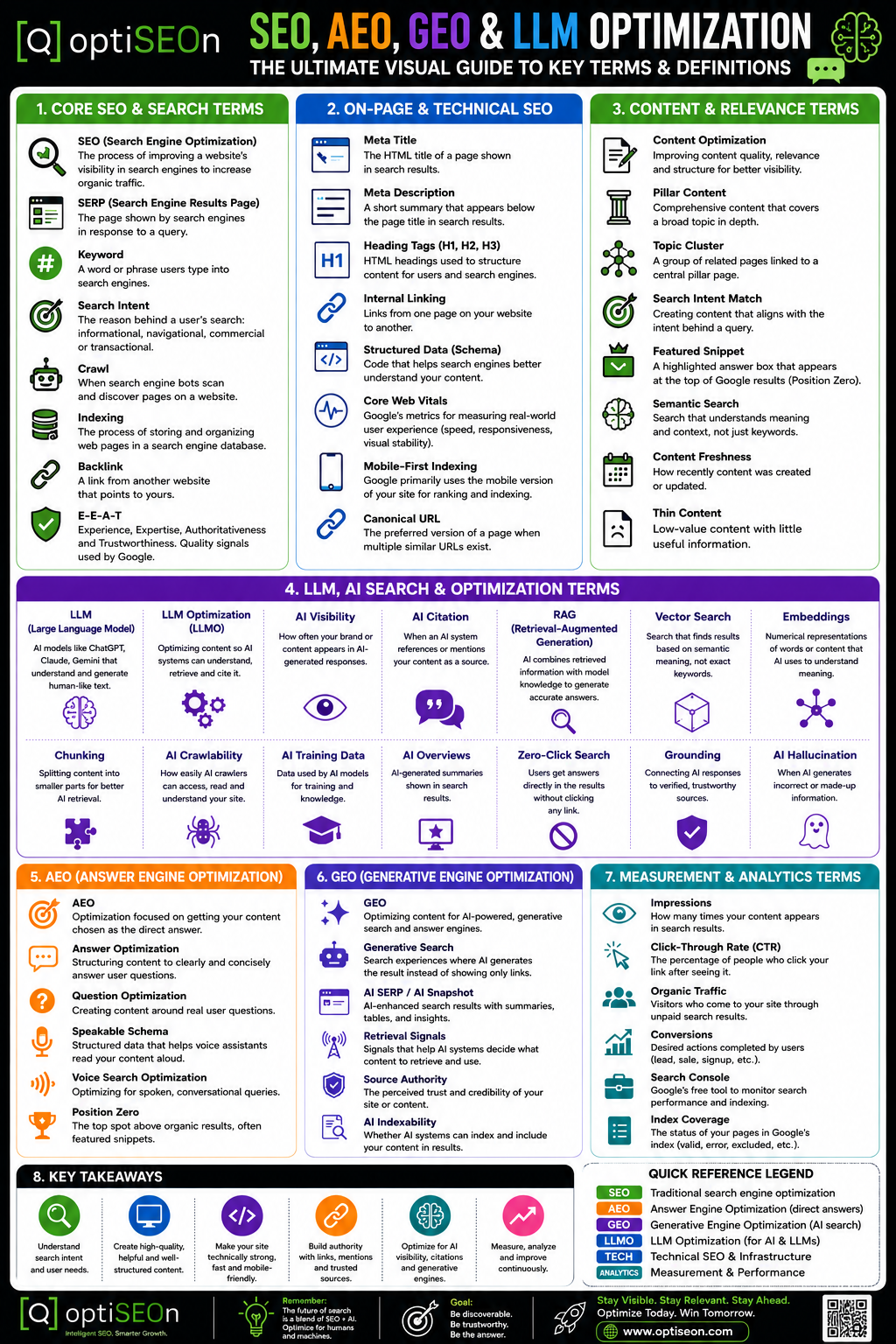
SEO
Search Engine Optimization
Ranking in traditional search results (Google, Bing).
AEO
Answer Engine Optimization
Being chosen as the direct answer in snippets and AI assistants.
GEO
Generative Engine Optimization
Being retrieved, synthesized, and cited inside AI-generated answers.
LLMO
LLM Optimization
Being understood and reproduced correctly by large language models, both via training data and live retrieval.
In practice, the same well-structured, authoritative, machine-readable content tends to win across all four. The acronyms describe emphasis, not separate disciplines.

Leave a Reply