Most businesses treat content as a one-way assembly line: write it, publish it, forget it, and move on to the next piece. That approach quietly wastes significant SEO value because content naturally decays over time. Rankings drop as competitors release updates, information goes stale, search intent evolves, and, crucially for 2026, AI engines stop citing pages that appear outdated.
In our client work, we consistently find that updating existing content offers a higher ROI than producing brand-new pieces. A page that already holds domain authority, backlinks, and search history can often move from position 8 to position 3 faster and more cost-effectively than building a page from scratch. Likewise, an outdated page that hurts performance can be pruned quickly.
Here is the 2026 step-by-step process for auditing, refreshing, and pruning content for both Google and AI search platforms.
TL;DR
Content refreshing updates existing pages to recover and grow rankings, while content pruning removes or consolidates pages that no longer add value. Both practices counter content decay, which is the steady loss of rankings and traffic over time. In 2026, freshness is critical because AI engines like Perplexity favor recently updated sources, and Google continues to reward well-maintained pages. The strategy is straightforward: audit your metrics, bucket each page (keep, refresh, consolidate, prune), update the high-potential content, and retire the rest.
What is content refresh and pruning?
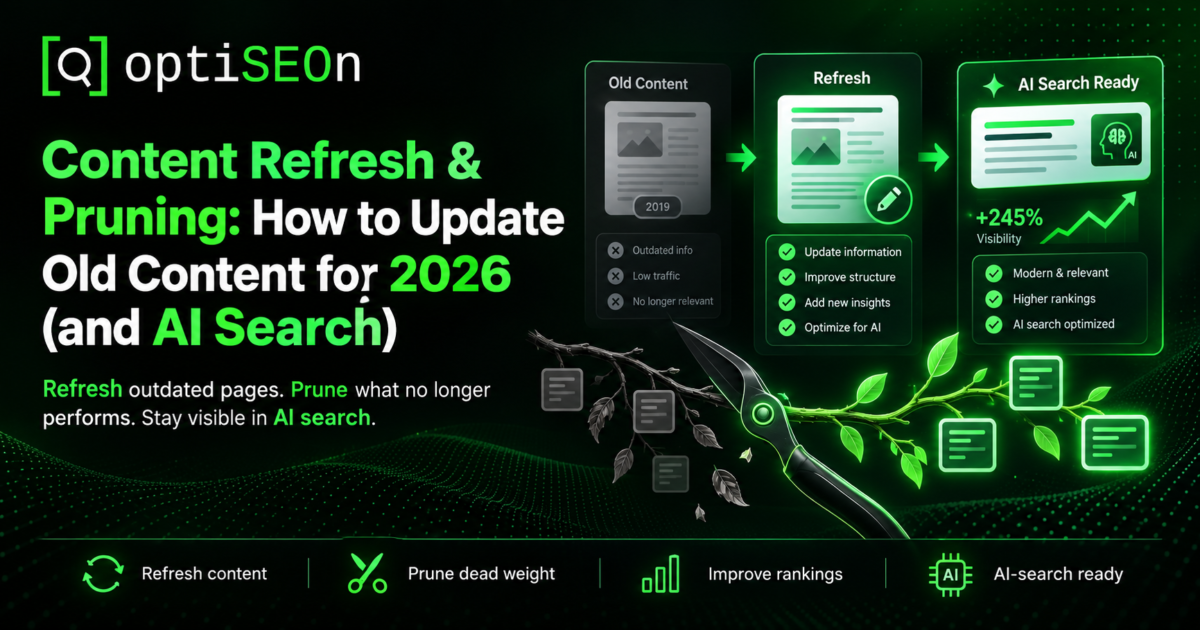
Refreshing content involves updating an existing page with current details, stronger structure, and deeper insights to boost its rankings. Pruning content means removing, consolidating, or redirecting pages that no longer serve your audience or goals. Working together, these tasks maintain a healthy, effective content library.
These actions address a core reality: content quality changes over time. Some pages need minor updates, while others need to be retired. Managing both on a clear schedule helps build a focused content library rather than an oversized, underperforming one.
Why do I need to update old content?
Because content loses traction over time. Competitors publish updated material, facts and pricing change, search habits evolve, and AI engines deprioritize older pages. A page that ranked near the top two years ago can easily slip if left untouched, even if its core content remains accurate.
Three forces drive decay:
- Competitive decay, where competitors publish fresher, more thorough content and take your position
- Informational decay, where statistics, references, and recommendations become outdated
- Intent decay, where the goal of the search query changes, leaving older content misaligned
In 2026, there is also AI freshness preference. Platforms like Perplexity prioritize recently updated content when selecting sources, meaning older pages can lose citations even if their search ranking stays steady. We explored this trend further in how to get cited by ChatGPT, Perplexity & Gemini.
Step 1: Audit performance
Review performance metrics first by evaluating traffic, keyword rankings, impressions, and user engagement over the past 6 to 12 months. Google Search Console and your primary analytics tools will provide the necessary data.
What to look at per page:
- Traffic and ranking trends, noting whether performance is growing, steady, or dropping
- Impressions vs. clicks in Google Search Console, as high impressions with low clicks point to title or meta description fixes
- Keyword positions, targeting pages ranking between 5 and 20 for quick wins
- Engagement metrics, including bounce rates, time on page, and conversion rates
- Backlink profile, since pages with established inbound links should be updated rather than removed
- Publication and edit dates to track content age
Step 2: Categorize every page
Place each URL into one of four actions: keep as-is, refresh, consolidate, or prune. Organizing your pages this way brings clarity and efficiency to the optimization process.
The four buckets:
- Keep: performing well, accurate, and needs ongoing tracking
- Refresh: ranks in positions 5–20, shows traffic loss, or contains outdated information with solid potential
- Consolidate: overlapping pages targeting similar terms; combine them into a primary resource and set up 301 redirects
- Prune: no traffic, links, or strategic value; safely delete or redirect
Step 3: Refresh the high-opportunity pages
A proper refresh involves meaningful updates: refreshing facts, expanding thin sections, adapting content structure for search intent, and updating the published date. Changing the date stamp without updating the core content does not yield lasting results and can damage credibility.
A real refresh includes:
- Update key facts, figures, and examples to reflect current standards
- Format for Answer Engine Optimization (AEO) by using clear heading questions and concise answers to capture featured snippets and AI Overviews
- Expand thin sections to address modern user queries
- Align with search intent if target search results favor a new format
- Improve internal linking by pointing to newer posts and receiving links from recent content
- Update schema markup so structured data reflects recent edits (you can use our schema generator)
- Revise the visible updated date after completing substantial improvements
Prioritize by opportunity: pages ranking 5–20 with commercial intent, pages declining from former highs, and pages with existing backlinks. These give the fastest returns.
Step 4: Consolidate overlapping content
When multiple pages target the same intent, they compete with one another and dilute search signals. Consolidate them into a single comprehensive page and implement 301 redirects for the remaining URLs. Unifying your content focuses authority onto one page, often driving quick gains in visibility.
Start by designating the strongest page as your primary URL. Incorporate the best sections from duplicate pages, set up 301 redirects to the main URL, and update internal links across your site accordingly.
Step 5: Prune the dead weight
Pruning removes low-performing pages that lack traffic, links, and strategic value, which improves overall site quality and crawl efficiency. Cleaning up weak content strengthens domain-wide quality signals and helps your best pages perform better.
How to prune safely:
- Verify the page offers no remaining value, checking for minimal traffic, inbound links, and conversions
- Use 301 redirects when relevant to transfer remaining authority to a related page
- Apply a 410 or 404 status if there is no suitable replacement page or external backlink value
- Avoid deleting pages with valuable backlinks without implementing proper redirects
- Keep a record of pruned pages in case you need to reference or restore content later
Pruning is effective, but it should be done carefully. Always verify your metrics first. Pages with valuable links or context should usually be updated or redirected rather than permanently removed.
Step 6: Establish a refresh cadence
Maintain a regular schedule for updates, such as quarterly reviews for high-value pages and annual audits for the entire library, to keep your content competitive. Successful sites manage their content as an evolving asset rather than a static archive.
A practical cadence:
- Quarterly: Review and update your top 10 to 20 key pages, making adjustments as traffic shifts.
- Annually: Conduct a full content audit to categorize all site pages.
- Event-driven: Update content immediately when industry facts change, rankings drop, or search intent shifts.
We use this exact routine for our own blog, ensuring our articles stay up to date as search trends evolve.
How OptiSEOn approaches content refresh
Content auditing, refreshing, and pruning are core components of our SEO services at OptiSEOn. For many businesses, updating existing pages is the fastest way to increase organic traffic. We help pinpoint high-opportunity content, optimize for search engines and AI platforms, resolve overlapping topics, and prune underperforming URLs. You can book a free content audit with us to uncover hidden opportunities across your site.
Frequently Asked Questions
How often should I update old blog posts?
Update high-value pages every quarter and audit your entire library annually. You should also update content whenever industry details change, rankings decline, or search intent shifts. In 2026, freshness impacts AI citations, as platforms like Perplexity prefer recently updated sources.
Does updating old content actually help SEO?
Yes, and it often yields faster results than publishing new posts. Pages with existing authority, established links, and ranking history can climb search results more efficiently when updated with fresh data, clear formatting, and thorough insights.
Will changing the date on my content improve rankings?
No. Simply changing the date without updating the content does not improve performance and can harm user trust. Search engines measure freshness through actual content improvements, such as added sections, updated statistics, and structural edits.
What is content pruning and is it safe?
Content pruning involves removing, consolidating, or redirecting underperforming pages to strengthen overall site authority and crawl efficiency. It is safe when handled carefully. Always redirect URLs with backlinks and ensure a page lacks traffic and strategic value before removing it.
How do I know which pages to refresh first?
Start with pages ranking between positions 5 and 20, content experiencing traffic loss, commercial pages, and articles with strong backlink profiles. These pages usually offer the quickest returns on effort.
What is keyword cannibalization and how does refreshing fix it?
Keyword cannibalization occurs when multiple pages target the same intent, causing search engines to split ranking authority between them. Consolidating those pages into one comprehensive resource and setting up 301 redirects resolves the issue and concentrates ranking signal strength.
Is your content library losing traffic and visibility?
Book a free content audit with OptiSEOn, a Dallas-based agency specializing in SEO, AEO, GEO, and LLM optimization. We will help you identify quick-refresh targets, fix overlapping content, and prune low-value pages.