Here is a question many business owners haven’t considered yet: if a potential customer asks ChatGPT to recommend a company in your industry, will your business appear in the response?
Beyond your Google search rankings or content quality, consider whether an AI assistant would actively suggest your brand when answering a buyer’s question.
Many businesses don’t know the answer, which creates a significant blind spot. Potential buyers regularly consult AI platforms like ChatGPT or Perplexity for recommendations before visiting traditional search engine results. If your company isn’t included in those responses, you miss out on potential leads without seeing any lost traffic in your analytics.
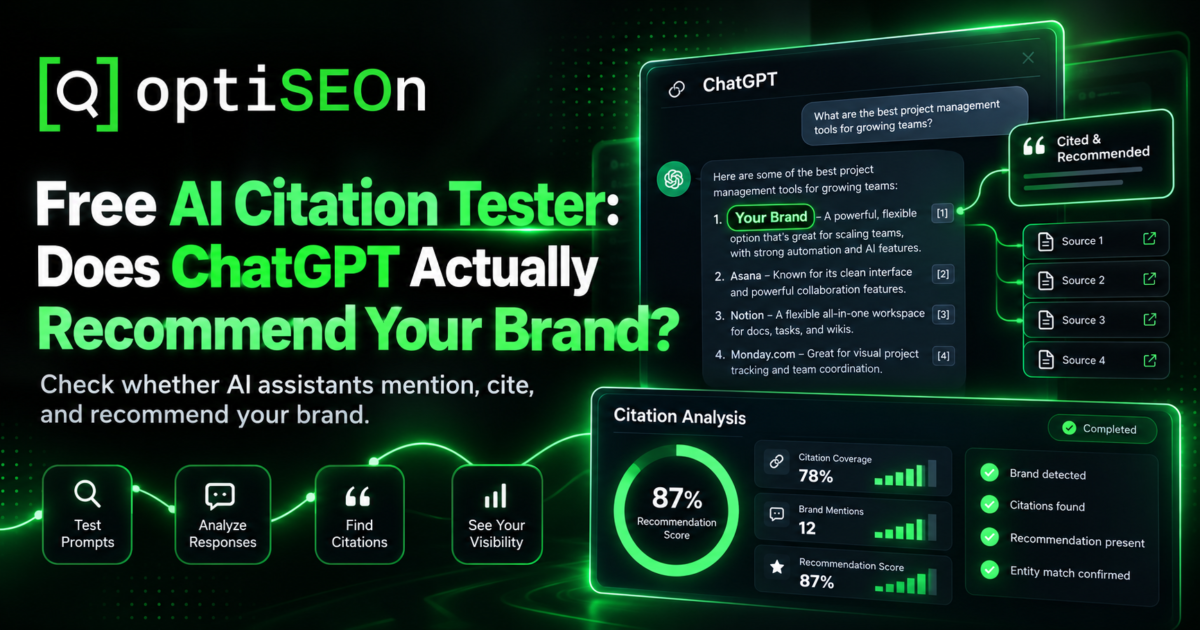
The free OptiSEOn AI Citation Tester helps solve this. It creates prompt sets based on actual buyer queries, lets you run them in ChatGPT, Perplexity, Claude, and Google AI with one click, and tracks your citation rate over time. Below, we explain how it operates, the design choices behind it, and how to use the findings.
TL;DR
An AI citation test checks if AI tools mention your business when answering common questions from potential customers. The free OptiSEOn AI Citation Tester generates a custom prompt set, connects you to ChatGPT, Perplexity, Claude, and Google AI, and helps track your citation rate using live responses you review directly without relying on simulated data. Results stay stored in your browser. If competitors are featured instead of your brand, strengthening entity signals, citable content, and external authority can help close the gap.
What is an AI citation test?
An AI citation test evaluates whether AI assistants reference or cite your brand in response to customer questions, helping you track your visibility rate over time. It functions much like tracking keyword rankings in traditional search, but focuses on measuring brand inclusion within generated answers.
Two outcomes worth distinguishing:
- Mention when an AI includes your brand name in its output (for example, listing your company alongside competitors)
- Citation when an AI links directly to your website as a source for its answer
Both outcomes are valuable. A brand mention ensures you are considered during a buyer’s evaluation, while a direct citation can drive referral traffic and demonstrate that the AI views your site as an authoritative reference. We cover these distinctions further in our guide on getting cited by ChatGPT, Perplexity, and Gemini.
What does the OptiSEOn AI Citation Tester do?
The tool constructs realistic buyer prompts, lets you launch them into ChatGPT, Perplexity, Claude, and Google AI with one click, and calculates your brand mention rate based on live responses. Prompts are not submitted automatically by the site; you run each query and record the output you observe.
The workflow:
- Build your prompt set. The tool generates the questions your buyers would realistically ask an AI assistant — the conversational, full-sentence kind, not keywords.
- Launch each prompt into ChatGPT, Perplexity, Claude, and Google AI with one click per platform.
- Log your results to track whether your brand was mentioned or cited, and note which competitors appeared.
- Track your citation rate over time as you do the work to improve it.
Your results are stored in your browser only. No signup, nothing sent anywhere.
Why do you make me run the prompts myself?
Running automated queries across AI platforms incurs API costs, and platform terms restrict re-distributing answers as an automated ranking product. As a result, tools offering instant results often generate simulated responses rather than checking live AI models. Relying on simulated outputs can lead to misleading conclusions when planning strategy.
This approach is central to how the tool was designed. Some AI monitoring software pays for direct API access, while other tools produce estimated outputs that model what an AI might say rather than pulling a live answer.
Baseing strategic decisions on estimated data risks optimizing for simulated metrics while real-world visibility stays unchanged.
We designed the tool so you can check live answers directly on each platform within minutes, giving you accurate feedback on what prospective customers see.
This matches the approach of our Entity Signal Checker, which only scores signals verified against live sources.
What prompts should I test?
Focus on full-sentence queries that buyers naturally ask, including category questions, problem descriptions, product comparisons, and branded searches. Natural language prompts often differ significantly from traditional search keywords.
The difference in practice:
| Google query | Actual AI prompt |
| dallas seo agency | Who’s a good SEO agency in Dallas for a small B2B company? |
| best crm | What CRM should a 12-person sales team already using HubSpot switch to? |
| plumber near me | My water heater is leaking in North Dallas. Who should I call? |
The four prompt types worth covering:
- Category prompts such as “Best [category] in [location]” or “Best [category] for [audience]” measure your market share of voice.
- Problem prompts focus on how customers describe an issue before identifying specific service providers.
- Comparison prompts evaluate queries like “Option A vs Option B” or “alternatives to [competitor].”
- Branded prompts such as “Is [your brand] reliable?” measure how AI models describe your business specifically, covering both visibility and reputation.
Branded searches often highlight unexpected issues. If an AI system misrepresents your services, location, or company details, that inaccuracy can impact potential sales. Incomplete or inconsistent entity signals are frequently the root cause.
For additional strategies on building prompt banks alongside keyword research, see our 2026 keyword research guide.
How often should I test?
We recommend running tests weekly while actively optimizing for AI search, or monthly for ongoing monitoring. AI responses evolve as models update and competitor content changes, so tracking ongoing trends provides the clearest picture. Focus on overall performance over time rather than single test runs.
Regular testing is especially helpful for two reasons:
- Model updates alter outputs. An AI platform that mentions your business today might adjust its answers after an update, even if your site content stays the same.
- Generative answers vary. The same query can yield slightly different responses across separate runs. A single test represents a point in time rather than a permanent result.
Establish a baseline over a few weeks to track long-term progress. For details on setting up GA4 tracking for AI referral traffic, review our guide on measuring AI search traffic from ChatGPT, Perplexity, and Gemini.
What do I do if competitors are named and I’m not?
When AI platforms feature competitors over your brand, it usually stems from three areas: weak entity signals, unstructured content, or limited third-party mentions. Addressing these elements in order helps improve overall brand visibility.
Diagnosing which one is your problem:
- Weak entity signals make it harder for AI models to verify your business details. Run a test with our Entity Signal Checker to review Organization schema, sameAs links, NAP consistency, and Wikidata profiles.
- Unstructured content can prevent AI models from extracting direct answers. Formatting content with clear question-based headings helps; see our guide on getting cited by ChatGPT, Perplexity, and Gemini along with our featured snippets guide.
- Limited third-party mentions can restrict how often AI models reference your business. If AI responses in your industry pull data from review platforms, directory sites, or forum discussions, building an active presence on those channels can help. Read our guide on using Reddit for AI citations and explore our citation building services.
First, verify that AI web crawlers can access your site. If your robots.txt file blocks bots like GPTBot or PerplexityBot, AI engines will not index your content. Test your file using our free robots.txt AI Crawler Checker.
It is also helpful to review which external sources AI platforms cite when recommending competitors. This highlights key directories and publications in your industry.
Understanding what an AI citation test reveals
A citation test shows how your brand performs for specific prompts at a given moment, rather than providing a single fixed “AI rank.” AI answers are generated dynamically for each prompt, vary over time, and differ across platforms.
The test offers useful insights by establishing a practical baseline, tracking visibility trends over time, highlighting featured competitors, and revealing how AI platforms describe your brand. Tracking these directional trends helps guide strategy effectively.
Frequently Asked Questions
How do I check if ChatGPT mentions my business?
Query ChatGPT using natural prompts that your buyers might use, including category searches like “best [category] in [city]” and branded questions like “is [brand] reliable?” to see if your company appears. The free OptiSEOn AI Citation Tester generates relevant prompt sets and connects you directly to ChatGPT, Perplexity, Claude, and Google AI.
What is the difference between an AI mention and an AI citation?
An AI mention occurs when a platform includes your business name in a response. An AI citation happens when the platform links directly to your website as a source. Citations can drive referral traffic and demonstrate domain authority, while brand mentions help keep your business on a buyer’s shortlist.
Why doesn’t the tool run AI queries automatically?
Running automated API queries across AI platforms adds service costs, and platform terms restrict redistributing answers in automated rank-tracking products. Tools promising automated instant data often rely on simulated answers rather than live checks. Reviewing real prompts directly provides reliable data you can trust.
How often should I test my AI citation rate?
We suggest testing weekly if you are actively working on AI optimization, or monthly for ongoing monitoring. Because generative outputs can shift as platform models update, establishing a baseline over several weeks offers a clearer picture than relying on a single test run.
Why do competitors show up in ChatGPT while my brand doesn’t?
This typically relates to three factors: weak entity signals that make your brand harder to verify, content that is not formatted for direct extraction, or limited presence on third-party platforms referenced by AI models. Reviewing entity signals, content structure, external mentions, and your robots.txt access can help address these gaps.
Can I improve my brand’s AI citation rate?
Yes. Improving AI visibility involves strengthening entity signals (such as schema and directory profiles), formatting content for easy extraction, and building mentions across external sources trusted in your industry. Initial improvements often appear within 60 to 90 days, with broader gains taking 6 to 12 months.
Is the OptiSEOn AI Citation Tester free?
Yes, it is free with no registration required. The tool builds prompt sets, connects you to ChatGPT, Perplexity, Claude, and Google AI, and saves your findings locally in your browser. It is part of our collection of free SEO tools.
See if AI platforms recommend your business using live responses. Build your free prompt set. If competitors are featured over your brand, OptiSEOn can help close the visibility gap. We are a Dallas-based agency offering SEO, AEO, GEO, and LLM optimization services. Schedule a free GEO strategy session.
Leave a Reply