
Every SEO engagement eventually arrives at the same conversation: is this working?
It’s a fair question and a surprisingly hard one to answer well, because SEO’s returns are delayed, partially attributable, and easy to dress up with metrics that look impressive and mean nothing. An agency can show you a chart of rising keyword rankings while your phone doesn’t ring any more than it did last year. Both facts can be true simultaneously.
So here is how to measure SEO returns honestly. We’ll look at what to track, what to ignore, how to handle attribution without pretending it’s simple, and what a good report should actually cover.
We have an obvious stake in this: we’re an agency, and we produce these reports for clients. Read accordingly. But the framework below is the one we’d want applied to our own work, including the parts that make agencies look worse.
TL;DR
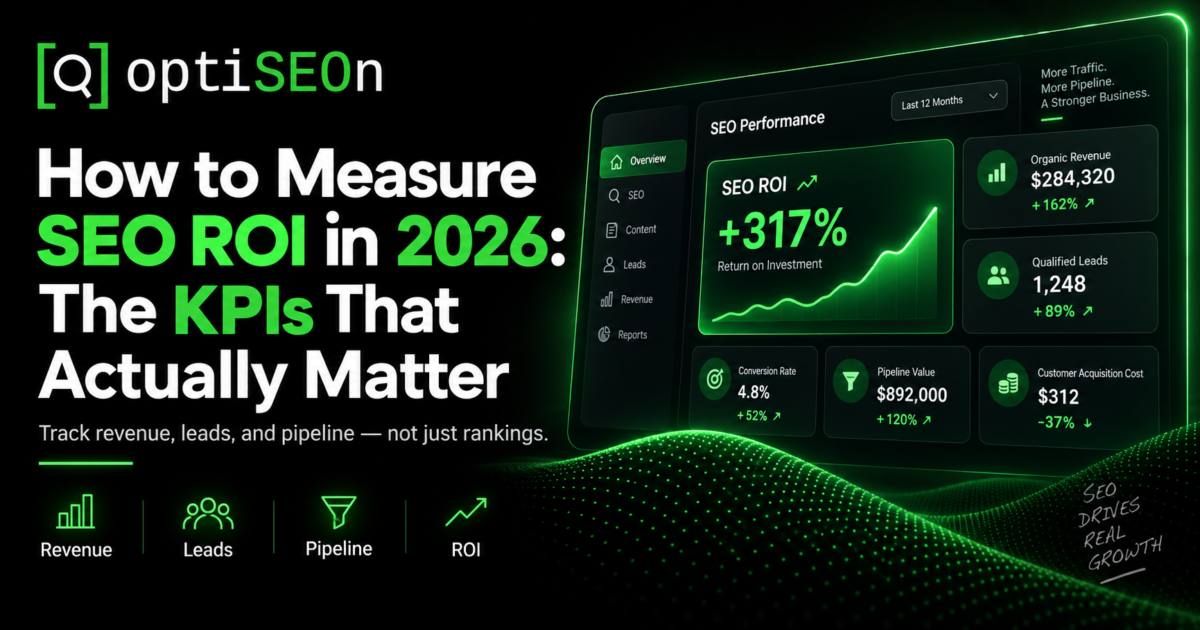
SEO ROI is measured by tracking organic-attributed revenue or qualified leads against total SEO investment over a long enough timeframe for compounding to show (typically 6 to 12 months minimum). The KPIs that matter include organic conversions, qualified leads, revenue by landing page, and cost per acquisition compared to other channels. Meanwhile, metrics to deprioritize include raw keyword rankings, total traffic, impressions, and domain authority scores. Attribution is rarely perfect, and good reporting acknowledges that rather than hiding it.
What is SEO ROI and how do you calculate it?
SEO ROI is the return generated by organic search relative to what you spent on it, calculated as (organic-attributed revenue − SEO investment) ÷ SEO investment, expressed as a percentage. The inputs are simple; the difficulty is in measuring the revenue side honestly.
The basic formula:
SEO ROI = (Organic Revenue − SEO Cost) ÷ SEO Cost × 100
For a lead-generation business where revenue attribution is less direct, the practical version:
Organic Leads × Lead-to-Customer Rate × Average Customer Value = Organic Revenue
The variables you need: organic conversions, your close rate on those leads, your average customer value (ideally lifetime, not first sale), and your full SEO spend including agency fees, tools, and internal time.
Which SEO KPIs actually matter?
The KPIs that reflect business outcomes: organic conversions, qualified leads from organic, revenue by landing page, organic cost per acquisition, and share of revenue from organic. Everything else is diagnostic — useful for understanding why the business metrics moved, but not a substitute for them.
The hierarchy we’d use:
Tier 1 — business outcomes (report these first):
- Organic conversions (form fills, calls, bookings, purchases)
- Qualified leads from organic — not raw leads, qualified ones
- Revenue attributed to organic
- Cost per acquisition from organic vs. other channels
- Organic share of total pipeline or revenue
Tier 2 — leading indicators (they predict Tier 1):
- Rankings for commercial-intent keywords specifically
- Click-through rate from search
- Conversions by landing page
- Branded vs. non-branded search volume
- Map Pack visibility and calls for local businesses
Tier 3 — diagnostics (useful, not reportable as success):
- Total organic sessions
- Impressions
- Pages indexed, crawl stats
- Core Web Vitals
- Backlink counts and domain authority
The failure mode in agency reporting is presenting Tier 3 as if it were Tier 1. A chart of rising impressions is not evidence of ROI.
Which metrics are vanity metrics?
Total traffic, raw keyword counts, impressions, and third-party authority scores are the most commonly over-reported vanity metrics — they can all improve substantially while revenue stays flat. They’re worth tracking as diagnostics, not presenting as results.
Why each one misleads:
- Total organic traffic: Traffic from non-buying informational queries inflates numbers without touching revenue. A post that attracts 10,000 students researching a definition is not a business result.
- Keyword count (“we now rank for 4,000 keywords”): Most of those are irrelevant long-tail variations picking up incidental impressions.
- Impressions: You can gain impressions by ranking on page 4 for more terms, but that is hardly real progress.
- Domain Rating / Domain Authority: These are third-party proprietary metrics, not Google ranking factors. They are useful for comparing link profiles, but meaningless as a core success measure. We make this point onour own DR checker as well, because a free tool that overstates its own metric isn’t doing anyone a favor.
- Average position: This is an aggregate number that often moves for reasons completely disconnected from your commercially important terms.
None of these are useless. They’re just not ROI.
How long before SEO shows measurable ROI?
Most businesses see leading indicators within 60 to 90 days and genuine ROI between months 6 and 12, because SEO compounds rather than switching on overnight. Measuring ROI at month two and concluding that it failed is the most common way businesses waste their SEO investment, as they quit right before the curve turns.
A realistic progression:
- Month 1–2: Technical fixes, indexing improvements, baseline established. No meaningful traffic change expected.
- Month 3–4: Early ranking movement on lower-competition terms; leading indicators begin moving.
- Month 5–8: Conversions become measurable; the trend direction becomes clear.
- Month 9–12: Compounding is visible; ROI calculation becomes meaningful.
- Beyond 12 months: At this stage, the compounding advantage kicks in. This is where SEO’s cost per acquisition typically drops well below paid channels.
This is also why the comparison “SEO vs paid ads” is usually framed wrong. Paid delivers immediately and stops when you stop paying. SEO delivers slowly and keeps delivering. They’re different instruments, and most businesses want both.
How do you handle the attribution problem?
Honestly, start by acknowledging that organic search is under-credited by last-click attribution, and use a combination of analytics, call tracking, and direct customer questions rather than trusting any single source. Anyone claiming perfect SEO attribution is overstating what is actually measurable.
The specific difficulties:
- Long consideration cycles. Someone finds you organically in March and converts in July via a direct visit. Last-click credits “direct.”
- Multi-touch journeys. Organic, then an ad, then an email, then a direct visit. Which gets the credit?
- Offline conversions. Phone calls, walk-ins, and referrals that started with a search.
- Zero-click discovery. Someone sees you in an AI Overview or AI assistant answer, learns your name, and searches for you directly later. Organic did the work; branded search gets the credit.
- Dark social. Your content shared in a Slack or WhatsApp group appears as direct traffic.
What actually helps:
- Call tracking with dynamic number insertion for organic sessions is essential for local and home services businesses.
- “How did you hear about us?” on every form and intake call. Imperfect, but it catches what analytics can’t.
- Branded search volume as a proxy: Rising branded searches usually mean your other marketing work is effectively building awareness.
- Assisted conversions in GA4, not just last-click
- Cohort comparison: Compare performance across distinct periods rather than trying to attribute every individual conversion perfectly.
When measuring AI search specifically (such as tracking referrals from ChatGPT, Perplexity, and Gemini, or monitoring brand mentions), check out our guide to measuring AI search traffic.
What should a good SEO report contain?
Focus on business outcomes first, leading indicators second, and diagnostics third, along with a plain-language explanation of what moved, what didn’t, and what changes as a result. A report that only highlights success is a sales pitch, not an honest review.
What we’d expect in any competent monthly report:
- Conversions and leads from organic, compared to prior period and prior year
- Revenue or pipeline attributed to organic where measurable
- Commercial keyword movement: Focus on the terms that actually matter to your bottom line, not just all terms.
- What was actually done that month, specifically
- What didn’t work and what’s changing because of it
- Next month’s priorities and why
That fifth point is the one that separates useful reporting from theater. Every month contains things that underperformed. A report that never mentions them isn’t being honest with you.
Is SEO worth it for my business?
SEO is worth it when your customers actively search for what you offer, your average customer value justifies a 6–12 month payback horizon, and you can sustain the investment long enough to reach compounding. It’s a poor fit for businesses needing leads next week, or in categories where nobody searches.
Honest cases where SEO isn’t the right first investment:
- You need revenue within 30 days. In this case, run paid ads first and build organic search in parallel.
- Your category genuinely has no search volume, which sometimes happens with brand-new product types.
- Your average order value is low and your margins cannot absorb the initial setup period.
- You cannot sustain 6 or more months of investment. Starting and stopping early wastes your budget entirely.
We’d rather say this up front than take on an engagement that cannot succeed. It is also why our plans are month-to-month with no long-term contracts. If it isn’t working, you shouldn’t be locked in.
How OptiSEOn reports
Every client receives a monthly written report alongside a live Looker Studio dashboard covering rankings, traffic, conversions, and AI citation data. The written commentary explains what moved, what didn’t, and what we are changing (including during months where something underperformed). That is the standard we expect of ourselves.
Frequently Asked Questions
How do you calculate SEO ROI?
Use (Organic Revenue − SEO Cost) ÷ SEO Cost × 100. For lead-generation businesses, derive organic revenue as organic leads × lead-to-customer rate × average customer value. Include all SEO costs (such as agency fees, tools, and internal time) rather than just the primary invoice.
What is a good ROI for SEO?
It varies widely by industry, margin, and customer lifetime value, so any universal benchmark should be treated skeptically. The more useful comparison is your organic cost per acquisition against your other channels: if organic CPA is meaningfully below paid CPA and trending down as content compounds, SEO is working.
How long does it take to see ROI from SEO?
Leading indicators typically appear within 60 to 90 days, with genuine, measurable ROI developing between months 6 and 12. Because SEO compounds over time rather than acting like an instant switch, measuring at month two and concluding failure is premature. It is the most common reason businesses waste their SEO investment.
Are keyword rankings a good measure of SEO success?
Only for commercial-intent keywords, and only as a leading indicator. Total keyword counts and average position function as vanity metrics, as you can rank for thousands of irrelevant terms without generating a single qualified lead. Track rankings for the specific terms your buyers use, then measure whether those rankings convert.
Why doesn’t my analytics show SEO driving conversions?
Usually attribution, not performance. Last-click models under-credit organic when customers discover you via search and convert later through direct visits or other channels. Long consideration cycles, offline conversions, and zero-click AI discovery all hide organic’s contribution. Use call tracking, “how did you hear about us” questions, assisted conversions, and branded search volume to fill the gap.
Should I invest in SEO or paid ads?
They solve different problems. Paid ads deliver leads immediately and stop when spending stops, while SEO takes 6 to 12 months to build momentum and then compounds (typically at a much lower cost per acquisition). Most businesses benefit from running both: paid for immediate revenue, and organic for long-term economics.
Want an honest assessment of whether SEO will pay off for your business, including if the answer is no? Book a free audit. OptiSEOn is a Dallas-based SEO, AEO, GEO, and LLM optimization agency, and we’d rather tell you up front than take on an engagement that can’t work.
Leave a Reply