There is a common issue in AI search that frequently gets misdiagnosed. A business might do everything right, including creating strong content, setting up clean technical SEO, and achieving high search rankings, yet still get passed over when someone asks ChatGPT or Perplexity for a recommendation in their industry. The default reaction is to assume the content needs work, but that is rarely the underlying issue.
The real issue is that the AI cannot confidently figure out what your brand is. Beyond what a specific webpage states, AI models need to understand your company as a distinct, verifiable organization. If an AI system is unsure whether your business is legitimate or fits the requested category, it simply will not recommend you. It has no reason to risk giving an inaccurate answer based on an unverified brand.
That confidence comes from entity signals: your Organization schema, your linked profiles, your Wikipedia and Wikidata presence, your consistent name-address-phone data. Most businesses have never audited them, because there was never an obvious reason to.
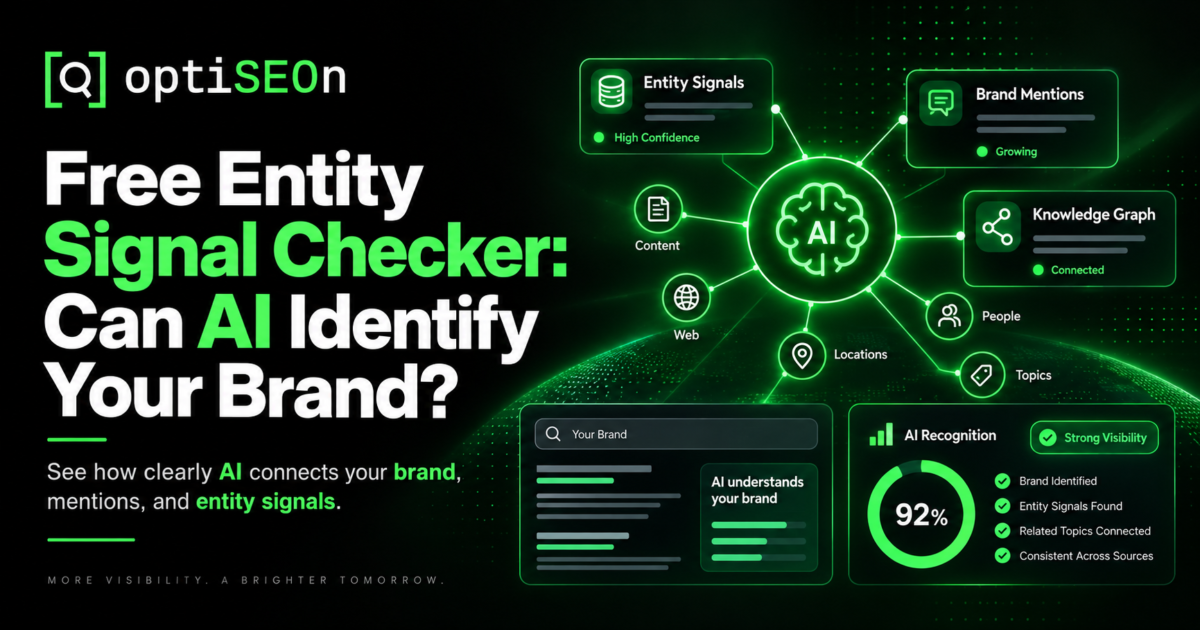
To address this, we built a free Entity Signal Checker that checks these signals against real data sources and highlights which gaps to address first. Below, we break down what entity signals are, why AI platforms rely on them so heavily, and how to evaluate your results.
TL;DR
Entity signals are verifiable data points, such as Organization schema, sameAs links, Wikipedia and Wikidata entries, and consistent NAP details, that allow search engines and AI models to identify your brand as a real, distinct entity. The free OptiSEOn Entity Signal Checker verifies each signal against live sources (including site markup and the Wikipedia and Wikidata APIs), prioritizes fixes, and avoids scoring signals that cannot be verified. It requires no signup and runs live lookups.
→ Run the free Entity Signal Checker · Try stripe.com, notion.so, or your own domain.
What is entity SEO?
Entity SEO focuses on establishing your brand as a distinct, verifiable entity for search engines and AI systems, rather than treating your website as merely a collection of keyword-rich pages. It marks the difference between a search engine recognizing that your pages mention “Dallas SEO agency” and recognizing that your company actually is one.
Search engines have operated on this principle since Google launched the Knowledge Graph in 2012, organizing the web around connected real-world entities like people, places, organizations, and concepts instead of standalone documents. Modern AI systems have expanded on this approach, since delivering direct recommendations requires far greater certainty than presenting a standard list of links.
What are entity signals?
Entity signals are specific, machine-verifiable data points that confirm your brand’s identity online. These include structured data defining your business, authoritative external references, linked profiles, and consistent NAP details across directory listings. While single signals are small on their own, combined they form a fully verified digital identity.
The signals that matter most, and what each one does:
| Signal | What it establishes |
| Organization schema | Declares in machine-readable terms who you are, what you do, and how to identify you |
| sameAs links | Connects your website to your LinkedIn, X, Crunchbase, and other profiles as one entity |
| Wikipedia presence | The single strongest third-party confirmation available (if you meet notability rules) |
| Wikidata entry | Structured, machine-readable entity data — heavily used by AI systems |
| Consistent NAP | Name, address, phone matching everywhere confirms you’re a real, locatable business |
| llms.txt | An emerging format that outlines your site structure for AI crawlers (currently carries low impact, as noted below) |
Why do AI systems care about entity signals?
Because AI systems provide direct recommendations rather than simple link lists, recommending a business requires confidence that the company exists, is legitimate, and fits the user’s intent. Entity signals build that confidence by enabling independent verification across multiple sources.
For instance, when a user asks for “a good SEO agency in Dallas,” an AI model must verify which organizations are real businesses, located in Dallas, offering SEO services, and backed by sufficient evidence to justify a recommendation. A brand with complete Organization schema, a Wikidata page, consistent NAP listings, and linked profiles is straightforward to verify. Conversely, a brand lacking those signals looks like unverified text on a page, making it hard to distinguish from a personal blog or an inactive business.
This is also why ambiguity is so costly. If your brand name is shared with other companies, or you use different name variations across platforms, AI systems can’t confidently attribute anything to you. Entity clarity isn’t a nice-to-have; it’s the precondition for being recommended at all.
How does the OptiSEOn Entity Signal Checker work?
The tool analyzes key identity signals, including Organization schema, sameAs links, Wikipedia, Wikidata, NAP details, and llms.txt, validating each against live sources and ranking issues by priority. Data is pulled directly from your site’s markup or via official Wikipedia and Wikidata APIs, offering real-time checks with no account required.
What it does specifically:
- Reads your site’s schema markup to confirm Organization schema is present and properly formed
- Checks your sameAs links to ensure your website properly links to your official profiles
- Queries the Wikipedia and Wikidata APIs to verify real presence rather than guessing
- Checks NAP details for the consistency AI systems rely on
- Checks for llms.txt as a supplementary signal
- Prioritizes missing elements so you can focus on the most impactful fixes first
Why doesn’t the tool score everything?
Certain signals, such as Google Knowledge Panels or Crunchbase listings, cannot be verified without automated scraping. The tool highlights these for manual review instead of generating arbitrary scores. Presenting estimated data as verified fact can lead to misinformed decisions.
We chose this approach intentionally. Many tools estimate or approximate unverified signals and bundle them into an overall score without clarifying which data points are actually confirmed. That can give a false impression of accuracy based on partial guesswork.
We prefer to focus on verified data. Signals that can be confirmed directly are included in the score, while unverified items are flagged for manual review to keep the analysis clear and reliable.
This same focus on accuracy applies to our AI Citation Tester, which lets you run live prompts directly instead of relying on simulated responses, as well as our robots.txt AI Crawler Checker, which evaluates crawler precedence rules accurately.
How do I improve my entity signals?
Start by implementing Organization schema and sameAs links on your website, establish consistent NAP details across web directories, create a Wikidata entry, and evaluate Wikipedia eligibility if applicable. Following this order lets you complete quick, controllable setup tasks before moving on to longer-term authority building.
The practical sequence:
- Add complete Organization schema across your entire site, including your brand name, URL, logo, description, contact details, and address. You can generate JSON-LD markup with our free schema generator and review our schema guide for best practices.
- Include sameAs links in your Organization schema pointing to your official profiles on platforms like LinkedIn, X, Facebook, Instagram, Crunchbase, G2, and YouTube. This simple step helps connect your web presences into a single recognized entity.
- Standardize NAP details across all platforms. Use a single format for your business name, address, and phone number across your website, Google Business Profile, and directories. Minor variations, such as switching between “Suite 100” and “Ste 100,” can create confusion. Check our GBP guide for local optimization tips.
- Use one canonical brand name. Alternating between your full legal name, an abbreviation, and a stylized variant actively confuses entity recognition. Pick one and use it consistently everywhere.
- Create a Wikidata entry if your business does not have one yet. Wikidata has accessible entry guidelines, allows community contributions, and is regularly referenced by AI engines, making it an efficient way to strengthen your entity signals.
- Build out supporting profiles on sites like Crunchbase, G2, Capterra, industry directories, and review platforms. Having multiple independent sources confirm your details reinforces your brand identity. Learn more about how our citation and authority building services manage this process.
- Explore Wikipedia creation only if your business meets notability guidelines. While a Wikipedia page provides strong validation, strict editorial standards mean many smaller businesses will not qualify initially.
How long does entity building take?
Setting up schema and sameAs links can be done in a single day, while updating directory listings across the web takes several weeks. Establishing long-term authority so AI tools consistently recognize your brand develops over several months. Entity trust relies on multiple independent sources confirming your details over time.
Here is a typical timeline: Technical updates like schema, sameAs links, and standardizing brand names can be completed right away. Cleaning up directory listings usually takes 30 to 90 days, depending on how many existing profiles need updates. Setting up a Wikidata entry can be completed quickly once prepared. Over 6 to 12 months, accumulating consistent references builds solid authority that AI engines recognize.
While this process takes time, it also creates a strong competitive advantage. Established entity authority is difficult for competitors to replicate quickly.
Entity signals are the foundation, not the whole building
Clear entity signals make your brand eligible for recommendations, but getting recommended also requires structured content that addresses user queries along with solid overall domain authority. Proper entity setup verifies identity, but compelling content completes the picture.
The rest of the system:
- Ensure AI crawlers can access your site by testing with the robots.txt AI Crawler Checker and reviewing our crawler access guide.
- Structure content for easy extraction and citations by following our guide on getting cited by ChatGPT, Perplexity, and Gemini.
- Test your brand’s AI recommendations using the AI Citation Tester.
- Track performance over time by reading our overview on measuring AI search traffic.
Entity optimization is an ongoing effort that serves as a core foundation for OptiSEOn’s LLM optimization services.
Frequently Asked Questions
What is an entity in SEO?
An entity is a distinct, verifiable item, such as a person, place, organization, or concept, that search engines and AI systems recognize independently. Entity SEO focuses on helping search platforms identify your brand as a real-world organization rather than just a collection of keyword-focused pages.
How do I check if AI can recognize my brand?
You can check your domain using OptiSEOn’s free Entity Signal Checker, which evaluates Organization schema, sameAs links, Wikipedia, Wikidata, and NAP data against live sources to prioritize improvements. You can also evaluate live brand recommendations with our AI Citation Tester.
Do I need a Wikipedia page to be recognized by AI?
No. While Wikipedia is a strong signal, its strict notability requirements mean many businesses will not qualify. Wikidata offers a practical alternative with accessible entry guidelines and wide use across AI platforms. Implementing Organization schema, linking sameAs profiles, and keeping NAP details consistent are generally higher priorities for most companies.
What are sameAs links and why do they matter?
sameAs links are schema properties that connect your website to your official profiles on platforms like LinkedIn, X, and Crunchbase. They confirm to AI platforms and search engines that these separate profiles belong to one organization, uniting your brand signals into a single recognized entity.
Why does NAP consistency affect AI visibility?
Consistent Name, Address, and Phone data helps systems verify that your business is real and active. Inconsistent information across web directories can confuse algorithms, lowering confidence in your brand identity and impacting both local search rankings and AI recommendations.
How long does entity building take to work?
On-page updates like schema and sameAs links can be completed quickly. Standardizing directory listings usually takes 30 to 90 days, while building sustainable entity authority for consistent AI recommendations develops over 6 to 12 months.
Is the OptiSEOn Entity Signal Checker really free?
Yes, it is completely free with no registration required. Every check runs against live data sources like site markup or official APIs, and unverified signals are noted separately for manual review. It is part of our suite of free SEO tools.
Check if AI systems can identify your brand. Run the free Entity Signal Checker to review your signals in seconds and highlight priority fixes. If you want expert support building your entity presence, OptiSEOn is a Dallas-based agency specializing in SEO, AEO, GEO, and LLM optimization. Schedule a free entity audit.
Leave a Reply