
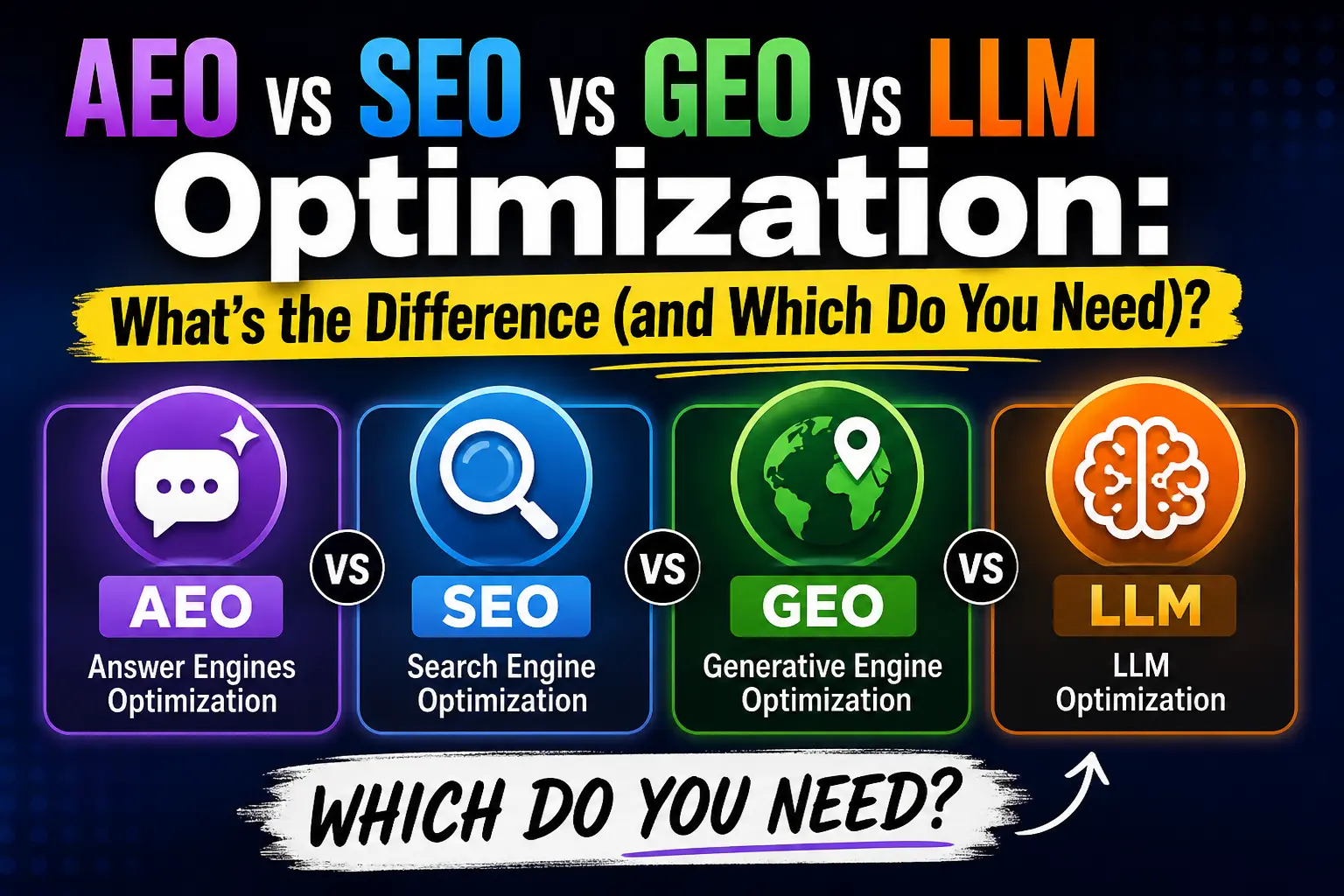
If you’ve spent any time researching how to make your business more findable online lately, you’ve run into an alphabet soup of three-letter acronyms: SEO, AEO, GEO, LLM. They all promise more visibility. They all sound like the same thing. And most articles you’ll find treat them as if they are.
They’re not.
Each one targets a different kind of search, on a different kind of platform, with a different kind of optimization work behind it. Get the difference right and you’ll know exactly where to spend. Get it wrong and you’ll pay an SEO agency in 2026 with a 2018 playbook — and stay invisible everywhere except Google.
Here’s the plain-English breakdown.
TL;DR — the four-line answer
- SEO gets you ranked on Google and Bing for keyword searches.
- AEO gets you featured in answer boxes, voice results, and “People Also Ask.”
- GEO has two meanings in 2026: Geographic SEO (local map pack) and Generative Engine Optimization (showing up in ChatGPT/Perplexity answers). Yes, really. Same acronym, two meanings.
- LLM Optimization is the umbrella term for getting recommended by AI tools like ChatGPT, Gemini, Claude, and Perplexity.
You probably need a combination — and the right combination depends on whether your customers are clicking blue links, asking voice assistants, walking in off Google Maps, or asking ChatGPT for a recommendation. Most businesses now need all four.
What is SEO (Search Engine Optimization)?
SEO is the original. It’s the work of getting a website to rank highly on traditional search engines — Google primarily, then Bing, DuckDuckGo, and Yandex. When someone types “best plumber in Dallas” or “marketing automation software for small businesses” into a search bar and hits enter, SEO is what determines whether your business shows up on page one.
The core ingredients of modern SEO:
- On-page SEO — keyword-optimized titles, headings, body copy, image alt text, and meta descriptions
- Technical SEO — site speed, mobile responsiveness, crawlability, structured data, internal linking
- Off-page SEO — backlinks from authoritative sites, brand mentions, digital PR
- Content SEO — publishing useful, original content that earns rankings naturally
If you want a deeper look at what’s actually moving rankings this year, our breakdown of the 2026 SEO ranking factors that actually matter goes into the specifics. SEO still works in 2026, and Google still drives the majority of search traffic for most businesses — but it’s no longer the only discovery channel that matters.
You can read more about how OptiSEOn handles SEO specifically on our services page.
What is AEO (Answer Engine Optimization)?
AEO is what happens when search stops returning ten blue links and starts returning a single answer.
Open Google today and search “what’s the best time to post on Instagram.” Notice what shows up at the top — it’s not a list of links. It’s a featured snippet pulling a direct answer from somebody’s blog post. That’s an answer engine result. AEO is the practice of structuring your content so that your answer is the one that gets pulled.
Where SEO targets the search results page, AEO targets:
- Featured snippets (the “position zero” answer box at the top of Google)
- People Also Ask (the expanding question boxes)
- Voice search results (when someone asks Siri, Alexa, or Google Assistant)
- Google AI Overviews (the AI-generated summaries now appearing on a growing share of queries)
The work behind AEO is mostly content structure: writing in question-and-answer format, using FAQ and HowTo schema markup, keeping answers between 40–60 words (the sweet spot for snippet extraction), and making sure your most important facts are in the first paragraph of every section, not the last.
If you want AEO done for you, OptiSEOn’s AEO service includes featured snippet targeting, FAQ schema, and voice search optimization.
What is GEO? (Both meanings explained)
This one’s frustrating because the SEO industry collectively agreed to use the same acronym for two completely different things. Here’s how to tell them apart in 2026.
Meaning 1: Geographic SEO (local SEO)
Geographic SEO — sometimes called Local SEO — is what you do to rank in location-based searches. The Google Map Pack (those three local listings with the map at the top of search results), “near me” searches, voice queries like “find a coffee shop near me,” and Google Business Profile rankings.
Geographic SEO is critical for any business with a physical location or a defined service area: dentists, plumbers, restaurants, law firms, multi-location retailers. The core work involves:
- Google Business Profile optimization — complete profile, accurate categories, regular posts, photos
- Local citations — consistent name/address/phone (NAP) across directories
- Local landing pages — one optimized page per service area or city
- Reviews — both quantity and velocity matter for ranking
Meaning 2: Generative Engine Optimization
Generative Engine Optimization is the newer, AI-native meaning. It’s the practice of optimizing your content and brand signals so that you appear in answers generated by AI tools — ChatGPT, Google Gemini, Claude, Perplexity, Microsoft Copilot.
A traditional Google search returns links. A generative engine returns a generated answer with citations. GEO (in this sense) is what gets your business cited inside that answer.
Some of the techniques overlap with AEO and LLM Optimization, but Generative Engine Optimization specifically focuses on:
- Building strong entity signals — Wikipedia, Wikidata, structured data, brand mentions across the web
- Creating citation-worthy content — original data, statistics, expert quotes
- Earning third-party authority — getting mentioned on Reddit, in industry publications, on review sites that AI engines weight heavily
The confusing part: at OptiSEOn we offer both meanings of GEO, because both matter. Our Geographic SEO service covers map pack rankings, and our LLM Optimization service covers generative engine work.
What is LLM Optimization?
LLM Optimization is the umbrella term for everything that gets your business recognized, trusted, and recommended by Large Language Model–powered AI tools.
When someone asks ChatGPT “what’s the best B2B SEO agency in Dallas,” LLM Optimization is what determines whether you’re in the answer or not.
We’ve covered the strategic shift in detail in How LLMs Are Replacing Traditional Search, and What You Can Do About It, and we’ll dig into the tactical side in our next post on how to get cited by ChatGPT, Perplexity, and Gemini (publishing May 13).
The short version: LLM Optimization combines AEO content structure, GEO entity signals, and a few new techniques like llms.txt files, schema markup tuned for AI extraction, and consistent brand presence on the platforms AI tools cite most heavily.
Side-by-side: SEO vs AEO vs GEO vs LLM
| Discipline | Where it gets you visible | Primary tactic | Best for |
|---|---|---|---|
| SEO | Google, Bing search results | Keywords, backlinks, technical SEO | Every business with a website |
| AEO | Featured snippets, voice, People Also Ask | Q&A content, FAQ schema, structured answers | Service businesses, publishers, B2B |
| Geographic SEO | Google Maps, Map Pack, “near me” | Google Business Profile, local citations, reviews | Local businesses, multi-location brands |
| Generative Engine Optimization | ChatGPT, Gemini, Perplexity answers | Entity signals, citation-worthy content | Businesses competing for AI recommendations |
| LLM Optimization | All AI tools (umbrella term) | Combined AEO + GEO + AI-specific techniques | Any business that wants to be AI-discoverable |
Which one does your business actually need?
Here’s the honest answer: in 2026, most businesses need a combination, and trying to pick one is the wrong frame.
But if you’re starting from scratch and have a limited budget, here’s the order I’d prioritize:
- Start with SEO and AEO together. They reinforce each other. You can’t earn featured snippets without solid SEO fundamentals, and you can’t earn AI citations without first being indexable and structured well.
- Add Geographic SEO next if you’re a local or service-area business. The map pack converts at higher rates than organic blue links for local intent.
- Layer LLM Optimization on top once you have the foundation. AI engines pull from already-authoritative sources, so the work you do for SEO and AEO directly feeds your AI visibility.
Trying to skip the foundation and jump straight to “ranking on ChatGPT” rarely works. The AI engines are pulling from the same web your SEO is optimizing — they just present it differently.
How OptiSEOn handles all four in one system
Most agencies sell you one of these and call the rest an “upgrade.” That’s how you end up with a pretty website that ranks on Google but is invisible to ChatGPT, or a strong AI presence with no map pack visibility.
OptiSEOn integrates all four pillars into one monthly engagement. SEO builds the foundation, AEO captures the answer-box opportunities, Geographic SEO owns your local market, and LLM Optimization gets you recommended where buyers are increasingly looking. See how the four pillars work together, or check out our pricing — month-to-month, no long-term contracts.
Frequently Asked Questions
What is the difference between SEO and AEO? SEO targets traditional ranked search results (the list of blue links on Google). AEO targets answer-based formats — featured snippets, voice search results, People Also Ask, and Google AI Overviews. AEO is best understood as a specialized layer on top of SEO, not a replacement.
Is GEO the same as Generative Engine Optimization? “GEO” is currently used to mean two different things in 2026: Geographic SEO (local search and map pack optimization) and Generative Engine Optimization (showing up in AI-generated answers). Always clarify which meaning your agency or article is using.
Do I need all four — SEO, AEO, GEO, and LLM? Most businesses benefit from all four because each one captures a different type of search. A local service business needs Geographic SEO heavily; a B2B SaaS company benefits more from LLM Optimization; almost everyone needs SEO and AEO as foundations.
Which has the best ROI in 2026? Geographic SEO typically delivers the fastest ROI for local businesses because map pack visibility converts directly to phone calls and visits. LLM Optimization has the longest tail — once your brand is established as an AI-cited source, it compounds. SEO and AEO sit in the middle.
Can I do this myself or do I need an agency? The technical foundation (schema, site speed, indexability) and the content-structuring work for AEO can be done in-house if you have the time. LLM Optimization and Geographic SEO are more nuanced and benefit from specialized expertise. The fastest path is usually a free audit to identify which areas you’re weakest in.
Ready to figure out which of these your business actually needs? Book a free SEO + AI visibility audit — no pitch, no pressure. We’ll show you exactly where you’re winning and where you’re invisible.
Leave a Reply