
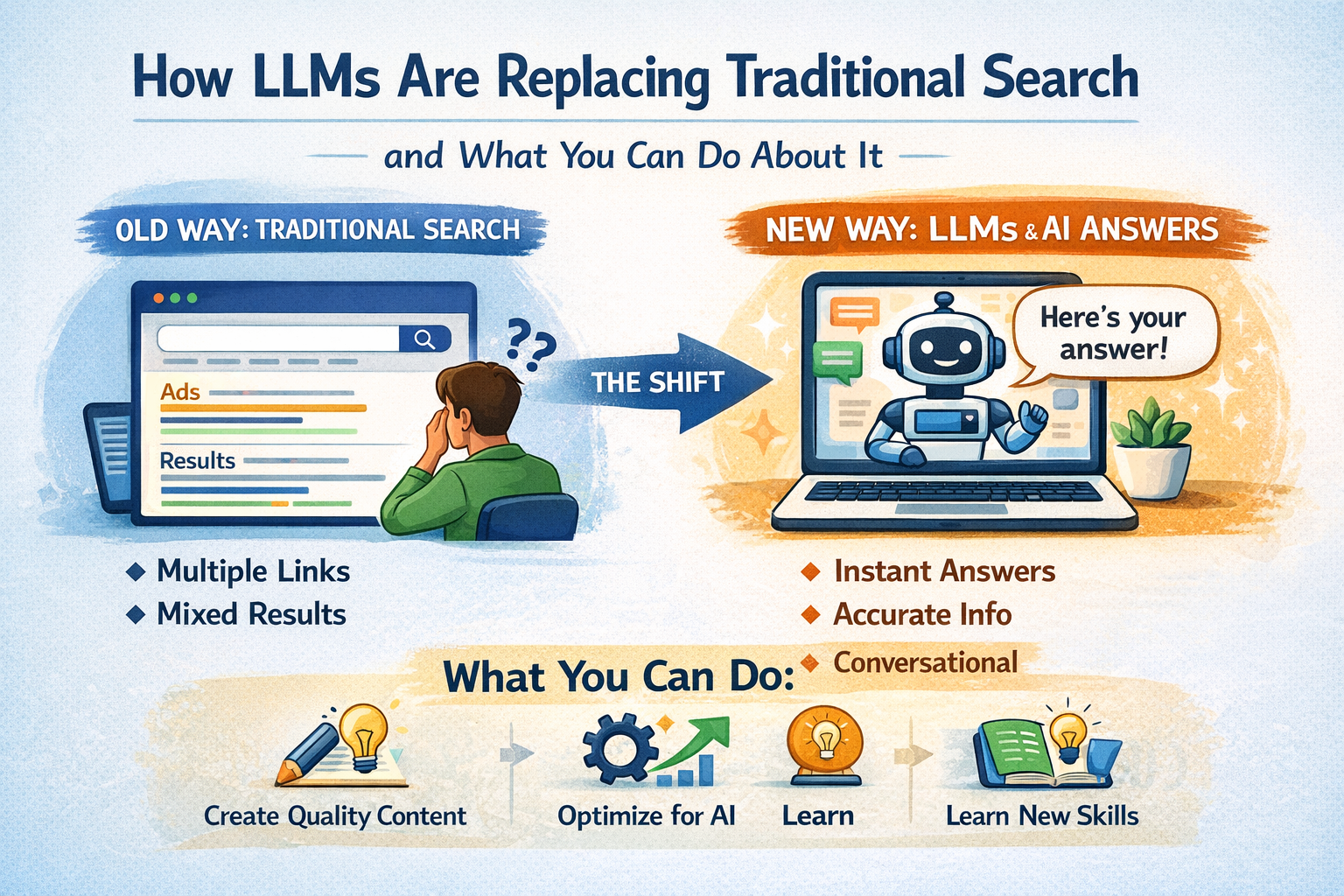
The way people find information online is changing—fast. Traditional search engines like Google are no longer the only gateway to answers. Instead, users are turning to large language models (LLMs) like ChatGPT, Claude, and Perplexity AI to get direct, conversational responses. This shift is reshaping SEO—and giving rise to GEO (Generative Engine Optimization) and AEO (Answer Engine Optimization).
If you rely on organic traffic, this isn't a trend to watch—it's a transformation you need to act on.
Large Language Models (LLMs) are AI systems trained on massive datasets to understand and generate human-like text. Instead of returning a list of links like traditional search engines, they deliver direct answers, summaries, and recommendations.
| Feature | Traditional Search | LLM-Based Search |
|---|---|---|
| Output | Links | Direct answers |
| User Intent | Keywords | Natural language questions |
| Interaction | One-way | Conversational |
| Click Behavior | Multiple clicks | Zero-click answers |
This means users are skipping websites entirely and getting what they need instantly.
"Zero-click searches" are queries where users get their answer without clicking a result. This trend has exploded with AI.
Platforms like Google SGE are integrating AI directly into search results—blurring the line between search engines and LLMs.
GEO is the practice of optimizing your content so it gets cited, summarized, or used by AI models.
Instead of ranking #1 on Google, your goal becomes: being the source AI trusts and references.
If your content isn't optimized for this, you're invisible.
AEO focuses on structuring your content so it can be easily turned into direct answers.
Think:
AEO is the bridge between SEO and AI-driven search.
Classic SEO still matters—but it's no longer sufficient.
Search is evolving from "find the best page" to "give me the best answer."
Here's what actually works in 2026:
Use clear, direct language.
Example:
Break content into:
This makes it easier for AI to extract information.
Include real questions users ask:
Q: Are LLMs replacing Google?
A: Not entirely, but they are reducing reliance on traditional search by providing direct answers.
Cover entire topics—not just keywords.
Instead of: one article on "SEO tips"
Create:
Search engines and AI models understand entities (people, brands, concepts). Mention and contextualize:
AI favors trustworthy sources. Boost credibility with:
Use related terms naturally. Instead of repeating "LLMs replacing search," include:
The future isn't "Google vs AI"—it's integration. Search engines are becoming AI-driven, and AI tools are becoming search engines.
Expect:
If you want to stay ahead:
LLMs aren't just changing search—they're redefining how information is discovered. If your content isn't being used by AI, it's not being seen.
The winners in this new era will be those who:
© 2026 OptiSEOn · Texas, USA