
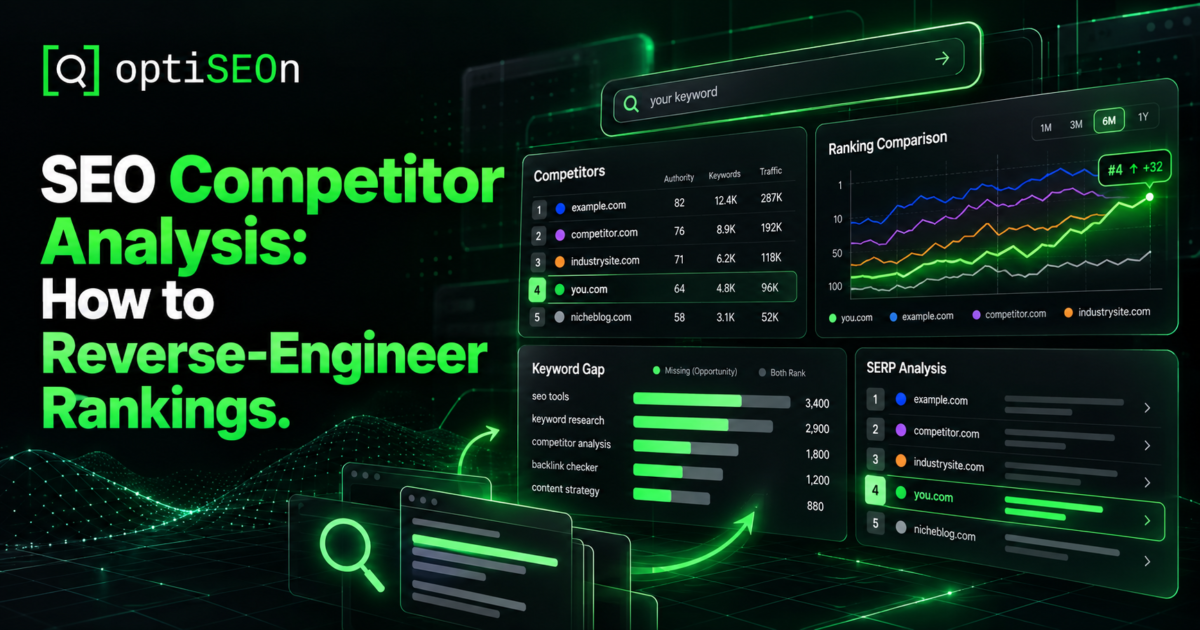
There’s a shortcut in SEO that isn’t a shortcut at all, but rather pure leverage. Your competitors have already spent years testing which keywords convert in your market, which content formats Google rewards, and which links are gettable. That information is sitting in public, yet most businesses never look at it.
Competitor analysis isn’t about copying. It’s about establishing what the actual bar is before you spend six months and a budget clearing it. It answers the question nobody can answer from inside their own analytics: what does winning in this market actually require?
Here’s the process.
TL;DR
SEO competitor analysis means identifying who actually outranks you for the terms you care about, then systematically comparing their content, keywords, backlinks, technical health, and AI visibility against yours to find the gaps worth closing. Your search competitors are often not your business competitors. Start by identifying the right ones, then work through content gaps, link gaps, and structural differences.
→ Book a free competitive audit
Who are my actual SEO competitors?
Your SEO competitors are whoever ranks on page one for the queries you want — which frequently isn’t your business competition at all, but directories, review sites, marketplaces, publishers, and aggregators. Identify them empirically rather than from memory.
To find them: take your ten to twenty most commercially important keywords, search each one (incognito, and location-set if you’re local), and record which domains appear repeatedly. The pattern that emerges is your real competitive set.
What usually surprises people: for many commercial queries, several page-one slots go to directories and listicles rather than businesses like yours. That changes strategy substantially. If four of ten results are “best X in Y” roundups, getting listed in those roundups may be worth more than trying to outrank them. Ultimately, that makes it a digital PR task, not a content task.
What should I compare?
Compare five dimensions: keyword coverage, content depth and format, backlink profile, technical health, and AI search visibility. Each reveals a different kind of gap and suggests a different fix.
| Dimension | What you’re looking for | How to check |
|---|---|---|
| Keywords | Terms they rank for that you don’t | Ahrefs/Semrush gap analysis, or manual SERP review |
| Content | Depth, format, structure, freshness | Read their top pages properly |
| Backlinks | Referring domain count and sources | Backlink Profile Checker |
| Technical | Speed, structure, schema | PageSpeed Insights, view source |
| AI visibility | Whether AI assistants name them | AI Citation Tester |
How do I do a content gap analysis?
A content gap analysis identifies topics and queries your competitors rank for that you have no content addressing. These are your highest-confidence content opportunities because demand is already proven. Paid tools automate it, while manual review works well for smaller sets.
With a paid tool (Ahrefs Content Gap, Semrush Keyword Gap): enter your domain plus two or three competitors and export keywords where they rank and you don’t. Filter for commercial intent and realistic difficulty.
Manually: list their blog and service pages, map each to the query it targets, and mark which you have no equivalent for. Slower, free, and often more insightful because you actually read the content.
Then prioritize using the framework in our keyword research guide, focusing on business value first, then achievability, and finally existing position.
How do I analyze their content properly?
Read their top-performing pages as a practitioner rather than skimming them. Look at structure, depth, format, freshness, author attribution, and what specifically they offer that you don’t. The goal is understanding why Google rewards it.
What to examine on each page:
- Format. Long guide, comparison table, tool, calculator, original data? Google’s choice of format for a query is a strong signal of what it wants.
- Depth. Word count is a crude proxy, but substantive coverage of sub-topics matters.
- Structure. Are they using question headings and direct answers? This structure is key to winning featured snippets and AI Overview citations.
- Freshness. Last-updated dates, current data.
- E-E-A-T signals. Named credentialed authors, original data, citations.
- What’s genuinely unique, such as proprietary data, tools, or real case studies.
That last point is the useful one. If every page-one result includes original data and yours doesn’t, you’ve found your gap, and it isn’t a word-count problem.
How do I find link opportunities from competitors?
Run a backlink gap analysis to find domains linking to several of your competitors but not to you. These are sites already demonstrably willing to link to businesses like yours. It’s the highest-conversion outreach list available.
The pattern: pull referring domains for your top three competitors, find the overlap, exclude domains already linking to you, and sort by relevance and authority. Sites linking to two or three of your competitors but not you are the priority.
What you’ll typically find: industry directories you’re missing, roundups and “best of” lists you could be included in, publications that cover your space, podcasts that interview people in your field, and local or trade organizations. Most are gettable by simply asking, once you know they exist.
The tactics for converting these are in our link building guide. If your gap analysis shows a large deficit, our citation and authority building service covers the systematic side.
Should I check whether AI assistants recommend them?
Yes, AI visibility is now a distinct competitive dimension, and a competitor can be invisible in Google while dominating ChatGPT recommendations, or vice versa. Test it directly rather than assuming the two correlate.
Run the category prompts your buyers would actually use, such as “best [category] in [city]” or “what should I use for [problem],” across ChatGPT, Perplexity, Claude, and Google AI, then record which brands get named. Our free AI Citation Tester builds the prompt set and tracks results over time.
If competitors are named and you aren’t, the diagnosis is usually entity signals, content structure, or third-party corroboration. We cover this in detail in how to get cited by ChatGPT, Perplexity & Gemini.
How do I turn analysis into a plan?
Convert findings into a prioritized list scored on business value, achievability, and effort. Then work the highest-value, lowest-effort items first. Analysis that doesn’t become a ranked backlog is just a document nobody reads.
A workable prioritization:
- Quick wins: terms where you rank 5–20 and a competitor’s page is beatable with a refresh
- Link opportunities: domains linking to multiple competitors but not you
- Content gaps with commercial intent: proven demand, no coverage from you
- Structural fixes: schema, internal linking, technical issues they’ve solved and you haven’t
- Long-term plays: original research, tools, and assets that take months to build
Most businesses get more from the first two than from months of new content.
An honest caveat
Competitor analysis tells you what’s working now, which means it’s inherently a follower’s strategy. It’s excellent for closing gaps and terrible for creating advantage. The things that actually differentiate (like original research, proprietary data, a genuine point of view, or tools nobody else built) by definition won’t show up in a competitor’s profile, because they haven’t done them either.
Use competitive analysis to reach parity efficiently. Use something else to get ahead.
Frequently Asked Questions
How do I find my SEO competitors?
Search your ten to twenty most important commercial keywords and record which domains appear repeatedly on page one. These are your actual search competitors, which often include directories, review sites, and publishers rather than only your business competitors.
What is a content gap analysis?
Identifying topics and keywords your competitors rank for that you have no content addressing. Because demand is already proven by their rankings, these are high-confidence content opportunities. Tools like Ahrefs Content Gap and Semrush Keyword Gap automate it; manual review works for smaller competitive sets.
How do I find out where competitors get their backlinks?
Run a backlink gap analysis: pull referring domains for two or three competitors, find domains linking to several of them but not to you, and sort by relevance and authority. Those sites have already shown willingness to link to businesses like yours, making them your highest-conversion outreach targets.
Should I just copy what my competitors are doing?
No. Use competitor analysis to understand the baseline your market requires, then exceed it with something they don’t have — original data, first-hand experience, a genuine point of view, or a useful tool. Copying achieves parity at best, and parity rarely outranks an incumbent.
How often should I do a competitor analysis?
A thorough analysis quarterly, with lighter monthly checks on your key commercial terms. Markets shift as competitors publish, earn links, and change strategy, but full analyses are time-consuming, and monthly repetition rarely surfaces enough change to justify it.
Do I need paid tools for competitor analysis?
They make it faster, not possible. Manual SERP review, reading competitor content, and Google Search Console cover a lot for free. Paid tools like Ahrefs and Semrush mainly save time on keyword and backlink gap analysis, which is tedious by hand but not impossible.
Want to know exactly who’s beating you and why? Book a free competitive audit. OptiSEOn is a Dallas-based SEO, AEO, GEO, and LLM optimization agency. We’ll map your real competitive set across Google and AI assistants, and show you the gaps worth closing first.
Leave a Reply