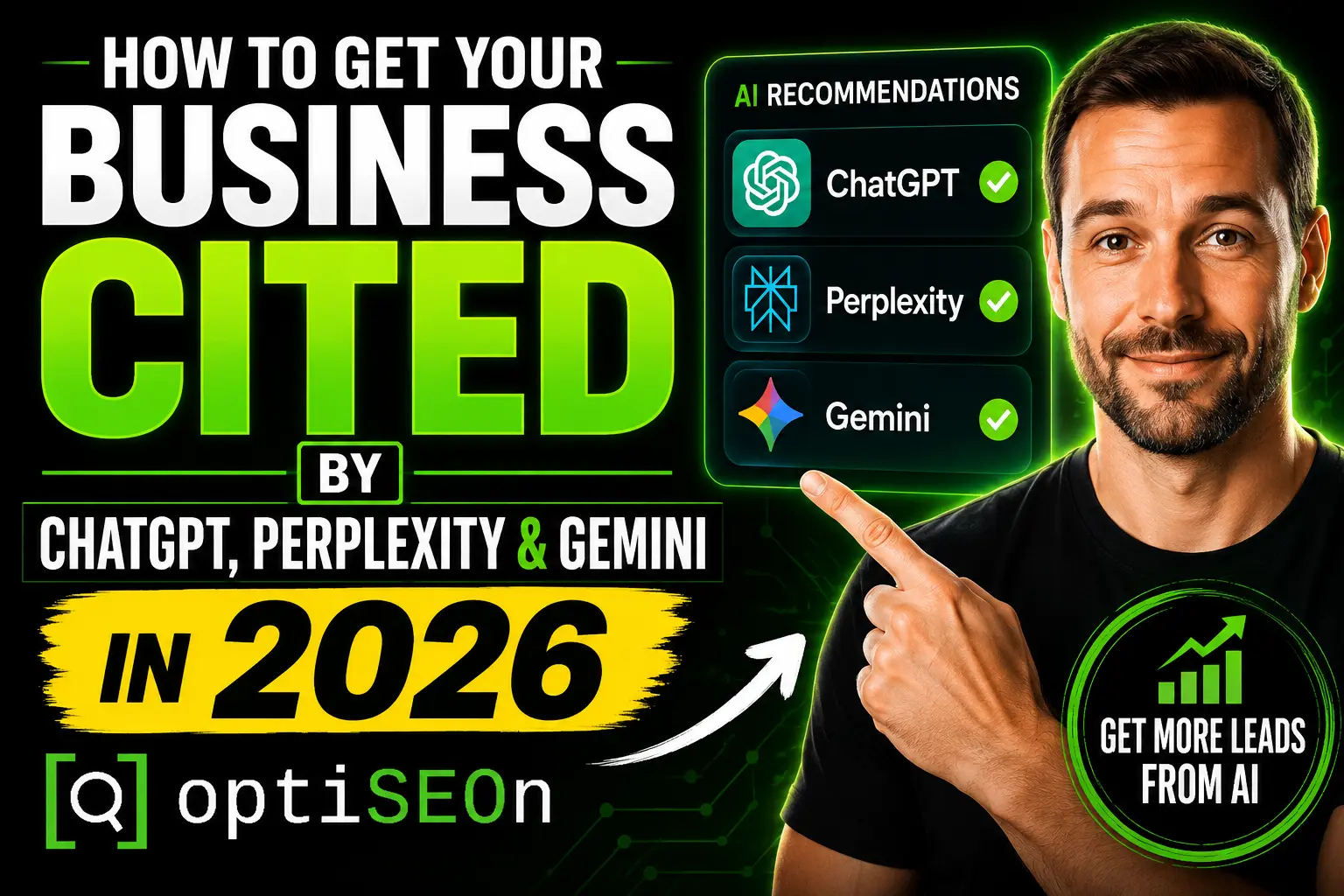
Two years ago, most people searched Google when they needed a service provider. Today, a growing number are asking AI tools like ChatGPT, Perplexity, or Gemini instead. Instead of scrolling through pages of search results, they get a direct answer with a few recommended brands.
If your business is not one of those recommendations, you are likely missing the lead.
This shift has created a new discipline often called AI citation optimization or LLM Optimization. The goal is simple: help AI platforms recognize, trust, and recommend your business. Here’s what is actually working in 2026, based on real-world results.
What Does It Mean to Be “Cited” by AI?
There are two ways AI tools typically reference brands:
- Mention: Your brand name appears in the response.
- Citation: The AI links directly to your website as a source.
Citations matter more. A mention shows the AI knows your business exists. A citation shows the AI considers your content trustworthy enough to use as a source.
Each platform handles this differently:
- Perplexity almost always displays source links and sends measurable referral traffic.
- ChatGPT sometimes includes citations, especially when web search is enabled.
- Gemini and Google AI Overviews blend citations into Google’s search experience.
- Claude increasingly shows citations when using web-enabled search.
The real objective is not just getting mentioned once. It’s becoming a trusted entity that AI systems consistently reference across different types of searches.
The Three Signals AI Engines Care About Most
Most “AI SEO” advice online can be simplified into three core signals.
1. Clear, Structured Content
AI systems prefer content that is easy to extract and summarize.
Pages that perform well usually include:
- Question-based headings
- Direct answers near the top of each section
- Bullet points and numbered lists
- Comparison tables
- Short summaries or TL;DR sections
A concise, useful answer beats long, unfocused writing almost every time.
2. Strong Entity Authority
AI tools want confidence that your business is legitimate and trustworthy.
That authority comes from:
- Consistent business information across the web
- Schema markup
- Mentions on reputable websites
- Reviews and citations
- Author profiles and E-E-A-T signals
- Presence on trusted platforms
The stronger your entity signals, the more likely AI tools are to recommend you.
3. Diverse Source Presence
Different AI platforms rely on different data sources.
For example:
- ChatGPT frequently references Wikipedia and authoritative editorial content.
- Perplexity often pulls from Reddit and community discussions.
- Google AI Overviews uses a broader mix of search-indexed sources.
If your business only exists on your own website, your visibility ceiling is limited.
Step 1: Structure Content for AI Extraction
This is one of the easiest and highest-impact improvements you can make.
The format that performs best usually looks like this:
- An H2 that matches a real question
- A direct answer within the first 40–60 words
- Supporting details afterward
- Lists or tables where useful
Examples:
- “What Is LLM Optimization?”
- “How Do AI Citations Work?”
- “Why Is Schema Markup Important?”
This approach overlaps heavily with Answer Engine Optimization (AEO). The same content structure that wins featured snippets in Google often performs well in AI-generated answers too.
Step 2: Implement Schema Markup Properly
Schema markup helps AI systems understand exactly what your content represents.
At minimum, most businesses should implement:
- Article schema
- FAQPage schema
- HowTo schema
- LocalBusiness schema
- Organization schema
- Author schema
- Product or Service schema
Without structured data, AI systems have to guess. With it, they can classify your content far more accurately.
In 2026, schema is not optional anymore. It is foundational infrastructure.
Step 3: Build Authority Beyond Your Website
Your website alone is usually not enough.
AI engines evaluate your reputation across the broader web.
High-value authority signals include:
- Industry publications
- Podcasts and interviews
- Reddit discussions
- G2, Trustpilot, and review platforms
- LinkedIn and YouTube content
- Brand mentions on trusted websites
Wikipedia and Wikidata are powerful signals too, although most smaller businesses will not qualify for a Wikipedia page due to strict notability standards.
This kind of authority building takes time, but it compounds.
Step 4: Monitor AI Visibility
Most companies have no idea whether AI tools are recommending them.
A simple tracking process includes:
- Build a list of 20–40 customer questions.
- Test those prompts weekly in ChatGPT, Perplexity, Gemini, and Claude.
- Record whether your business is:
- Mentioned
- Cited
- Missing entirely
- Track which competitors appear most often.
Dedicated platforms like Profound, Otterly, and Semrush AI Visibility Toolkit can automate much of this process.
Step 5: Keep Content Updated
Freshness matters more than many businesses realize.
Older content often loses visibility over time, even if the information is still accurate.
A strong refresh process includes:
- Updating statistics
- Revising examples
- Adding new FAQs
- Refreshing case studies
- Updating timestamps visibly on-page
Start with your highest-intent pages first.
What Not to Do
There is a lot of bad advice circulating around AI optimization right now.
Avoid these mistakes:
- Keyword stuffing for AI engines
- Paying for “guaranteed AI citations”
- Ignoring traditional SEO
- Optimizing for only one AI platform
AI visibility still depends heavily on strong technical SEO and crawlable content.
The Reality About Timelines
This is not an overnight process.
Most businesses start seeing early improvements within 60–90 days after improving structure, schema, and technical foundations.
Consistent visibility across multiple AI platforms usually takes 6+ months because it depends on long-term authority building.
The companies dominating AI visibility today started investing in it years ago.
Frequently Asked Questions
How long does it take to get cited by ChatGPT?
Many businesses begin seeing early mentions within 2–3 months after restructuring content and implementing schema. Consistent citations across multiple AI platforms generally take longer because authority signals build gradually.
Are AI citations more important than Google rankings?
No. Traditional SEO still drives most traffic for many industries. AI visibility is an additional discovery channel that is growing quickly and often produces highly qualified leads.
What’s the difference between a mention and a citation?
A mention includes your brand name in an AI-generated answer. A citation links directly to your website as a source.
Do I need a Wikipedia page?
No. It helps, but most businesses can still build strong entity authority through schema, third-party mentions, reviews, and consistent branding.
Can this be handled in-house?
The technical work can often be managed internally if your team understands SEO and structured data. Ongoing authority building and AI visibility monitoring typically require more time and specialized expertise.
How can I track whether AI tools recommend my business?
Create a list of customer search prompts and test them regularly across ChatGPT, Perplexity, Gemini, and Claude. Track when your business appears and compare your visibility against competitors.
Want to know where your business currently appears in AI-generated answers and where competitors are outranking you? OptiSEOn can run a full AI visibility audit and build a focused 90-day roadmap to improve your presence across ChatGPT, Gemini, Perplexity, and other AI platforms.
Leave a Reply