
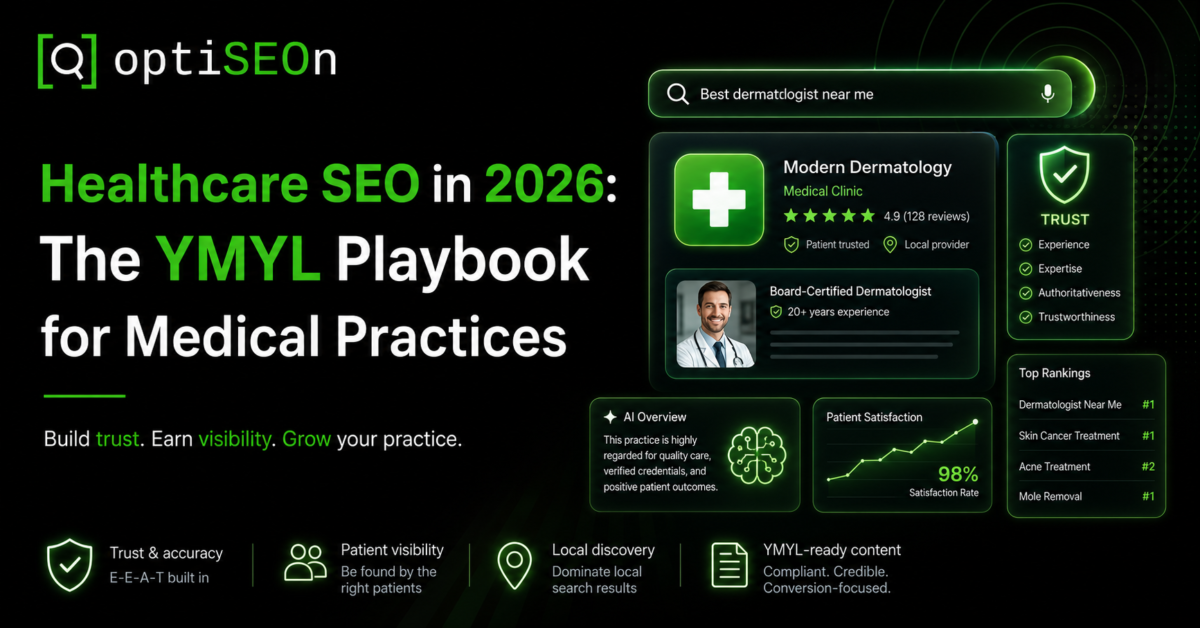
Healthcare is the hardest vertical in SEO. Not the most competitive by keyword difficulty — that title probably goes to insurance or legal — but the hardest to execute correctly, because three constraints stack on top of each other in a way no other industry deals with.
Google classifies medical content in its highest-scrutiny tier. HIPAA restricts which marketing and analytics tools you’re permitted to run. And you’re competing against WebMD, Mayo Clinic, Cleveland Clinic, and Healthline — organizations with two decades of accumulated authority and full-time medical editorial teams.
The payoff, when you get it right, is a durable new-patient engine that compounds. The cost of getting it wrong is content that sits on page four while you burn budget on paid acquisition.
Here’s the realistic playbook.
TL;DR — healthcare SEO in one paragraph
Healthcare SEO differs from general SEO in four ways: medical content sits in Google’s YMYL (Your Money or Your Life) tier and effectively requires licensed clinician authorship or review to rank; local intent dominates patient queries, making Google Business Profile work more important than blog authority for most practices; HIPAA constrains which forms, analytics, and review practices you can use; and review volume affects both ranking and conversion more than in almost any other vertical. Realistic timelines: local pack movement in 30–60 days, content rankings in 90–180 days, full compounding at 9–12 months.
What makes healthcare SEO different?
Healthcare websites fall under Google’s YMYL classification — content that could affect a person’s health, finances, safety, or wellbeing — which triggers the strictest quality evaluation standards Google applies. Practically, this means medical content without verifiable clinical expertise behind it gets filtered out regardless of how well it’s optimized.
The four structural differences:
- YMYL scrutiny. Google’s quality raters apply elevated standards for accuracy, author expertise, citation quality, and content freshness. Our E-E-A-T guide covers the underlying framework — healthcare is where it applies most strictly.
- Local intent dominance. Most patient queries are local (“orthopedic surgeon near me,” “pediatric dentist Plano”). For a single-location practice, Google Business Profile work typically outperforms blog content on ROI.
- HIPAA constraints. Forms, analytics configuration, testimonials, and review responses all carry privacy obligations that don’t exist in other verticals.
- Review sensitivity. Patients select providers substantially on reviews. Volume and rating affect both Map Pack ranking and booking conversion.
Layer 1: E-E-A-T and the clinical authorship requirement
This is the layer that makes or breaks healthcare content, and it’s where most practices try to cut corners.
What Google’s raters look for on medical content:
- Author is a licensed clinician, with credentials displayed (MD, DO, DDS, RN, PT, LCSW, etc.), state licensure where appropriate, and a real bio
- Or: content is authored by a professional writer and medically reviewed by a named licensed clinician, with the reviewer credited and the review date shown
- Citations to authoritative sources — peer-reviewed literature, CDC, NIH, professional society guidelines — not other marketing blogs
- Content freshness — medical information dates quickly; visible review dates matter
- Clear organizational trust signals — practice address, phone, licensure, provider roster, insurance accepted
The medical review workflow that works:
- Writer produces a draft from clinical sources
- Named licensed clinician reviews for accuracy
- Byline shows both: “Written by [Writer] · Medically reviewed by [Clinician, MD] on [date]”
- Clinician has a full bio page with credentials, schema markup, and links to professional profiles
- Content is re-reviewed on a defined cadence (annually at minimum for clinical content)
This costs real money and real clinician time. It is also non-negotiable — practices that skip it publish content that doesn’t rank, which is more expensive than doing it properly.
Schema that supports this: MedicalOrganization on the homepage, Physician on each provider page, MedicalClinic for location data, and Person schema on author and reviewer bios. Together these build the entity profile that both Google and AI engines use to evaluate and recommend a practice. See our schema markup guide for implementation.
Layer 2: Local SEO (where most practice revenue actually comes from)
For a single-location or small multi-location practice, this layer usually outperforms everything else on ROI.
Priorities:
- Google Business Profile, fully optimized — correct specialty as primary category (specific: “Pediatric Dentist,” not “Dentist”), complete provider information, accurate hours, insurance attributes, 20+ real photos, weekly posts. Our complete GBP guide published August 11 covers the full process.
- Separate GBP listings per provider where appropriate — many specialties support individual practitioner listings alongside the practice listing, which can multiply Map Pack presence.
- Location pages for each office, with genuinely unique content — providers at that location, directions, parking, insurance accepted, local landmarks. Not templated duplicates.
- Healthcare-specific citations — Healthgrades, Vitals, WebMD Provider Directory, Zocdoc, RateMDs, and insurance-carrier provider directories. Consistency across these matters as much as general directories.
- NAP consistency across every listing, including provider-level NPI records.
For DFW practices specifically, our Dallas local SEO playbook covers the metro-specific dynamics — geographic spread across Plano, Frisco, Richardson, Irving means service-area targeting needs deliberate structure.
Layer 3: Site architecture and service-line pages
Healthcare sites rank on structure more than volume of content.
The architecture that works:
- Service-line pages — one page per procedure or condition treated, with depth. “Knee Replacement Surgery” as its own page, not a bullet on a services list.
- Provider profile pages — one per clinician, with credentials, education, specialties, conditions treated, publications, languages spoken, and Physician schema. These rank well for name searches and feed E-E-A-T.
- Condition explainer content — informational content about conditions you treat, medically reviewed. This is where you compete with WebMD, so pick specifically: you’ll lose “diabetes symptoms” and can win “diabetic foot ulcer treatment in Dallas.”
- Insurance and billing pages — high-intent, frequently searched, almost always neglected.
- New patient information — forms, what to expect, appointment process.
The strategic principle: don’t fight national health publishers on general condition content. Compete where local intent, specific procedures, and provider identity intersect — that’s territory Mayo Clinic doesn’t contest.
Layer 4: HIPAA and compliance constraints
Speak to your compliance counsel about all of this. What follows is orientation, not advice.
Areas where healthcare marketing diverges from standard practice:
- Forms. Any form collecting health information generally requires encryption and a Business Associate Agreement with the form provider. Standard marketing form tools frequently do not offer BAAs.
- Analytics. Standard analytics configurations can transmit information that constitutes PHI in context. Analytics setup for healthcare sites typically requires deliberate configuration — IP anonymization, careful event design, avoiding PHI in URLs and page titles, and BAAs where available.
- Advertising pixels. Retargeting pixels on pages tied to specific conditions have been a significant enforcement area. Many practices have removed them from condition-specific pages entirely.
- Patient testimonials. Generally require explicit written authorization. Some state medical boards restrict testimonials further regardless of patient consent.
- Review responses. Publicly acknowledging that a reviewer is a patient can itself be a disclosure. The standard safe pattern is a generic response that neither confirms nor denies a treatment relationship, with an invitation to contact the practice directly.
- Health claims. FDA and FTC rules govern claims about treatments and outcomes. “Cure,” “guaranteed results,” and unsubstantiated efficacy claims create real exposure.
- Accessibility. ADA and WCAG 2.2 AA conformance is both a legal consideration and a genuine ranking and usability factor.
This is why generalist agencies frequently create compliance problems for healthcare clients — the default marketing playbook includes several practices that are straightforwardly non-compliant in a healthcare context.
Layer 5: Reviews under compliance constraints
Reviews matter enormously for patient acquisition, and the compliance overlay makes them harder.
What generally works:
- Ask every patient, systematically, at the point of a positive care experience — typically via the practice management system’s post-visit workflow
- Use a direct review link with no gating (gating violates platform policies)
- Never incentivize reviews
- Respond to every review using compliance-safe language that doesn’t confirm a treatment relationship
- Monitor healthcare-specific platforms — Healthgrades, Vitals, Zocdoc — alongside Google
A response template pattern many practices use: thank the reviewer generically, state the practice’s commitment to patient experience, and invite direct contact — without any acknowledgment of whether the person was seen.
Layer 6: AEO and AI visibility for healthcare
Patients increasingly ask AI tools before they search. “What kind of doctor should I see for chronic knee pain?” “Best pediatric dentist in Plano that takes Aetna?”
What earns healthcare citations in AI answers:
- Strong clinical E-E-A-T signals — AI engines demonstrably favor verifiable medical expertise when generating health-related answers, and apply elevated caution on health topics
- Structured, question-format content — condition explainers and FAQ content built with the answer-block structure covered in our featured snippets guide
- Complete medical schema — MedicalOrganization, Physician, MedicalClinic
- Presence on authoritative medical directories — AI engines cite Healthgrades and similar directories frequently for provider recommendations
- Consistent provider entity data across NPI records, directories, and your own site
The general AI citation framework is in how to get cited by ChatGPT, Perplexity & Gemini. Healthcare applies it with a higher expertise bar and a much lower tolerance for error.
Layer 7: Technical foundation
Standard, but with healthcare-specific emphasis:
- Core Web Vitals — patients on mobile, often in discomfort, abandon slow sites quickly
- Mobile-first — the large majority of patient searches are mobile
- Accessibility (WCAG 2.2 AA) — legal exposure plus genuine patient need
- HTTPS everywhere — non-negotiable for any site touching health information
- Clean indexation — patient portals, forms, and PHI-adjacent pages must be excluded from indexing
Realistic timelines (the honest version)
Healthcare timelines are slower than any other vertical. Anyone promising fast organic results is either running ads or measuring something that doesn’t matter.
- Days 30–60: Local pack movement from aggressive GBP and review work. This is the fastest-moving layer.
- Days 90–180: Content rankings on condition and procedure queries begin maturing.
- Months 9–12: Full compounding — organic becomes a dominant new-patient channel.
Budget and expectations should be set against that curve. The practices that win are the ones that commit through months 4–8, which is where most give up.
Link building for healthcare
Healthcare link building is constrained but not impossible:
- Local sponsorships and community health events — genuine local links
- Provider directory listings — Healthgrades, Vitals, professional societies
- Hospital and health system affiliations — if your providers have admitting privileges or academic appointments, those institutional pages often link
- Medical society memberships — state and specialty associations
- Expert commentary — providers quoted in local news and health journalism
- Original clinical or practice data where publishable and compliant
Our link building guide covers the general framework. In healthcare, avoid the paid-guest-post ecosystem entirely — the risk profile is worse when your site is already under YMYL scrutiny.
How OptiSEOn approaches healthcare clients
We work with healthcare and health-adjacent practices, and we structure those engagements differently from our SaaS and eCommerce work: clinical review workflow built into content production, medical schema implementation, healthcare-specific citation building, compliance-aware review management, and GBP work weighted more heavily than blog volume because that’s where practice revenue actually comes from.
We’re not attorneys and we don’t provide compliance advice — we work alongside your compliance counsel. See our services or book a free audit.
Frequently Asked Questions
Why is healthcare SEO harder than other industries? Three constraints stack: Google classifies medical content as YMYL and applies its strictest quality standards, HIPAA restricts which forms, analytics, and review practices you can use, and you compete against national health publishers with decades of accumulated authority. Timelines are correspondingly longer.
Do I need a doctor to write my medical content? Content should be authored by a licensed clinician or authored by a writer and medically reviewed by a named licensed clinician, with the reviewer and review date displayed. Medical content without verifiable clinical expertise behind it consistently underperforms in YMYL search results.
Is SEO HIPAA compliant? Standard SEO practices can be conducted compliantly, but several common marketing defaults are not — unencrypted forms without a BAA, standard analytics configurations, retargeting pixels on condition-specific pages, and testimonials without written authorization. Configuration matters. Work with compliance counsel.
How long does healthcare SEO take to work? Local pack improvements typically appear in 30–60 days with focused Google Business Profile and review work. Content rankings on condition and procedure queries generally take 90–180 days. Full compounding, where organic becomes a primary new-patient channel, usually arrives between months 9 and 12.
What schema markup do medical practices need? MedicalOrganization on the homepage, Physician schema on each provider page, MedicalClinic for location data, LocalBusiness for practice locations, and Person schema for content authors and medical reviewers. Together these build the entity profile Google and AI engines use to evaluate and recommend practices.
Can I respond to patient reviews online? You can respond, but publicly acknowledging that someone is a patient may constitute a disclosure. The common safe pattern is a generic response that neither confirms nor denies a treatment relationship, thanks the reviewer, and invites direct contact offline. Confirm your specific approach with compliance counsel.
Should a practice focus on blog content or Google Business Profile first? For most single-location practices, Google Business Profile and review acquisition deliver faster and larger returns than blog content, because patient queries are overwhelmingly local. Content becomes more valuable for multi-location groups, specialty practices competing on procedure-specific queries, and telehealth providers without geographic anchoring.
Want a healthcare SEO audit that accounts for YMYL, local intent, and compliance constraints? OptiSEOn is a Dallas-based SEO, AEO, GEO, and LLM optimization agency with healthcare experience. Book a free audit — we’ll assess your local visibility, E-E-A-T signals, and content architecture, and flag anything that looks like a compliance risk for your counsel to review.
Leave a Reply