
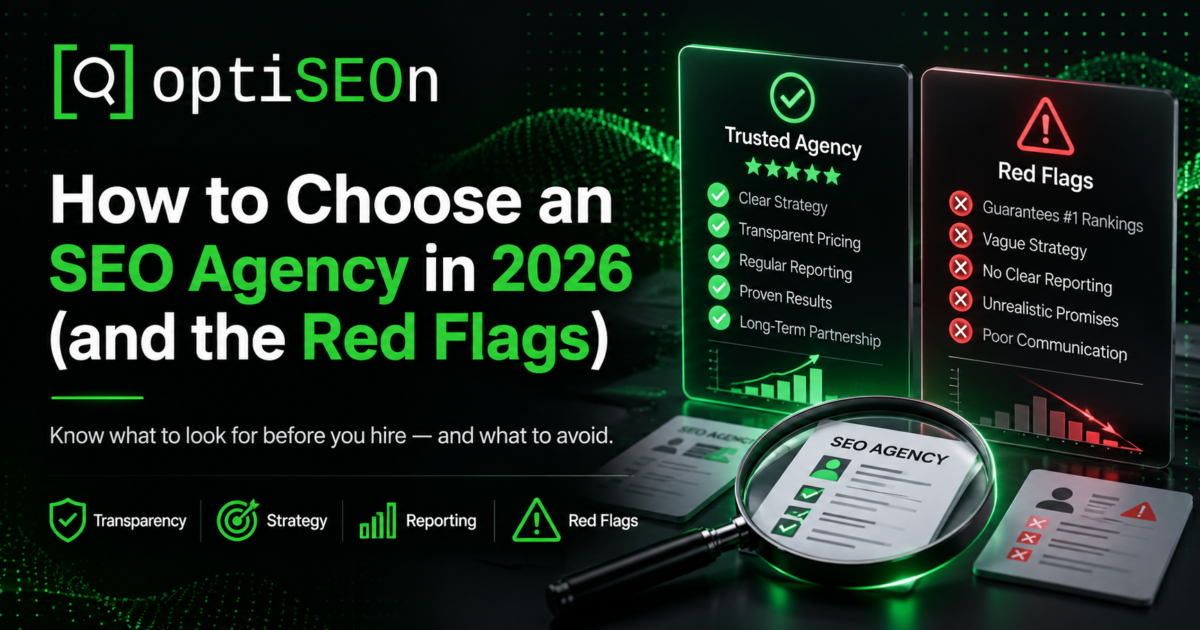
Let’s start with the obvious conflict of interest: we are an SEO agency, and this is an article about choosing one. You should weigh everything below accordingly.
We’re writing it anyway because the buying experience in this industry is genuinely bad. Most agency websites say the exact same things: “data-driven,” “proven results,” and “custom strategy.” They offer no real way to distinguish a competent operator from someone who’ll take your money for a year and show you a meaningless chart of impressions. Businesses get burned regularly, usually because they lack the background to evaluate technical sales pitches.
So here’s the honest version: what to ask, what should end the conversation immediately, and how to read a proposal. Some of it makes agencies, including us, look less appealing. That’s the point.
TL;DR
Choose an SEO agency by evaluating four things: whether they diagnose before prescribing, whether their deliverables are specific and verifiable, whether their claims are honest about timelines and uncertainty, and whether their contract lets you leave. The immediate red flags: guaranteed rankings, secret proprietary methods, refusal to explain tactics, pressure for long contracts, and suspiciously cheap pricing. The best single filter is asking what they won’t do and what could go wrong.
What should I look for in an SEO agency?
Look for an agency that diagnoses your specific situation before proposing a solution, describes its deliverables specifically enough that you could verify them, sets honest timelines, and offers contract terms that don’t trap you. Those four things filter out most of the bad actors without requiring you to evaluate technical claims you’re not equipped to judge.
The four in more detail:
- They diagnose first. A competent agency asks about your business, market, competitors, and current state before quoting. An agency that sends a standard package in response to a first email is selling a product, not solving your problem.
- Deliverables are specific. “Content optimization” means nothing. “8–12 pages optimized per month, with title tags, meta descriptions, heading structure, and internal links” is something you can check.
- Claims are honest. Realistic timelines, acknowledged uncertainty, no guarantees about things nobody controls.
- The contract lets you leave. Month-to-month, or a short initial term with a clear exit. Long lock-ins mostly protect agencies from the consequences of underperforming.
What are the biggest SEO agency red flags?
Guaranteed rankings, secret methods they won’t explain, pressure to sign long contracts, prices far below market, and reporting built on vanity metrics. Any one of these is reason enough to walk away.
The red flags, and why each one matters:
| Red flag | Why it’s disqualifying |
| “We guarantee #1 rankings” | Nobody controls Google’s algorithm. Google itself says no one can guarantee rankings. This claim is either ignorance or dishonesty. |
| “Our proprietary method is confidential” | You’re entitled to know what’s being done to your website. Secrecy usually conceals either nothing or something risky. |
| Long mandatory contracts | 12-month lock-ins with no exit protect the agency, not you. Short terms force agencies to earn renewal. |
| Suspiciously cheap | $199/month can’t fund real work. It funds automated reports and low-quality links that may actively harm you. |
| Reporting only on impressions/traffic | If they never show conversions or leads, there’s a reason. |
| Vague deliverables | “Ongoing optimization” is not a deliverable. |
| No questions about your business | If they don’t understand what you sell and who buys it, they can’t target the right terms. |
| They won’t name what they don’t do | Every honest operator has scope limits. |
| Buying links / PBNs | Direct violation of Google’s guidelines with real penalty risk. Ask explicitly how they build links. |
On that last point: link building is where the most damage gets done. Ask directly whether they buy links or use private blog networks. An agency doing this will usually euphemize it (“we have publisher relationships”). Press until you get a clear answer. Our link building guide covers what legitimate practice looks like in 2026.
What questions should I ask an SEO agency?
Ask what they won’t do, what could go wrong, how they’d measure success, what specifically they’d do in the first 90 days, and who actually does the work. These questions are hard to answer well without genuine competence, which makes them good filters.
The questions worth asking, roughly in order of diagnostic value:
- “What won’t you do?” Every competent agency has scope limits and tactics they refuse. An agency that claims to do everything is either lying or spread too thin.
- “What could go wrong with this engagement?” Honest answers exist: your market may be too competitive, your site may need development work you’re not budgeted for, results may take longer than you want. An agency that says nothing could go wrong isn’t thinking.
- “How will we measure success, and what’s the first metric that will move?” Look for conversions and leads, not impressions. See our guide to measuring SEO ROI.
- “What exactly happens in the first 90 days?” Specific deliverables with a sequence, not “we’ll start optimizing.”
- “Who does the work, and where?” Whether it’s in-house, freelance, or offshore isn’t automatically good or bad, but evasiveness about it is.
- “How do you build links?” Listen for outreach, digital PR, and earned placements. Walk away at anything resembling purchased links.
- “Can I talk to a current client in a similar situation?” References from current clients matter more than testimonials.
- “What happens if I want to leave?” Who owns the content, the accounts, the data? You should own all of it.
How much should SEO cost?
Legitimate SEO retainers for small and mid-sized businesses generally run from several hundred to several thousand dollars monthly, scaling with scope, market competitiveness, and content volume. Anything under roughly $300/month is unlikely to fund meaningful work. Price alone doesn’t indicate quality, but implausibly cheap pricing reliably indicates the absence of it.
What actually drives cost: how much content is produced, how competitive your market is, how much technical work your site needs, whether local/multi-location work is involved, and how much link building and citation building is included.
The useful question isn’t “is this expensive?” but “what specifically am I getting for this, and is that plausible at this price?” If someone offers 20 blog posts, full technical SEO, and 30 backlinks for $400/month, the arithmetic doesn’t work. Something in that list isn’t real.
For transparency on our own model, our pricing is published rather than quote-on-request.
Should I hire a specialist or a generalist agency?
Hire a specialist when your situation has genuine domain constraints: YMYL verticals like healthcare and legal, multi-location systems, or AI search visibility. Choose a generalist when your needs are broad and conventional. Specialization matters most where getting it wrong carries specific risk.
Where specialization genuinely matters:
- Healthcare (YMYL scrutiny plus HIPAA constraints). A generalist can create compliance problems. See our healthcare playbook.
- Legal (YMYL plus state bar advertising rules). See our law firm playbook.
- Multi-location / franchise (duplicate content risk at scale). See the multi-location playbook.
- AI search visibility, a genuinely new discipline most agencies haven’t built capability in yet.
Where a competent generalist is fine: standard local businesses, straightforward B2B, most eCommerce.
How do I evaluate an SEO proposal?
Check that the proposal reflects your specific situation, lists countable deliverables, states realistic timelines, explains measurement, and doesn’t promise outcomes nobody can control. A proposal that could have been sent to any business tells you it was.
A practical checklist:
- Does it reference your site, competitors, and market specifically?
- Are deliverables countable (pages, posts, links, citations) rather than adjectival?
- Are timelines realistic — months, not weeks, for meaningful results?
- Does it explain how success will be measured, in business terms?
- Does it acknowledge any risk or uncertainty at all?
- Are contract terms and exit conditions clear?
- Does it avoid guarantees about rankings or traffic?
The honest caveats about this article
Since we’re an agency writing about choosing agencies, a few things worth stating plainly:
- We are not the right fit for everyone. We don’t do paid ads, social media, web development, email, or video. If you need an integrated marketing partner, you need someone else.
- Some businesses shouldn’t hire any agency yet. If you need revenue in 30 days, SEO isn’t your answer. If your budget can’t sustain six months, starting and stopping wastes it entirely.
- In-house is sometimes better. If you have someone with capacity and aptitude, a lot of foundational SEO is learnable. Our free tools and this blog exist partly for that reason.
- The advice above applies to us. Ask us what we won’t do. Ask what could go wrong. Ask to leave. Our plans are month-to-month specifically so that question has an easy answer.
Frequently Asked Questions
Can an SEO agency guarantee first-page rankings?
No. Nobody controls Google’s algorithm, and Google explicitly states that no one can guarantee rankings. Any agency offering a ranking guarantee is either uninformed or being dishonest — and it’s one of the clearest signals to end the conversation.
How much does an SEO agency cost per month?
Legitimate retainers for small and mid-sized businesses generally range from several hundred to several thousand dollars monthly, depending on content volume, market competitiveness, technical scope, and link building. Pricing under roughly $300/month rarely funds meaningful work because the arithmetic of what’s promised doesn’t hold up.
What questions should I ask before hiring an SEO agency?
Ask what they won’t do, what could go wrong in the engagement, how success will be measured, exactly what happens in the first 90 days, who does the work, how they build links, and what happens if you want to leave. These are difficult to answer well without genuine competence, which makes them effective filters.
How long should an SEO contract be?
Prefer month-to-month or a short initial term with clear exit conditions. Long mandatory contracts primarily protect agencies from underperformance. That said, expect to commit 6–12 months of investment for results. The point is that continuing should be your choice, not contractually forced.
How do I know if my SEO agency is doing anything?
Ask for specific monthly deliverables you can verify — which pages were optimized, what content was published, which links were earned, what technical fixes were made. Check the work yourself. If reporting only shows impressions and traffic without conversions or a list of completed work, that’s a warning sign.
Should I hire a local SEO agency or does location not matter?
For most work, location doesn’t matter because SEO is done remotely. It matters more when you need genuine local market knowledge (such as a Dallas agency understanding DFW’s geographic spread and seasonal patterns) or when you strongly prefer in-person meetings. Judge on competence first, proximity second.
If you’re evaluating agencies, evaluate us the same way. Book a free audit with no pitch and no pressure. We’ll tell you what we’d do, what we wouldn’t, what could go wrong, and whether we’re honestly the right fit. Sometimes the answer is no, and we’d rather say so.
Leave a Reply