
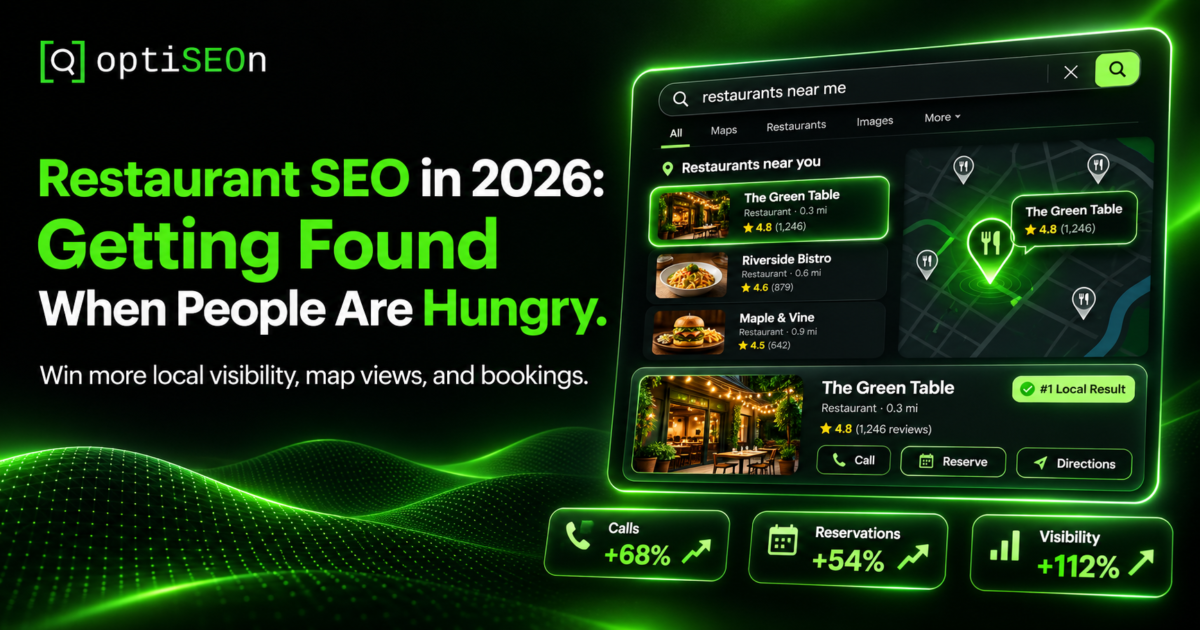
Restaurant search has a quality that almost no other vertical shares: the decision window is minutes, the intent is immediate, and the searcher is usually standing or sitting somewhere nearby with a phone in their hand. Nobody researches dinner for three weeks.
That compresses everything. There’s no consideration funnel to nurture, no email sequence, no comparison spreadsheet. Someone searches “best tacos near me,” looks at three results, reads a couple of reviews, glances at photos, and goes. You either appeared in that moment or you didn’t.
It also means the fundamentals matter more than the sophistication. A restaurant with an immaculate Google Business Profile, current hours and good photos will out-earn one with a beautiful website and a neglected listing, every time.
TL;DR
Restaurant SEO is almost entirely local and mobile: your Google Business Profile does most of the heavy lifting, reviews and photos drive decisions, and accurate details prevent lost customers. Get your menu indexed as real text rather than a PDF or image, keep your hours accurate (including holidays), and make sure the information AI assistants pull is correct, since “where should I eat” is now a common chatbot query.
What matters most for restaurant SEO?
Your Google Business Profile, by a wide margin. It’s where your hours, photos, reviews, menu links, and directions all live, and for most restaurants, it drives far more decisions than the actual website. The website supports the profile, not the other way around.
The priorities in order:
- Google Business Profile, complete and actively maintained
- Reviews (volume, recency, and your responses)
- Photos (food, interior, exterior)
- Accurate hours, including holidays and special closures
- Menu as indexable text
- Mobile site speed
- Reservation and ordering links that work
Notice the website appears sixth. That’s not a mistake. A restaurant with a mediocre website and an excellent profile beats the reverse consistently.
How do I optimise a restaurant’s Google Business Profile?
Complete every field, choose the most specific cuisine category available, upload real photos monthly, keep hours accurate, and respond to every review. Restaurants have more profile features available than most business types, and most use a fraction of them.
Restaurant-specific priorities:
- Primary category by cuisine. “Mexican Restaurant” or “Taqueria” beats “Restaurant.” Specificity is a relevance signal.
- Attributes like outdoor seating, takeout, delivery, reservations, wheelchair accessibility, good for groups, or vegetarian options. These act as filters in Google Maps, so adding relevant attributes gives you visibility you would otherwise miss.
- Menu link and menu items directly in the profile.
- Photos, updated monthly. Food photos drive more engagement than almost anything else on a listing. Use real photos, not stock images or generic supplier shots.
- Hours including holidays. Wrong holiday hours produce angry one-star reviews from people who drove over.
- Posts for specials, events, seasonal menus.
- Q&A pre-populated: parking, reservations, dietary options, group bookings, BYOB.
- Reservation and ordering links connected and tested.
The full field-by-field process is in our Google Business Profile guide, and the broader local approach in Local SEO for Dallas Businesses.
Should my menu be a PDF?
No. A PDF or image menu can’t be properly read, indexed or extracted, which means it’s invisible to search engines, AI assistants and screen readers alike. Your menu should be real HTML text on a real page.
This is one of the most common technical mistakes in restaurant SEO. Menu items are exactly what people search for: “green chile enchiladas Dallas” or “gluten free pizza near me.” If your menu is saved as an image or PDF, none of those terms exist on your site as far as Google is concerned.
A properly built menu page:
- Real text, structured with headings per section
- Item names and descriptions as actual content
- Prices in text
- Dietary tags such as vegetarian, vegan, and gluten-free written as text, since these are heavily searched terms
- Menu schema (Menu, MenuSection, MenuItem) so search engines can parse it easily. You can build this using our Schema Markup Generator
- Kept current. An outdated menu is worse than no menu.
Offer a downloadable PDF alongside if you like. Just never make it the only version.
How important are reviews for restaurants?
Critical, and not just for ranking. Reviews are the final deciding factor for most diners, and recency matters because people assume a restaurant’s quality changes over time. A glowing review from two years ago isn’t going to convince anyone today.
What matters:
- Volume relative to local competitors rather than any absolute number
- Recency and frequency, which signal an active, popular business
- Response rate. Respond to every review, positive and negative.
- Review content mentioning dishes, which helps relevance for those dish searches
- Photos in reviews, which carry disproportionate weight with diners
A simple approach: ask for feedback when customers are happiest, such as on the check, a table card, or in a booking follow-up. Just make sure never to gate reviews (asking only happy customers violates platform policies) or offer incentives.
On negative reviews: respond calmly, briefly, without litigating the detail. You’re writing for the next hundred people reading, not the reviewer. A defensive owner response does more damage than the original review.
What about the website itself?
It needs to load quickly on mobile, display hours and location immediately, make the menu easy to read, and let people book or order in one tap. Everything else comes second.
The things that actually matter:
- Mobile speed. Hungry people won’t wait for a slow site to load. Heavy image carousels and background videos are usually the main culprits (see our guide on Core Web Vitals in 2026).
- Hours, address and phone above the fold on mobile
- Tap-to-call and tap-for-directions
- Menu in HTML, as above
- Reservation or ordering in minimum taps
- Restaurant schema with cuisine, price range, hours, and acceptsReservations
- Location pages per venue for multi-site groups, featuring unique content (see our recommendations in Multi-Location & Franchise SEO)
What doesn’t matter nearly as much as restaurant web designers suggest: a splash animation, a full-screen video of the kitchen, or a bespoke scroll experience. These cost speed, which costs customers.
How do people find restaurants through AI now?
People frequently ask AI assistants questions like “Where should I eat near X?”, “Best vegan brunch in Dallas”, or “Somewhere good for a work dinner with outdoor seating.” These assistants pull answers from business profiles, review sites, directories, and local articles. Detailed descriptive information is key.
What makes a restaurant citable:
- Consistent NAP across Google, Apple, Yelp, delivery platforms and your site. Check with the Entity Signal Checker.
- Restaurant and Menu schema so cuisine, hours and dietary options are machine-readable
- Written content that answers common questions like “Is it good for groups?”, “Do you have vegan options?”, or “Is there parking?”. Include these directly on your site as text, not just in a third-party Q&A box.
- Presence on the platforms AI systems cite in food — Yelp, TripAdvisor, OpenTable, local food media
- Accurate, current information everywhere. If an AI confidently gives out wrong business hours, you lose a customer without ever knowing it.
Test whether assistants currently recommend you with our AI Citation Tester. We also cover the general framework in our guide on how to get cited by ChatGPT, Perplexity & Gemini.
A Dallas note
DFW’s geography makes location-specific targeting essential, even for a single location. Searching for “best brunch in Dallas” versus “best brunch in Bishop Arts” brings up completely different competition, and focusing on a specific neighborhood is much more achievable than targeting the whole metro area. Creating content that genuinely reflects your neighborhood, rather than using generic lines like “serving the Dallas area,” helps single restaurants outrank big directory sites.
Realistic timelines
- Weeks 1–4: Profile completion, photo upload, hours accuracy, review system launch. Fastest-moving work in the vertical.
- Weeks 4–12: Map pack movement, review volume building, menu indexed.
- Months 3–6: Established local visibility; neighbourhood content ranking.
Restaurants compound faster than most verticals because the profile work moves quickly and review velocity builds naturally from existing foot traffic.
Frequently Asked Questions
What’s the most important thing for restaurant SEO?
The Google Business Profile. It carries hours, photos, reviews, menu links and directions, and for most restaurants it drives more decisions than the website. A complete, actively maintained profile with current photos and recent reviews outperforms a beautiful website attached to a neglected listing.
Should my restaurant menu be a PDF?
No. PDFs and images can’t be properly indexed or extracted, so search engines and AI assistants can’t read your dish names — which are exactly what people search. Publish the menu as real HTML text with Menu schema, and offer a PDF alongside only if you want to.
How do I get more Google reviews for my restaurant?
Ask at the point of a good experience — on the check, a table card, or a post-booking follow-up — with a direct review link. Never gate by asking only happy customers, and never incentivise; both violate platform policy. Respond to every review, which both signals an active business and influences the next reader.
Does my restaurant need a website if the Google profile is good?
Yes, though it matters less than the profile. The site hosts your indexable menu, carries schema, gives you a reservation or ordering path you control, and provides content AI assistants can draw on. A simple fast site plus an excellent profile is the right balance.
How do I show up when someone asks ChatGPT where to eat?
Keep your information consistent and accurate everywhere, implement Restaurant and Menu schema, publish written content answering real diner questions (groups, dietary options, parking), and maintain presence on the review and booking platforms AI systems reference. Test your current standing with an AI citation check.
How long does restaurant SEO take to work?
Profile and review improvements often show within four to eight weeks, which is faster than most verticals. Map pack movement in competitive neighbourhoods typically takes two to three months, with established local visibility by months three to six.
Running a restaurant or hospitality group in DFW? Book a free local SEO audit. OptiSEOn is based in Dallas, and we can help check your profile, menu indexability, and AI visibility.
Leave a Reply