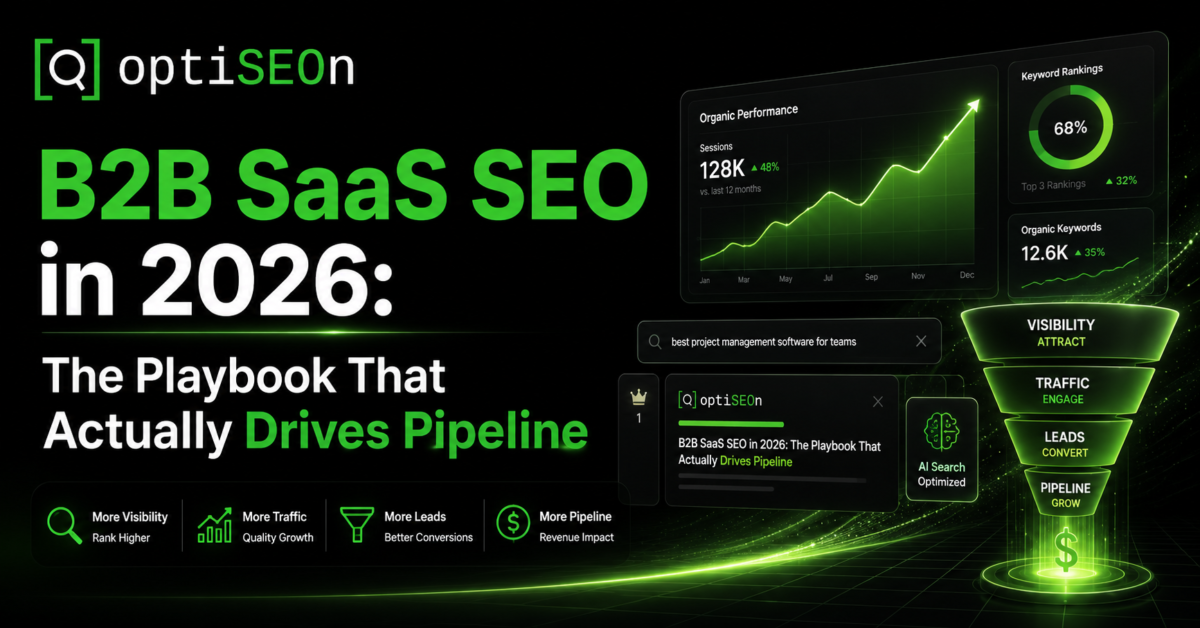
B2B SaaS SEO in 2026 is not what it was in 2022. The buyer journey has fundamentally shifted, and the playbook that worked four years ago — keyword research → blog posts → backlinks → demo requests — increasingly produces traffic that doesn’t convert to pipeline.
Three big changes broke the old playbook:
- B2B buyers research via AI tools before they ever land on your website. When a procurement team is evaluating “best customer success platforms for mid-market SaaS,” they ask ChatGPT first. If you’re not in that answer, you don’t make the shortlist.
- Comparison pages and alternatives pages convert better than top-of-funnel content — by a significant margin. Buyers in 2026 land mid-funnel or bottom-funnel, not from broad “what is X” queries.
- Programmatic content quality bar has risen. Thin AI-generated content that worked briefly in 2023–2024 now gets demoted aggressively by Google’s helpful content systems.
This is the playbook that actually drives pipeline for B2B SaaS in 2026 — not what worked four years ago.
TL;DR — The 2026 B2B SaaS SEO playbook in one paragraph
Modern B2B SaaS SEO has five layers that compound: (1) bottom-of-funnel commercial content (comparison pages, alternatives pages, integrations) that converts at 10x the rate of top-of-funnel; (2) AI visibility work (citations in ChatGPT, Perplexity, Gemini) because buyers research there first; (3) technical foundation (Core Web Vitals, schema, site speed); (4) thought leadership content that builds entity authority; (5) bottom-up keyword strategy starting from your highest-intent terms and working outward. Most SaaS companies spend 80% of their effort on layer 4 (thought leadership) and barely 20% on layer 1 (commercial pages). The math should be reversed.
Why SaaS SEO is different from SEO for other industries
A few structural realities that change the playbook:
- Long sales cycles. B2B SaaS sales cycles typically run 60–180 days. Someone who reads your blog today may not convert for 4–6 months. This makes attribution hard and traditional CRO frameworks misleading.
- Multiple decision-makers. Modern B2B SaaS buying committees average 4–6 stakeholders. Each one researches separately, asks different questions, and lands on different parts of your site.
- High research intensity. B2B SaaS buyers compare 5–8 vendors on average before shortlisting. Most of that research happens before they fill out a single form.
- High AOV makes lower conversion rates fine. A 2% conversion rate to demo is healthy if your ACV is $30K. The same rate is catastrophic at $30 ACV.
These realities mean SaaS SEO has to capture buyers at multiple stages, address multiple stakeholders, and play a long game.
Layer 1: The commercial bottom-funnel content (where most pipeline lives)
This is the highest-leverage and most-neglected SEO work in B2B SaaS. The content types that actually drive demos and trials:
Comparison pages (“[Your product] vs [Competitor]”). Buyers comparing two vendors search for the exact comparison string. If you don’t have a page for it, you’re not in the consideration set. Build a page for every major competitor — honest comparisons, with their wins acknowledged, convert better than self-serving ones.
Alternatives pages (“[Competitor] alternatives”). Buyers who have decided against a competitor and are looking for options. Massive intent. Build a page for each major competitor with three or four real alternatives (including yours), and rank for “competitor alternatives” as a category.
Integration pages. “[Your product] + [Major tool] integration.” Surprisingly high search volume, and buyers landing here are usually committed to evaluating you. Each integration page is a real piece of content, not a stub.
Use case pages. “[Your product] for [specific industry/role].” Where a horizontal product gets sliced into vertical content. Each use case page targets buyers in that specific segment with examples, social proof, and ROI framing specific to them.
Pricing pages — yes, with real numbers. B2B SaaS companies that hide pricing often lose the SEO battle to ones that publish it. “Schedule a call for pricing” is a conversion killer for self-serve and PLG motions.
Templates, calculators, and free tools. These rank well for bottom-funnel queries (“ROI calculator for [category]”) and convert visitors at notably higher rates than blog content.
The single biggest gap in most B2B SaaS SEO strategies is under-investment in this layer. The fix is straightforward: ship one comparison page, one alternatives page, and one integration page per month, for 12 months. That’s 36 high-intent pages that compound.
Layer 2: AI visibility (where modern buyers actually start)
In 2026, a meaningful share of B2B SaaS buyers begin their research in ChatGPT, Perplexity, or Gemini before they touch Google. When a buyer asks “best CRM for early-stage B2B sales teams,” the AI engine returns 3–5 recommendations. If you’re not in that answer, you’re not in the buyer’s shortlist.
The work that gets a SaaS company cited by AI engines:
- Content structure for extraction. Question-format H2s, 40–60 word direct answers, comparison tables. We cover this in detail in how to get cited by ChatGPT, Perplexity, and Gemini.
- Schema markup. SoftwareApplication or Service schema on product pages. Article schema on content. Organization and Product schema sitewide. Our schema markup guide for 2026 covers what each does.
- Third-party authority. Reviews on G2, Capterra, TrustRadius. Mentions in industry publications. Active presence in relevant communities (see our Reddit for AI citations post).
- Fresh content. AI engines weight recently-updated content heavily, especially Perplexity. Pages should be reviewed and refreshed at least quarterly.
A SaaS company that ranks #1 on Google but is invisible to ChatGPT in 2026 is missing 30–50% of its addressable buyers, depending on category. AI visibility isn’t optional anymore.
Layer 3: The technical foundation
Nothing else works if the technical layer is broken. The non-negotiables for B2B SaaS in 2026:
- Core Web Vitals passing. Especially INP, which is now the most-failed metric — 43% of sites fail it in 2026. We cover the specifics in our Core Web Vitals 2026 guide.
- Mobile-first indexing. Mobile experience is what Google evaluates, even though most B2B SaaS buyers convert on desktop. Mobile rendering failures hurt rankings universally.
- Indexability and crawl efficiency. Clean robots.txt, proper canonicals, no accidental noindex on important pages, XML sitemaps current.
- Site architecture. Clear taxonomy of categories, use cases, integrations, and resources. SaaS sites with messy IA leak authority.
- HTTPS, HSTS, security headers. Table stakes, but worth auditing periodically.
This is the foundation OptiSEOn’s technical SEO service covers as part of every engagement, because nothing else compounds if the foundation isn’t right.
Layer 4: Thought leadership and entity authority
This is where most SaaS marketing teams over-invest, but it does matter — especially for entity authority that AI engines pull from.
The thought leadership content that actually moves the needle:
- Original research with proprietary data. “We analyzed 10,000 [things] and here’s what we found.” Gets cited heavily by other publishers, builds backlinks, and earns AI citations.
- In-depth playbooks on specific topics where you have unique expertise. 4,000+ words, comprehensive, regularly updated.
- Founder/executive thought leadership distributed across LinkedIn, your blog, and industry publications. Entity authority — Google and AI engines understanding who the experts at your company are — increasingly matters.
- Podcast appearances and quoted commentary. Easy entity signals.
What doesn’t work in 2026: thin “10 tips for [thing]” blog posts, AI-generated content with no original perspective, and “ultimate guides” that are 80% common knowledge.
Layer 5: Bottom-up keyword strategy
The traditional approach: keyword research, find topics with high volume, write content. Result: a blog full of medium-intent traffic that doesn’t convert.
The 2026 approach: start with your highest-intent keywords (comparison terms, alternatives terms, integration terms, “best [category]” terms), build excellent pages for those, then work outward to top-of-funnel content that supports those pages.
A typical priority order for a B2B SaaS company:
- Your product name + product name variants (defensive — don’t let competitors hijack your branded SERPs)
- Comparison terms (“[your product] vs [competitor]”)
- Alternatives terms (“[competitor] alternatives”)
- Integration terms (“[your product] + [tool]” combinations)
- Category terms (“best [category] for [segment]”)
- Use case terms (“[your product] for [industry]”)
- Problem-aware terms (“how to [solve problem your product solves]”)
- Educational top-of-funnel (“what is [category]”)
Most SaaS companies start at #8 and never make it back to #1–4. Reversing that order is one of the highest-leverage SEO shifts available.
What about Dallas-area B2B SaaS specifically?
If you’re a SaaS company based in Dallas or DFW, two things compound:
- Geographic relevance for funded SaaS hubs. Dallas is a real SaaS hub in 2026, with substantial enterprise tech and adjacent industries. Geographic positioning matters for hiring, partnerships, and B2B local discovery.
- Local + national strategy works in parallel. A Dallas-based SaaS company benefits from both local SEO Dallas tactics (for “Dallas SaaS company” type queries, Map Pack presence, regional press coverage) and national SaaS SEO for category leadership.
OptiSEOn is itself based in Dallas, and we know the local SaaS scene well — which makes us unusually well-positioned to help DFW SaaS companies execute both layers simultaneously.
A 90-day B2B SaaS SEO sprint plan
For a SaaS company starting from “average” SEO maturity, a realistic 90-day sprint:
Days 1–30:
- Audit current rankings, identify top 10 comparison/alternative/integration keyword gaps
- Technical foundation audit (Core Web Vitals, schema, indexability)
- Ship two new commercial pages (comparison or alternatives)
Days 31–60:
- Implement schema markup across product pages
- Begin AI visibility work — content restructuring for top 10 pages
- Ship two more commercial pages
- Begin Reddit + community signal mapping
Days 61–90:
- Re-measure Web Vitals after 28-day CrUX window
- Ship two more commercial pages
- Publish one original-research thought leadership piece
- Start AI citation monitoring across ChatGPT, Perplexity, Gemini
That’s 6 high-intent pages, a technical foundation, AI visibility infrastructure, and original research in 90 days. Compound this for 12 months and you have a defensible SEO + AI visibility moat in your category.
How OptiSEOn helps B2B SaaS companies specifically
Most agencies treat SaaS like any other vertical. They do generic SEO, write blog posts, build links, and call it a day. OptiSEOn’s approach is different because the four service pillars we’ve already mapped — SEO, AEO, GEO, and LLM Optimization — directly align with how modern B2B SaaS buyers actually research:
- SaaS buyers compare via Google → our SEO and AEO work gets you ranking and snippet-ready
- SaaS buyers ask ChatGPT and Perplexity → our LLM Optimization gets you cited
- SaaS hiring and partnership decisions happen geographically → our GEO work covers Dallas and beyond
- Procurement teams look at independent comparison sites → we earn placement on G2, Capterra, etc.
Pricing is straightforward, no long-term contracts, monthly cancellation. Built for SaaS companies who want results without agency overhead.
Frequently Asked Questions
How long does B2B SaaS SEO take to work? For commercial bottom-funnel content (comparison pages, alternatives, integrations), 60–120 days to start seeing meaningful rankings on long-tail terms. Top-of-funnel content takes 6–12 months. AI visibility work shows partial results within 60 days and compounds significantly over 12 months.
Should B2B SaaS companies invest in SEO or PPC first? Both, usually, but with different roles. PPC validates message-market fit and captures bottom-funnel intent immediately. SEO compounds over time and reduces CAC long-term. The math typically favors a roughly 70/30 split toward SEO once a SaaS company is past Series A, because the SEO compound effect outpaces PPC ROAS by the third year.
Are SEO and AI visibility separate strategies? No, they’re integrated. The work for traditional SEO (content quality, technical foundation, authority signals) directly feeds AI visibility. AI engines pull from the same web content Google indexes — they just present it differently. See our breakdown of AEO vs SEO vs GEO vs LLM Optimization.
What’s the most-overlooked SEO tactic for B2B SaaS in 2026? Comparison and alternatives pages, by a wide margin. Most SaaS companies have one or two; market leaders have dozens. The intent on these pages is so high that even mid-tier rankings convert significantly.
Do programmatic SEO pages still work for SaaS in 2026? Yes, but the quality bar has risen sharply. Programmatic pages with thin, generated content get demoted by Google’s helpful content systems. Programmatic pages with real, useful data (integrations with custom screenshots, comparison data, use-case-specific content) still work well.
Is technical SEO still worth investing in for SaaS? Absolutely. Core Web Vitals are a tiebreaker in competitive SaaS SERPs, and INP failures (which 43% of sites have in 2026) drag rankings meaningfully. Schema markup is increasingly weighted by both Google and AI engines.
Want a SaaS-specific SEO + AI visibility audit? OptiSEOn understands B2B SaaS — long sales cycles, multi-stakeholder buying, the comparison-page dynamics, the AI search shift. Book a free audit. We’ll show you exactly where your category’s traffic is going, which competitors are winning the comparison/alternatives terms, and how you’d show up in ChatGPT today if a buyer asked.
Leave a Reply