
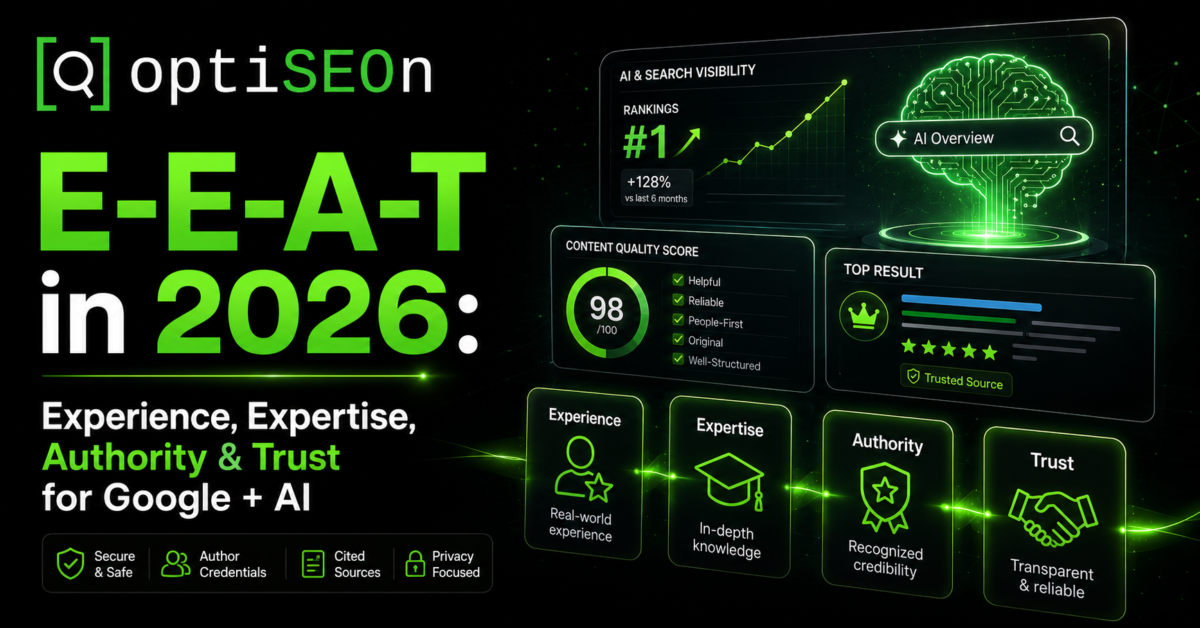
If you’ve spent any time reading SEO advice in 2026, you’ve run into four letters that seem to explain everything: E-E-A-T. It shows up in every ranking-factors guide, every AI search strategy, every Google update explanation. Most of the time it’s presented as a mystical checklist, or worse, as a “signal” you can just optimize for the way you’d optimize a title tag.
Here’s what we’ve learned from auditing hundreds of business websites at OptiSEOn: E-E-A-T isn’t a ranking factor. It’s a framework Google’s quality raters use to evaluate whether a site is good. But that distinction matters less than it used to, because in 2026, the same signals that satisfy human quality raters also determine which sites get pulled into Google AI Overviews, cited by Perplexity, and recommended by ChatGPT.
E-E-A-T is where SEO, AEO, and LLM Optimization all meet. Here’s the honest, practical version.
TL;DR — E-E-A-T in one paragraph
E-E-A-T stands for Experience, Expertise, Authoritativeness, and Trust — a quality framework from Google’s Search Quality Rater Guidelines. “Experience” was added in December 2022 (it used to be E-A-T). Google doesn’t measure it directly, but its algorithms are trained to reward signals that correlate with high E-E-A-T. In 2026, AI engines (ChatGPT, Perplexity, Gemini) also weight these signals when selecting sources to cite. Signaling E-E-A-T means demonstrable first-hand experience, credentialed authors, editorial reputation, and site-wide trust markers — not badge-collecting or keyword stuffing.
Where E-E-A-T actually comes from
E-E-A-T originates in Google’s Search Quality Rater Guidelines — a public document (currently 180+ pages) Google gives to the thousands of human contractors who evaluate search result quality. Those raters don’t directly change rankings. Their evaluations train Google’s ranking algorithms indirectly, by telling engineers whether the algorithm is currently returning “good” or “bad” results.
The “E-A-T” acronym existed for years. In December 2022, Google added a second “E” for Experience, recognizing that first-hand experience with a topic often matters as much as formal expertise. A guide to hiking Colorado’s fourteeners written by someone who’s actually climbed 40 of them signals something different than the same guide written by someone who read Wikipedia.
The four components:
- Experience — Direct, first-hand experience with the topic. Have you actually done the thing you’re writing about?
- Expertise — Formal or informal skill and knowledge. Do you know what you’re talking about?
- Authoritativeness — Recognition by others in your field. Are you a known source?
- Trustworthiness — Accuracy, honesty, safety, reliability. Can readers rely on your information?
Trust is treated as the most important of the four in Google’s own documentation. Without trust, the other three don’t matter.
Why E-E-A-T matters more in 2026 than it did in 2022
Three shifts elevated E-E-A-T from “a nice-to-have SEO consideration” to “the framework that decides whether you show up at all.”
1. AI-generated content flooded the web. Google’s Helpful Content system and the March and June 2026 spam updates hit sites producing scaled, low-value content — much of it AI-generated. Whether Google can perfectly detect AI content is beside the point; it can detect content that doesn’t demonstrate expertise, experience, or authority, and it demotes those pages regardless of how they were produced.
2. AI engines cite E-E-A-T-signaling sites disproportionately. When ChatGPT or Perplexity generates an answer, it doesn’t cite random sources — it cites sources it “trusts.” That trust is trained partly from the same signals Google’s raters look for: author expertise, editorial reputation, third-party citations, credibility markers. Our post on how to get cited by ChatGPT, Perplexity & Gemini goes deep on this — E-E-A-T is the underlying reason those tactics work.
3. Google’s YMYL (Your Money or Your Life) topics have expanded. Health, finance, and legal content have always had higher E-E-A-T thresholds. In 2026, that bar effectively applies to any topic where bad advice could cause real harm — and AI engines apply an even stricter version of it.
How to signal Experience (the “E” most sites skip)
Experience is the newest and most under-implemented element. Signals:
- First-hand accounts. “We audited 200 websites and found…” beats “According to industry data…” every time. Specific, dated, first-person accounts of doing the thing.
- Original photos and screenshots of you actually doing the work, not stock images. In our client audits, we often see sites that could rank better simply by replacing stock photos with real ones from the business.
- Case studies with specifics — real numbers, real client names (where permitted), real timelines, real failures.
- Author bio detail that includes years of experience and specific projects.
The trap: manufactured “experience” reads exactly as fake as it is. If you haven’t done the thing, don’t claim you have — Google’s raters (and AI engines) increasingly detect the difference, and the penalty for getting caught is severe.
How to signal Expertise
Expertise is more traditional and easier to signal:
- Named authors with credentials. Not “the [Company] Team.” Real named humans, with real bios.
- Author schema on author bio pages, connecting the person as a Person entity with sameAs links to LinkedIn, professional profiles, publications. Our 10 schema markup types for 2026 covers Person schema in detail.
- Formal credentials where relevant — degrees, certifications, licenses. For YMYL topics, these matter significantly.
- Depth of content. Expert writing is longer, more nuanced, and includes the caveats a novice wouldn’t know to add.
- Publications and press appearances. If you’ve been quoted in industry publications, referenced on other sites, or spoken at conferences, list them.
For agencies and consultants: your team page is one of your highest-leverage SEO assets. Named consultants with detailed bios, LinkedIn links, and portfolio work outperform anonymous team pages by significant margins in both rankings and AI citation rates.
How to signal Authoritativeness
Authority is external — you can’t grant it to yourself. Signals:
- Backlinks from authoritative sites in your field. More on this in our post on link building in 2026 (July 14).
- Brand mentions across the web — including unlinked mentions. Google’s algorithms increasingly parse brand entity signals across the web, not just links.
- Third-party reviews and ratings. Trustpilot, G2, Capterra, industry-specific review sites.
- Wikipedia and Wikidata presence where you qualify. This is the strongest single entity signal on the web.
- Speaking engagements, guest posts, podcast appearances — earned media that positions you as an authority.
- Consistent citations by others in your space — being referenced by other content, not just referencing others.
Authority builds slowly and compounds. Two years of consistent activity outperforms two months of aggressive campaigning, every time.
How to signal Trustworthiness
Trust is the foundation. Without it, the other three don’t rescue you. Signals:
- Accurate, dated information. Publish dates and last-updated dates visible on every article.
- Corrections when you get things wrong — visibly acknowledged, not silently edited.
- Clear contact information. A physical address (yes, even for online businesses), a phone number, a real email address.
- HTTPS across the entire site — table stakes.
- Clear privacy policy, terms of service, and refund policy where applicable.
- Ownership transparency. Who owns the site? Who are the authors? What’s the editorial policy?
- No deceptive design patterns — no fake countdowns, no fake reviews, no clickbait headlines that don’t match content.
At OptiSEOn we frequently audit sites that fail on trust signals for the simplest reasons: missing About page, no author bios, no physical address. These are fifteen-minute fixes that meaningfully move quality-signal detection.
How Google actually evaluates E-E-A-T
A common misconception is that Google has an “E-E-A-T score” it applies to pages. It doesn’t — E-E-A-T is a framework for human raters, not an algorithm. What Google’s algorithms actually do is approximate E-E-A-T by looking at hundreds of correlated signals:
- Author information density and consistency
- Entity signals (schema, brand mentions, Wikipedia presence)
- Backlink quality and pattern
- Content depth and originality
- Site-wide trust markers (contact info, HTTPS, policies)
- Historical accuracy patterns
- User engagement signals
- Third-party review data
You can’t directly “optimize for E-E-A-T” — but you can optimize for the signals that correlate with it. That’s what actually moves rankings and AI citations.
E-E-A-T for AI engines specifically
Here’s what most SEO articles miss: AI engines like ChatGPT, Perplexity, and Gemini apply their own version of E-E-A-T when selecting citations. They favor:
- Named authors over anonymous content
- Dated content over undated content (Perplexity especially — recent updates get preference)
- Sites with strong entity signals — real businesses, real teams, real presence
- Content that cites its own sources — meta-citation is a trust signal
- Editorial reputation — sites known for accuracy get cited more often
We covered the mechanics in how to get cited by ChatGPT, Perplexity & Gemini — E-E-A-T is the underlying quality framework those tactics express.
The 90-day E-E-A-T improvement plan for a typical business site
Based on the audits OptiSEOn runs for Dallas-area and national clients, most sites can meaningfully raise their E-E-A-T signaling in 90 days without a rewrite. The priority order:
Days 1–30 — Trust foundation:
- Add a real About page with named team members, credentials, physical address, and story
- Add author bios to every article page
- Publish visible publish dates and last-updated dates
- Verify HTTPS, privacy policy, terms of service are current
Days 31–60 — Expertise signals:
- Add Person schema to author pages, with sameAs links to LinkedIn and professional profiles (see our schema guide)
- Rewrite the top 10 traffic pages with clearer named-author attribution and specific expertise markers
- Add editorial policy page describing how content is created, reviewed, and updated
Days 61–90 — Authority and experience:
- Publish 1–2 original research pieces or case studies with specific data
- Begin earning external mentions — podcast appearances, guest posts, quoted commentary
- Update Wikipedia and Wikidata presence if you qualify
- Refresh top content with first-person experience markers where truthful
We integrate this work with the broader SEO, AEO, and LLM Optimization our clients pay for — because E-E-A-T signaling is the connective tissue that makes each individual tactic work.
Frequently Asked Questions
Is E-E-A-T a Google ranking factor? No, not directly. E-E-A-T is a framework used by Google’s human quality raters to evaluate search results. Google’s algorithms are trained to reward signals that correlate with high E-E-A-T. So while E-E-A-T isn’t a “ranking factor” in the traditional sense, the signals it describes very much affect rankings.
What does the extra “E” in E-E-A-T stand for? Experience. Google added it in December 2022 to recognize that first-hand experience with a topic often matters as much as formal expertise. The previous framework was E-A-T (Expertise, Authoritativeness, Trustworthiness).
Which E-E-A-T component is most important? Trust. Google’s own documentation identifies Trustworthiness as the most important of the four. Without trust, the other three components don’t help — a site with impressive-looking expertise but no trust markers still fails E-E-A-T evaluation.
Do AI engines like ChatGPT use E-E-A-T? Not by that name, but yes — they apply similar underlying signals. AI engines favor named authors, dated content, sites with strong entity signals, and content with clear editorial reputation. The tactics that improve E-E-A-T for Google also improve AI citation rates.
Can AI-generated content have good E-E-A-T? Potentially, if it demonstrates real expertise and is reviewed by credible humans. Google has explicitly said AI use isn’t automatically penalized as long as content meets quality standards, including E-E-A-T. What gets penalized is thin, scaled AI content produced primarily to rank rather than to help users.
How long does it take to improve E-E-A-T signals? Foundational trust markers (About page, author bios, dated content, contact info) can be added in 30 days. Building genuine authority — external mentions, entity signals, editorial reputation — takes 6–12 months minimum. Trust compounds. There is no shortcut.
Want an honest E-E-A-T audit of your site — with a prioritized fix list? OptiSEOn audits sites for the specific signals that correlate with quality-rater outcomes and AI citation eligibility. Book a free audit — we’re based in Dallas, we’ve done this for hundreds of businesses, and we won’t sell you a badge you don’t need.
Leave a Reply