Every year, someone declares link building dead. Every year, someone launches a new “revolutionary” link building service that will “guarantee” 50 backlinks a month. Every year, sites get hit with algorithmic devaluations, spam actions, or manual penalties, and their owners wonder what happened.
Here’s what’s actually true in July 2026: link building still works. Cheap, manipulated link building has never worked worse. The gap between the two has never been wider.
Google’s spam enforcement in the past 18 months has been the most aggressive in the platform’s history. Four broad ranking incidents in the first 13 weeks of 2026. SpamBrain 3.0 evaluating link patterns rather than individual links. The June 2026 spam update targeting scaled, templated content — which included a lot of what “link building services” have been quietly relabeling as “content marketing.”
Here’s the honest playbook for what earns rankings in 2026 versus what quietly tanks them.
TL;DR — Link building in one paragraph
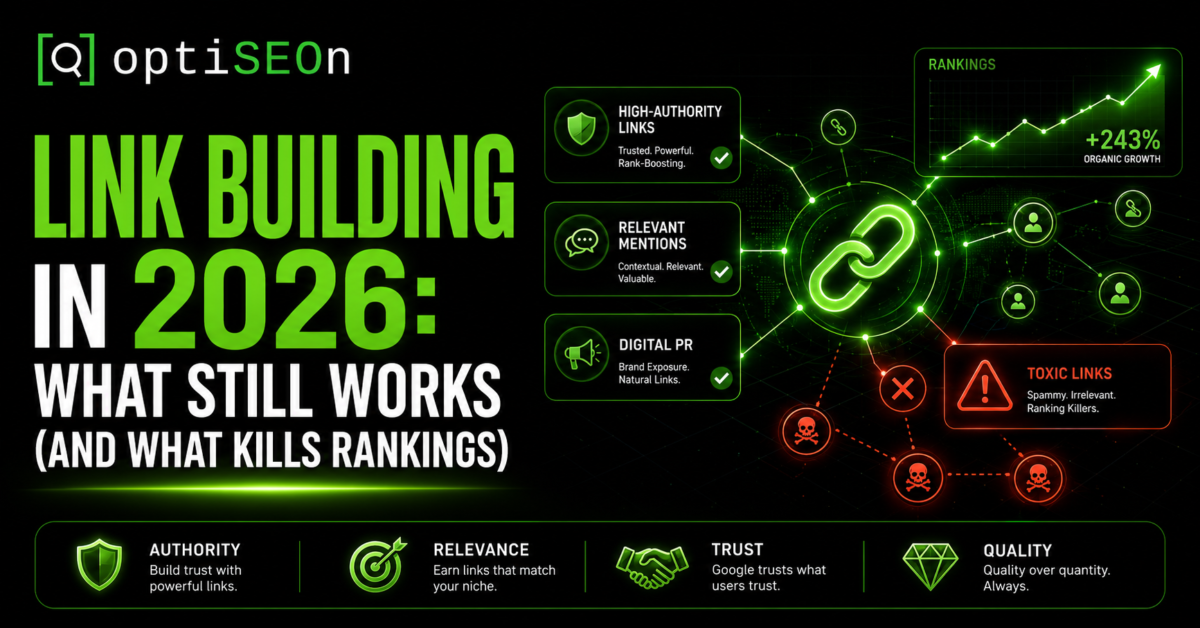
Backlinks remain a top-3 Google ranking signal in 2026, but Google’s SpamBrain now evaluates link patterns across your entire profile — not individual links. Manipulated or purchased links get algorithmically neutralized (they still exist, they just pass zero authority) or in worse cases trigger site-wide devaluation. What still works: digital PR, original data-driven content that earns editorial links, broken link building on high-authority resource pages, HARO/Qwoted expert quotes, podcast appearances, and long-term community credibility. What doesn’t: mass guest posting, private blog networks (PBNs), paid links, link exchanges, and any “guaranteed X links per month” service.
Why link building isn’t dead in 2026
Google’s own documentation confirms links remain a primary ranking signal in 2026. What’s changed isn’t the importance of links; it’s how they’re evaluated.
Three shifts define the 2026 landscape:
1. SpamBrain 3.0 evaluates link patterns, not individual links. Google’s AI spam-detection system now looks at your link profile — how links behave together, over time, across referring domains. Sudden bursts of similar-looking links from mediocre domains? Flagged. All-exact-match anchor text? Flagged. Links from sites that also link to spam sites? Flagged.
2. Enforcement is now near-real-time. The August 2025 spam update rollout showed algorithmic devaluation happening within minutes of link pattern detection, not months. Sites that once could get away with manipulation for a quarter before consequences hit now see effects immediately.
3. AI-era links matter more, not less. AI engines (ChatGPT, Perplexity, Gemini) increasingly cite content that Google trusts. Backlinks feed the underlying trust signal that determines which content gets pulled into AI answers. In practical terms: strong backlink profiles now drive both organic rankings and AI citation rates. Bad backlink profiles hurt both.
The businesses winning organic search in 2026 aren’t the ones with the most backlinks — they’re the ones with the most credible backlinks earned through real value creation.
What actually works in 2026 (the seven tactics)
Ranked roughly by effort-to-return ratio:
1. Original research and data-driven content. The single highest-ROI link acquisition tactic in 2026. Publish something with proprietary data — a survey, an analysis of a public dataset, industry benchmarks — and journalists, bloggers, and industry publications link to it because you’re the primary source. One well-researched study can earn hundreds of editorial backlinks over its lifetime.
We’ve watched Dallas SaaS clients earn 40+ referring domains from a single benchmark study. The study has to be genuinely useful and methodologically sound — inflated survey pieces get called out publicly, which is worse than not publishing.
2. Digital PR. Pitching stories, angles, and expert commentary to journalists and publishers. Real PR — the kind PR agencies charge real money for — earns editorial links from high-authority publications that individual guest posting can’t touch. Tools like Muck Rack help identify journalists covering your beat.
The catch: digital PR requires actually having something newsworthy to say. Recycled “5 tips” pitches get ignored.
3. HARO, Qwoted, and expert quote platforms. Journalists post queries; you respond with a quote if you’re qualified. When they use your quote, you get an editorial mention (often linked) in a high-authority publication. This scales well for busy experts and consistently produces high-DR links over time.
Response quality matters — thoughtful, quotable expert responses get used far more often than generic promotional pitches.
4. Podcast appearances and speaking engagements. Every podcast appearance typically earns a show notes page with a link to your site or LinkedIn. Every conference speaking slot earns a speaker page. These build sitewide authority signals and often lead to secondary press coverage. Also excellent for E-E-A-T signaling, which we covered in our E-E-A-T guide.
5. Broken link building. Find broken links on authoritative resource pages in your niche; suggest your content as the replacement. Response rates are low (5-15% is typical) but link quality is high, and it scales well because the outreach angle is genuinely useful to the site owner (they want to fix broken links).
6. Resource page inclusion. Many industry sites maintain curated resource pages. Getting included is often just a matter of politely asking, if your content is genuinely worth including. Not spammy if approached correctly.
7. Community credibility and inbound requests. The slowest-compounding but most durable tactic. Being consistently visible and helpful in your industry — through Reddit (see our June post on Reddit for AI citations), LinkedIn, Twitter/X, industry newsletters — generates inbound link requests. Journalists reach out to you. Podcasters invite you on. Bloggers reference your work without needing to be pitched.
This is the moat. Six months in, it looks like nothing is happening. Two years in, competitors can’t touch you.
What doesn’t work (and often tanks rankings)
The tactics that have moved from “risky” to “actively harmful” in 2026:
- Mass guest posting on low-quality sites. SpamBrain identifies this pattern reliably. Neutralizes the links at minimum, devalues the entire referring domain in worse cases.
- Private Blog Networks (PBNs). Detection is essentially automatic in 2026. Sites relying on PBNs are being caught within days of pattern emergence, not months.
- Paid links (any format). Direct violation of Google’s Webmaster Guidelines. Detection has improved with SpamBrain 3.0. The upside is short-term; the downside is severe.
- Link exchanges at scale. “You link to me, I link to you” reciprocal networks are pattern-detectable and get neutralized.
- Comment link farming. Zero value in 2026. Everyone using this tactic gets the same lift (which is none).
- Any service promising “X links per month, guaranteed.” No legitimate operator can guarantee earned links because you can’t force a publisher to link to you. If they’re guaranteeing quantity, they’re using tactics that get detected.
- Directory submissions in bulk. A handful of high-quality, industry-specific directories can be fine. Bulk submissions to generic directories are ignored at best, flagged at worst.
The single best diagnostic question when evaluating a link-building tactic: “Would this link exist if search engines didn’t exist?” If no, it’s likely to be neutralized or penalized. If yes, it’s probably legitimate.
How to audit your existing backlink profile
Before building new links, audit what you have. Signs of a healthy profile:
- Referring domains growing steadily over time (no sudden spikes without a corresponding event)
- Anchor text diversity — mostly branded and URL anchors, with organic keyword variations mixed in
- Referring domains from your topical space, not random unrelated sites
- A mix of DR levels — a healthy profile has some high-DR editorial links, plenty of mid-DR industry references, and normal levels of low-quality background noise
- Consistent linking sites (relationships that produce multiple links over time)
Warning signs:
- Anchor text over-optimization (too many exact-match commercial anchors)
- Sudden spikes of referring domains without a corresponding content or news event
- High concentration of referring domains from a single IP range or hosting network (PBN signature)
- Links from sites in unrelated languages or topics
- Referring sites that also link to obvious spam
If you find toxic links, the disavow tool is still the appropriate response — but use it sparingly. Google explicitly recommends against disavowing links unless you have a manual action or reasonable suspicion of manipulation.
How E-E-A-T connects to link building
This is the connective piece most link-building articles miss: the reason quality links move rankings is that they signal E-E-A-T — specifically the Authoritativeness component. A link from The New York Times isn’t just “a high-DR link”; it’s an editorial endorsement from an authoritative publisher that a real editor decided your content was worth referencing.
That’s why the tactics that work in 2026 all share a common feature: they produce links that a real human decided to give you, in a real editorial context. Anything else looks like manipulation because it is manipulation, however creatively packaged.
We covered the full E-E-A-T framework in our E-E-A-T guide — link building is one of the primary tactics for signaling Authoritativeness specifically.
A realistic 90-day link-building sprint
For a mid-size business starting from an underdeveloped backlink profile:
Days 1–30 — Foundation:
- Audit existing backlink profile with Ahrefs, Semrush, or Moz
- Identify and disavow toxic links (only if clearly manipulative)
- Sign up for HARO, Qwoted, and Featured (respond 2-3x weekly)
- Plan an original research or benchmark study
Days 31–60 — Content and outreach:
- Publish original research
- Begin digital PR outreach to journalists in your beat
- Identify 20-30 broken-link opportunities on relevant resource pages
- Pitch 3-5 podcasts appropriate to your expertise
Days 61–90 — Compounding:
- Follow up on outreach that didn’t convert
- Convert podcast appearances into repurposed content
- Continue HARO/Qwoted responses
- Begin planning next research or data piece
This produces 10-30 quality referring domains for most B2B businesses in 90 days. That doesn’t sound like much until you compare it to the 500 spammy links your competitor bought — which now pass zero authority and may have flagged their site for algorithmic devaluation.
Link building integrates with the broader work covered in our 2026 SEO ranking factors post and, for eCommerce specifically, our eCommerce SEO playbook publishing July 28.
How OptiSEOn approaches link building
For every OptiSEOn client, link building is part of the monthly retainer — but we don’t sell “X links per month.” We sell earned authority. That means original research support, digital PR outreach, HARO management, and long-term community credibility building. If a client’s biggest current gap is links, we prioritize accordingly. If they need technical fixes or content first (which is usually the case), we do that work before pouring effort into outreach for a site that couldn’t yet convert the traffic.
Our SEO service page covers the specifics.
Frequently Asked Questions
Are backlinks still a Google ranking factor in 2026? Yes. Google’s own documentation and the underlying algorithm data both confirm backlinks remain a top-3 ranking signal in 2026. What’s changed is how Google evaluates them — SpamBrain 3.0 now looks at link patterns across your profile rather than individual links.
Can you buy backlinks safely in 2026? No. Buying links violates Google’s Webmaster Guidelines and detection has improved sharply with SpamBrain 3.0. The short-term upside is minimal; the long-term downside — algorithmic devaluation, manual penalties, months-long recovery — is severe.
How long does link building take to affect rankings? Individual links can start passing authority within days of being crawled. Meaningful ranking movement from a link-building campaign typically requires 3–6 months of consistent earning of quality links, because Google evaluates patterns over time rather than single events.
Is guest posting still worth doing in 2026? Selective guest posting on high-quality, industry-relevant publications with real traffic still works. Mass guest posting on generic sites doesn’t — the pattern is detected reliably by SpamBrain and links are neutralized. The bar for what qualifies as a “worthwhile” guest post has risen sharply.
What’s the safest link-building tactic? Original research and data-driven content. When you’re the primary source, other publishers link to you because it’s the natural editorial choice — there’s no manipulation involved. This tactic is also the highest-leverage: a single well-crafted study can earn hundreds of editorial backlinks over its lifetime.
Do nofollow links count for anything? Yes, indirectly. Google treats nofollow, sponsored, and UGC attributes as hints in 2026, meaning they influence but don’t guarantee link processing. Nofollow links from authoritative sites still drive referral traffic, brand visibility, and entity signals — all of which support rankings and AI citations.
Want an honest backlink audit for your site — including which of your current links are actively hurting you? OptiSEOn is a Dallas-based SEO agency that has audited hundreds of backlink profiles. Book a free audit. We’ll show you your current profile, identify toxic links to disavow, and outline a 90-day earned-link plan — no guaranteed-link promises.
Leave a Reply