
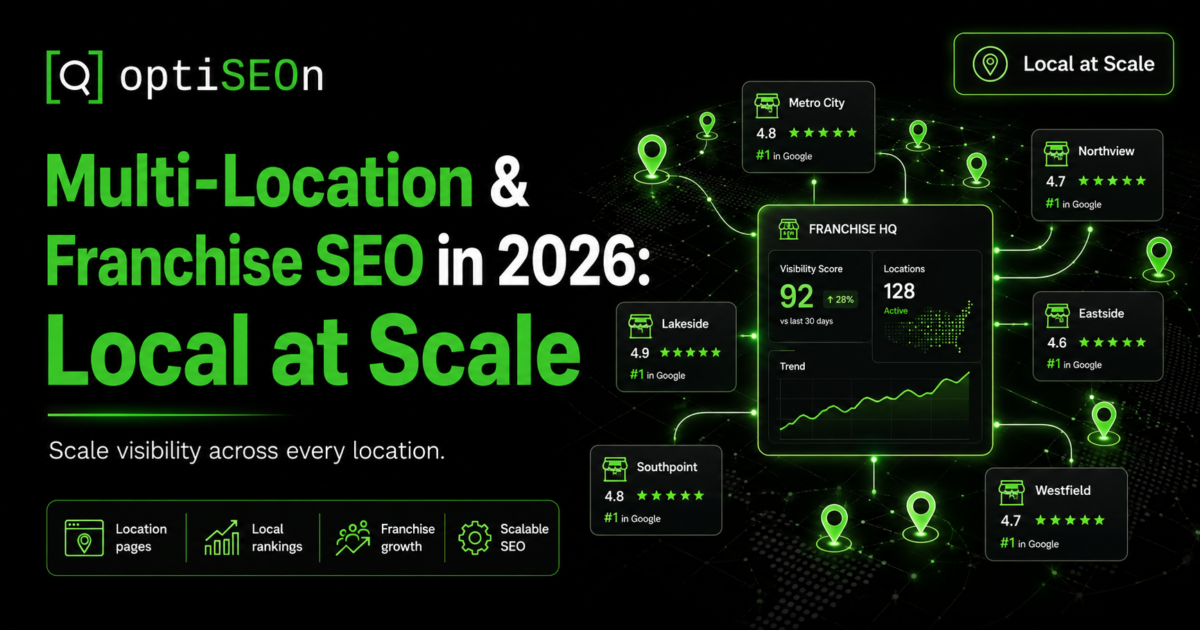
Ranking a single business in a single market is a solved problem — we walked through it in our Dallas local SEO playbook and our complete Google Business Profile guide. Ranking five locations, or fifty, or a five-hundred-unit franchise system, is a fundamentally different problem — and most of the tactics that work for one location actively backfire at scale.
The core tension is this: every location needs its own genuinely unique, locally-relevant web presence, but you’re producing those presences from a shared template, a shared brand, and often a shared content team. Do it lazily and you generate hundreds of near-duplicate pages that Google treats as doorway spam — a category the June 2026 spam update specifically reinforced enforcement against. Do it well and you build a compounding local moat competitors can’t touch.
Here’s the 2026 playbook for local SEO at scale.
TL;DR
Multi-location and franchise SEO means earning local visibility for every location while avoiding the duplicate-content and doorway-page penalties that come from templated pages at scale. The five pillars: a separate, fully-optimized Google Business Profile per location; genuinely unique location landing pages (not templated clones); a clean URL and internal-linking architecture; consistent NAP across every location and directory; and a governance model that balances brand-level control with local-level authenticity. Proximity is the dominant local ranking factor, so the goal is to maximize every other signal for each location.
→ Book a free multi-location SEO audit
What is multi-location SEO?
Multi-location SEO is the practice of optimizing a business with more than one physical location so each one ranks in its own local market — in the Google Map Pack, local organic results, and AI answers — while the brand maintains consistency and avoids self-competition. It applies to chains, franchises, multi-office professional practices, and any business serving several distinct geographic markets.
The discipline differs from single-location local SEO in three ways: you manage many Google Business Profiles instead of one, you produce location pages at scale (where duplication risk lives), and you have to prevent your own locations from cannibalizing each other in search.
Why can’t I just copy my best location page for every location?
Because near-identical location pages — same content with only the city name swapped — are classic doorway pages, which Google demotes and, since the June 2026 spam update, enforces against more aggressively. Duplicate content across your own locations also splits ranking signals and can cause Google to filter all but one of the pages out of results entirely.
This is the single most common and most damaging mistake in multi-location SEO. A 40-location business with 40 templated “Plumbing Services in [City]” pages hasn’t built 40 assets — it’s built one asset duplicated 40 times, and Google treats it accordingly. The fix isn’t more pages; it’s more genuinely different pages.
Pillar 1: One optimized Google Business Profile per location
Every physical location needs its own separate, fully-verified Google Business Profile — this is the largest ranking lever in multi-location SEO, because the Map Pack drives the majority of local clicks. Managing them at scale requires the Business Profile Manager and, past roughly 10 locations, often bulk verification.
At scale, the priorities from our GBP guide still apply per location, plus:
- Consistent-but-localized profiles. Same brand, same categories, but genuinely local photos, local posts, and location-specific attributes. Stock-photo-cloned profiles underperform — real local photos drive meaningfully more direction requests and calls.
- Correct primary category per location, identical across locations unless services genuinely differ.
- Local phone numbers where possible — a local number outperforms a central toll-free line for local ranking signal.
- Bulk management via the Business Profile Manager, with location groups and, for franchises, careful ownership/permission structures so franchisees and the brand both have appropriate access.
- Review acquisition and response per location — reviews are location-specific ranking and conversion signals, so a central “corporate” review strategy has to be executed location by location.
Pillar 2: Genuinely unique location landing pages
Each location needs one dedicated landing page with content that’s actually specific to that location — local team, local reviews, local service nuances, directions, area-specific information — not a template with the city name find-and-replaced. This is where multi-location SEO is won or lost.
What makes a location page genuinely unique:
- Local staff and management — real names, real photos of that location’s team
- Location-specific reviews and testimonials from customers in that market
- Area-specific service details — what’s different about serving this neighborhood, climate, regulation, or market
- Genuine local content — nearby landmarks, parking, transit, service radius, local partnerships
- Embedded map and location-specific NAP
- Location-specific schema — LocalBusiness schema with that location’s exact data (generate it per page with our free schema markup generator)
The practical test: if you could swap two of your location pages’ city names and nobody would notice the difference, they’re not unique enough. Every page should contain information that could only be about that location.
For franchises, this creates a governance question — how much do you let franchisees write themselves versus centrally produce? The answer that works: central team produces the brand-consistent skeleton and SEO structure; local input supplies the genuinely local details that can’t be faked from headquarters.
Pillar 3: URL architecture and internal linking
Use a consistent, logical URL structure for locations — typically /locations/city-name or /city-name/service — with a central locations hub page linking to every location, and each location page linking to its relevant services. Clean architecture helps Google understand the relationship between your locations and prevents authority from leaking.
The standard patterns:
- Store locator / locations hub at /locations/ linking to every location page — this is the distribution point for internal link equity
- Consistent location URLs — pick one pattern and never deviate
- Location-to-service internal links connecting each location to the services offered there
- Breadcrumb navigation with BreadcrumbList schema showing the location hierarchy
For very large systems (hundreds of locations), a well-structured store locator with proper internal linking and an accurate XML sitemap is what makes the whole system crawlable and indexable.
Pillar 4: NAP consistency across everything
Name, address, and phone number for every location must be identical across your website, every Google Business Profile, and every directory citation — even minor variations like “Suite 100” versus “Ste 100” can suppress local rankings. At scale, this requires a single source of truth and disciplined citation management.
The multi-location NAP challenge is combinatorial: 50 locations across 40 directories is 2,000 listings, each of which can drift. The solution:
- Maintain a master location data sheet as the single source of truth
- Use consistent formatting for every field, everywhere
- Audit citations regularly — listings drift as directories update, businesses move, and phone numbers change
- Prioritize the citations that matter — Google Business Profile, Apple Business Connect, Bing Places, the major data aggregators, and industry-specific directories, rather than chasing hundreds of low-value listings
OptiSEOn’s citation and authority building handles this at scale, which removes most of the manual burden for larger systems.
Pillar 5: Governance — brand control vs. local authenticity
Multi-location SEO needs a governance model that keeps brand and SEO consistency at the center while allowing enough local input to make each location’s presence genuinely authentic. Too much central control produces sterile, templated pages; too little produces inconsistent, off-brand, and sometimes non-compliant local pages.
The model that works for most systems:
- Central team owns: brand standards, SEO structure, technical foundation, schema, primary categories, URL architecture, and the location-page skeleton
- Local/franchisee input supplies: local photos, staff details, local reviews, market-specific service notes, community involvement, and local posts
- Shared discipline: NAP consistency, review response standards, and posting cadence, enforced centrally but executed locally
For franchises specifically, this also means deciding how franchisee-generated content is reviewed before it goes live — a light approval workflow prevents both SEO mistakes and brand-safety problems.
How multi-location businesses show up in AI search
Multi-location businesses have a specific AI-search dynamic: when someone asks ChatGPT or Perplexity for “a [business type] near [neighborhood],” the AI pulls from local signals, directory data, and review platforms. The work above — accurate per-location GBP, consistent NAP, genuine location pages, location schema — is exactly what feeds those AI answers. The general framework is in how to get cited by ChatGPT, Perplexity & Gemini; for multi-location brands, it’s applied per market.
Keep every location’s information current, too — stale hours, old addresses, and outdated data hurt both local rankings and AI accuracy. That’s part of why an ongoing content and data refresh discipline matters at scale.
A realistic rollout for a multi-location system
Weeks 1–4: Conduct an audit of all existing Google Business Profiles (GBPs) and citations. Create a comprehensive master location data sheet, resolve any Name, Address, and Phone number (NAP) inconsistencies, and claim or verify any unclaimed profiles.
Weeks 5–8: Develop or revamp the locations hub and URL structure. Implement location schema and start transforming templated location pages into unique pages, prioritizing the highest-traffic markets.
Weeks 9–12: Launch a review acquisition strategy for each location and establish a posting schedule. Finalize the uniqueness of each location page and begin tracking movement in the Map Pack for each market.
Ongoing: Maintain governance, manage citations, oversee reviews, and conduct quarterly data refreshes.
How OptiSEOn approaches multi-location & franchise SEO
We handle multi-location and franchise systems as Geographic SEO engagements with citation and authority building built in — master data management, per-location GBP optimization, unique location-page production, citation consistency at scale, and a governance model that fits how your brand and locations actually work together. We’re Dallas-based and work with local, regional, and national multi-location brands.
Frequently Asked Questions
How do I rank multiple business locations on Google?
Create a separate, fully-optimized Google Business Profile for each location, build a genuinely unique landing page per location (not templated clones), maintain identical NAP across all listings, and use a clean URL structure with a central locations hub. Proximity dominates local ranking, so the goal is maximizing every other signal per location.
Will duplicate location pages hurt my SEO?
Yes. Near-identical location pages — the same content with only the city name changed — are treated as doorway pages, which Google demotes and, since the June 2026 spam update, enforces against more aggressively. Duplicate content also splits ranking signals across your own pages. Each location page needs genuinely unique, locally-specific content.
How many Google Business Profiles can one business have?
One per genuine physical location. A business with 20 real locations should have 20 profiles, managed through the Business Profile Manager. Creating multiple profiles for a single location, or profiles for locations without a real physical presence, violates Google’s guidelines and risks suspension of all of them.
What’s the best URL structure for multi-location SEO?
A consistent, logical pattern — commonly /locations/city-name or /city-name/service-name — with a central /locations/ hub page linking to every location, and each location page linking to its relevant services. Consistency matters more than the exact pattern; pick one and apply it everywhere.
How is franchise SEO different from multi-location SEO?
The mechanics are the same, but franchises add a governance layer: multiple owners (franchisees) with a shared brand. The challenge is balancing central brand and SEO control against local authenticity and franchisee input, plus a light content-approval workflow to prevent SEO mistakes and brand-safety issues at the local level.
How long does multi-location SEO take to work?
Individual locations often see Map Pack movement within 30–60 days of GBP and citation fixes, similar to single-location timelines. But rolling the work across all locations and rebuilding templated pages into unique ones is a 3–6 month program for most systems, longer for very large franchise networks.
Running SEO across multiple locations or a franchise system? Book a free multi-location audit. OptiSEOn is a Dallas-based SEO, AEO, GEO, and LLM optimization agency — we’ll assess your per-location visibility, flag duplicate-content risk, and show you where the biggest local wins are hiding.
Leave a Reply