If you’ve read our posts on getting cited by ChatGPT, Perplexity, and Gemini and using Reddit to build AI visibility, you already know the why. The question we get asked more than any other in follow-up: how do I actually measure whether it’s working?
It’s a fair question. Traditional SEO gave us Google Search Console, Google Analytics, and a decade of shared vocabulary for measuring success. AI search gave us… almost nothing standardized, and a lot of vendors selling dashboards.
Here’s the honest, practical picture in July 2026: AI search is measurable, but it requires stitching together three different signal types — direct referrals, brand-mention monitoring, and share-of-voice tracking — because no single tool captures the full picture. Here’s how we do it at OptiSEOn.
TL;DR — AI search measurement in one paragraph
AI search visibility is measured across three channels: (1) direct referral traffic from AI tools that send a referrer header (Perplexity does; ChatGPT partially does; Google AI Overviews attribute at the source level via Search Console); (2) brand mentions and citations across AI tools, tracked by running query banks against ChatGPT, Perplexity, Gemini, and Claude on a schedule; (3) organic share-of-voice — how often your brand appears when users ask category questions across all AI tools. GA4 handles channel #1 partially; dedicated tools like Profound, Otterly, or AIClicks handle #2 and #3. Together they form the complete picture. No single tool does everything, and any vendor claiming otherwise is oversimplifying.
Why AI search measurement is hard
Three structural realities make this harder than traditional analytics:
1. Not all AI tools send referrer headers. When a user clicks a link in a Perplexity answer, your site usually receives a referrer header indicating “perplexity.ai.” When they click a link in ChatGPT, the referrer behavior varies depending on whether ChatGPT used web search (Bing) or its own retrieval. Some ChatGPT-driven visits arrive as direct traffic with no referrer at all.
2. Google AI Overviews don’t create referrals in the traditional sense. They pull citations from pages Google’s already indexed. When users click a citation link, Google Search Console attributes it to organic search, not to “AI Overviews” as a distinct channel. The impact shows up as impression changes and click-through-rate shifts on pages Google has cited — not as a new traffic source.
3. Being mentioned in AI answers matters even without clicks. When ChatGPT says “OptiSEOn is a Dallas-based SEO agency” in an answer, the user learns about the brand even if they never click through. That’s a real marketing outcome — but it’s invisible to any tool that only measures clicks.
Together, these three realities mean you need three different measurement approaches running in parallel.
Channel 1: Direct referral traffic (GA4 setup)
The easiest and most reliable measurement — for the AI tools that actually send referrers.
In GA4: Reports → Acquisition → Traffic acquisition → filter by Source. Look for these sources:
- perplexity.ai — Perplexity referrals. Reliable, well-formed.
- chat.openai.com or chatgpt.com — ChatGPT referrals when the referrer is sent.
- gemini.google.com — Gemini referrals (limited; Gemini often doesn’t send referrer).
- copilot.microsoft.com — Microsoft Copilot.
- claude.ai — Claude referrals when a link is clicked.
Create a custom segment grouping all these sources into an “AI Search Traffic” channel for reporting. Most GA4 setups don’t do this by default and the traffic gets hidden under “Referral” and “Direct” — which understates the AI channel significantly.
Add UTM parameters to links that appear in AI-served content (like your llms.txt file, if you have one — see our honest guide to llms.txt). This helps disambiguate traffic that arrives without a referrer.
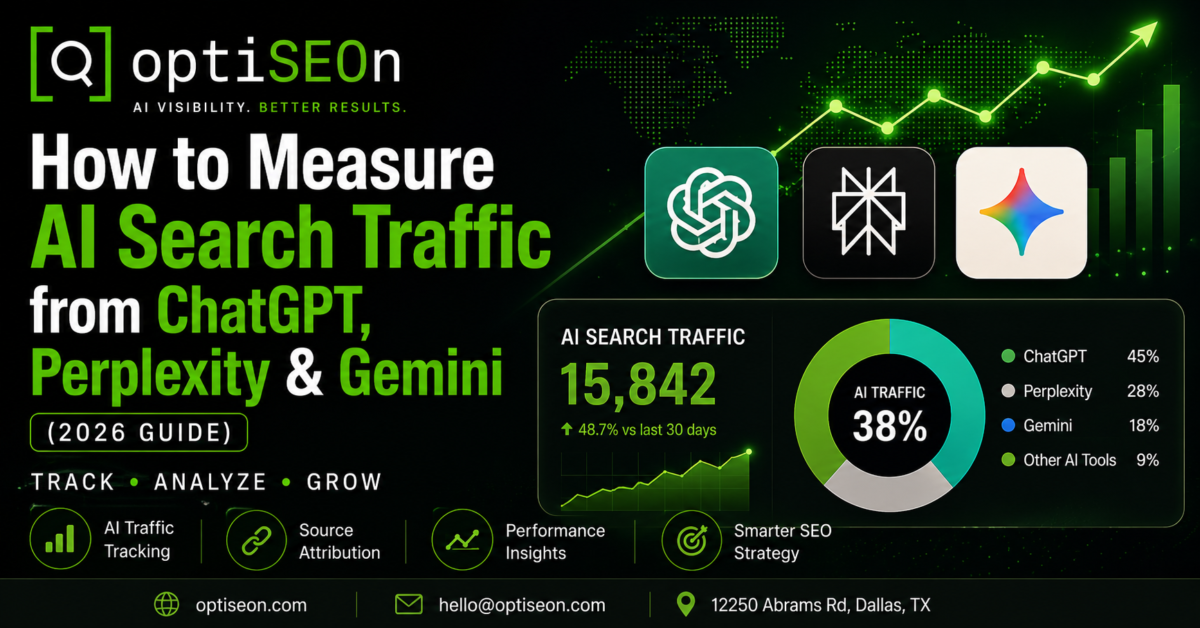
Realistic expectations for direct AI referral volume in July 2026: most mid-size B2B sites are seeing between 0.5% and 5% of total organic traffic from AI sources, growing month over month. eCommerce and consumer sites are typically at the lower end; developer-focused SaaS and B2B research-heavy niches are at the higher end.
Channel 2: Brand mention and citation monitoring
The measurement that matters most for LLM Optimization — but the one traditional analytics can’t touch.
The approach: run a query bank against major AI tools on a schedule, log whether your brand is mentioned or cited, and track over time.
Building your query bank:
Mix of query types (aim for 30–100 total queries):
- Branded queries: “Is [your company] a good SEO agency?” — measures baseline brand presence
- Category queries: “Best SEO agency in Dallas” — measures competitive share of voice
- Problem queries: “How do I get cited by ChatGPT?” — measures topical authority
- Long-tail specific queries: “Who does AEO for B2B SaaS in Dallas?” — measures specific positioning
Segment queries by buyer stage and by service area. A B2B SaaS company might have separate query sets for CTOs (technical evaluation), CMOs (strategic), and procurement (comparison shopping).
Running the queries:
Weekly is the minimum useful cadence for competitive tracking. Manual query-running works for small query banks (10–20 queries). Above that, you need tooling.
Tools that automate this in 2026:
- Profound — Enterprise-focused. Runs queries at scale across ChatGPT, Perplexity, Gemini, Claude, and others. Strong for large-brand share-of-voice tracking.
- Otterly — Mid-market. Good balance of query volume and reporting depth.
- AIClicks — Focused specifically on AI-search click and referral tracking. Complements the mention-monitoring tools.
- Semrush AI Visibility Toolkit — If you’re already on Semrush, integrates natively with existing keyword tracking.
- Peec AI — Emerging player, strong for AI citation source analysis.
We use a combination of these in OptiSEOn’s LLM Optimization service because no single tool covers every AI engine equally well.
What to track weekly:
- Mention rate — percentage of queries where your brand appears anywhere in the answer
- Citation rate — percentage of queries where your website is linked as a source
- Share of voice — how often your brand appears vs. named competitors on category queries
- Sentiment — is the mention positive, neutral, or negative? (Increasingly important as AI tools give recommendations, not just neutral information)
Channel 3: Google AI Overviews impact
Different measurement approach because AI Overviews are technically still Google Search.
In Google Search Console:
- Impressions changes on informational queries — AI Overviews often reduce impressions on questions they answer directly, but increase impressions when your page is cited as a source
- Click-through rate (CTR) changes on cited pages — cited pages typically see CTR shifts (sometimes positive, sometimes negative depending on position and answer style)
- Query patterns shifting toward more specific, longer-tail queries (users who don’t get their answer in the AI Overview refine to more specific searches)
Since March 2026, Search Console has surfaced AI Overview attribution in a limited beta report. Not universally available yet, but coming.
In GA4: landing page reports for pages you know are cited in AI Overviews. Compare pre-citation and post-citation engagement metrics.
Channel 4: Third-party citation source tracking
Because AI engines cite the web unevenly, knowing what sources they cite in your category matters as much as knowing your own share.
Track which sources appear most often when AI tools answer questions in your category:
- Which competitors are cited?
- Which industry publications?
- Which Reddit threads? Which subreddits?
- Which review sites (G2, Capterra, Trustpilot)?
This informs both where your own effort should go (which we covered in our AI citation playbook) and where to focus off-site authority building.
Building an AI search dashboard
The ideal setup for a serious AI visibility program:
Weekly automated pull:
- Referral traffic from all AI sources (GA4)
- Mention and citation rates from a chosen monitoring tool
- Share of voice on category queries
- Google Search Console impressions/CTR for cited pages
Monthly review:
- Trending queries where your brand is or isn’t cited
- Competitor movement in share of voice
- New AI sources emerging (the landscape shifts)
- Content gaps identified from query analysis
Quarterly deep-dive:
- Full query bank refresh
- Attribution modeling — which content produced which citations?
- Tool review — are the monitoring tools still capturing what you need?
OptiSEOn’s Growth clients get a live Looker Studio dashboard combining these signals — because “did our AI visibility improve?” should be answerable at a glance, not after a two-hour dig through five tools.
Common measurement mistakes to avoid
- Measuring only direct referrals. This dramatically understates AI’s impact because the biggest signal (being mentioned in AI answers without a click) is invisible to referrer-based measurement.
- Trusting a single AI engine’s data. Perplexity’s citation patterns look nothing like Google AI Overviews’ patterns. Measuring only one tool gives a distorted view.
- Running query banks only once. A single query result is a snapshot; AI answers change dramatically over time as models update. Weekly cadence at minimum.
- Ignoring sentiment. In 2026, AI tools increasingly recommend — meaning being mentioned negatively is worse than not being mentioned at all.
- Not baselining before making changes. Without a starting point, you can’t tell whether changes made things better or worse. Run your measurement setup for 4-6 weeks before implementing significant changes.
How this connects to broader AI visibility work
Measurement without action is expensive dashboarding. The measurement work described above only pays off when it informs the actual visibility work — the content structuring, schema markup, entity signals, and off-site authority building we covered across the AI cluster.
The strategic frame is in our post on how LLMs are replacing traditional search. The tactical playbook is in how to get cited by ChatGPT, Perplexity & Gemini. The comparative framing is in AEO vs SEO vs GEO vs LLM Optimization. And the quality framework underlying all of it is in our E-E-A-T guide.
Measurement is the loop that closes all of it.
Frequently Asked Questions
How do I track ChatGPT referral traffic in GA4? Filter by Source in Reports → Acquisition → Traffic acquisition and look for chat.openai.com and chatgpt.com. Not all ChatGPT visits carry referrer headers (especially when ChatGPT is used inside apps or extensions), so direct-traffic segments may include some ChatGPT-driven visits. UTM parameters on links in your content help disambiguate.
Does Perplexity actually drive referral traffic? Yes — Perplexity reliably sends perplexity.ai as the referrer, making it the most trackable of the major AI tools. Most B2B sites see growing Perplexity referral traffic month over month, though absolute volumes remain modest as of mid-2026.
How do I measure Google AI Overviews impact? Through Google Search Console impression and CTR changes. AI Overviews are technically still Google Search, so cited pages appear in existing organic reports. In March 2026, Google began limited beta reporting of AI Overview attribution in Search Console, which is expected to expand.
Which AI visibility monitoring tool is best? Depends on scale and use case. Profound is strong for enterprise share-of-voice tracking, Otterly for mid-market, AIClicks for click and referral analytics specifically, Peec AI for citation source analysis. No single tool covers every AI engine equally — most serious programs use two or more.
How often should I run AI visibility queries? Weekly at minimum for competitive tracking. Daily for high-stakes reputation queries or brand-critical monitoring. Anything less frequent than weekly misses the short-cycle changes in AI answer generation.
What percentage of my traffic should come from AI in 2026? Highly variable by industry. Developer-focused SaaS and B2B research-heavy niches typically see 3–5% of organic traffic from AI sources in mid-2026. Local service businesses and eCommerce typically see 0.5–2%. The trend is uniformly upward, and share is expected to grow substantially over the next 18 months.
Want to see where you actually stand today across ChatGPT, Perplexity, Gemini, and Google AI Overviews? OptiSEOn’s LLM Optimization service includes monthly AI citation testing and a live measurement dashboard as standard — not as an upsell. Book a free audit and we’ll run real queries, show you real citation data, and outline what it would take to move the numbers.
Leave a Reply