
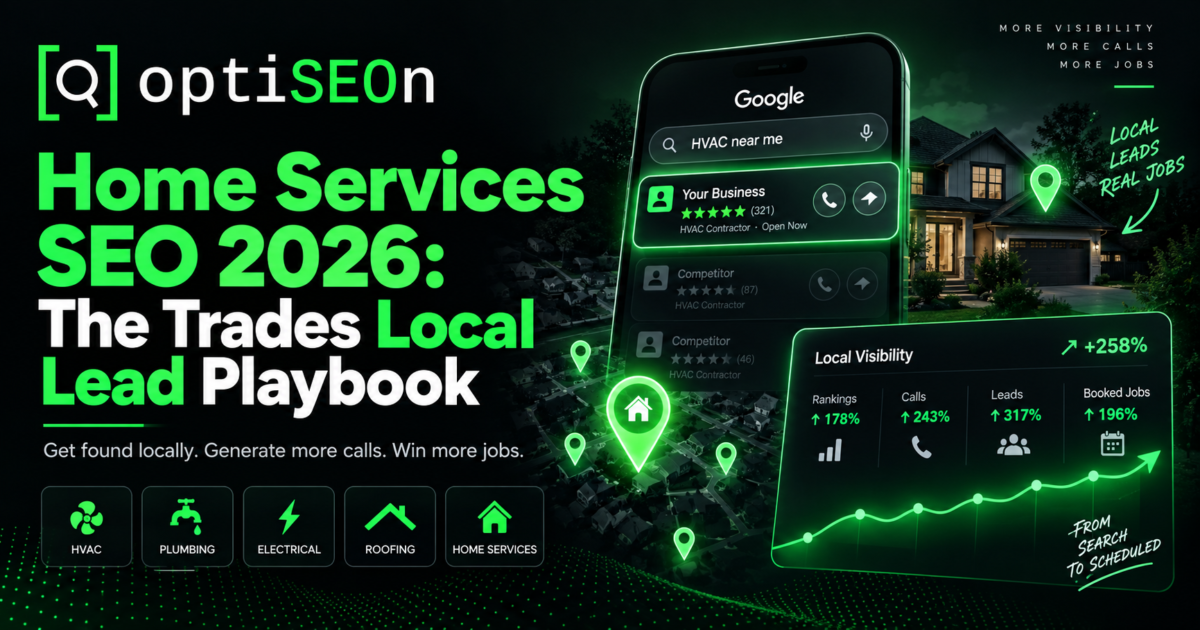
Home services is the vertical where local SEO either proves its value or quietly wastes your money. The search intent is immediate, the decision window is minutes, and a single top-three Map Pack position in a decent-sized metro can be worth more annually than most contractors spend on marketing in five years.
It’s also the vertical where the competitive bar is far higher than most contractors realize before they start. Recent 2026 market analysis puts the median review count needed to crack the top three in Google Maps at roughly 2,084 for HVAC, which is the highest of any trade category. Plumbing sits around 1,343 and pest control is near 803. If you’re a plumber with 40 reviews wondering why you can’t break into the Map Pack in a competitive metro, that’s your answer.
The good news is that demand has never been stronger. Emergency-intent search volume has surged dramatically. For instance, one 2026 analysis tracked “emergency plumber” rising from roughly 18,100 to 74,000 monthly searches (a 309% jump), with emergency HVAC repair and “24 hour plumber near me” showing even steeper climbs. The homeowners are looking for help. The real question is whether you’re the business they find.
Here’s the 2026 playbook.
TL;DR
Home services SEO rests on three pillars: an actively managed Google Business Profile, sustained review velocity, and genuinely local service-area pages. Emergency intent dominates searches for terms like “near me,” “open now,” and “24 hour,” so speed to answer matters just as much as ranking. In fact, research suggests a large majority of homeowners hire whoever responds first. Review thresholds in competitive metros are high, with the HVAC median around 2,084 for top-three Maps placement. Most contractors should run Google Local Services Ads for immediate leads while building organic visibility over a 6 to 12 month horizon.
Why is home services SEO different?
Because the intent is urgent, the decision is fast, and the searcher is usually in a tough spot. When a pipe bursts at 7:00 AM, nobody sits around carefully comparing five different contractors. That compresses the entire sales funnel into a single search and one or two quick phone calls.
Three consequences follow:
- The Map Pack captures the overwhelming majority of the value. Homeowners tap one of the top three listings and call. Organic results below the fold see a fraction of that action.
- Response speed is part of your conversion rate. Industry research consistently finds that a large majority of homeowners hire the first contractor who actually answers. Ranking first and missing the call is the same as not ranking.
- Seasonality is extreme. HVAC spikes in Dallas summers, plumbing during freezes, roofing after storms. Your content and budget should anticipate the calendar, not react to it.
Pillar 1: Google Business Profile as a live channel
Your Google Business Profile is the single most influential signal in home services SEO, and it rewards active management rather than a one-time setup. One 2026 case study tracked sustained profile management from November 2025 through March 2026. It reported an 86% increase in profile views and a 177% increase in customer interactions from profile activity alone, even without making any website changes.
Treat it as a channel you work weekly, not a listing you claimed once. The priorities specific to trades:
- Precise primary category. “HVAC Contractor” versus “Air Conditioning Repair Service” versus “Furnace Repair Service” are different signals. Pick the one matching the work you most want, and add secondary categories for the rest.
- Service area configured honestly. This is the mistake we see most often. Setting your service area to the entire metro — or the whole state — dilutes your relevance signal for the neighborhoods where you actually win jobs. Set it to where you genuinely want to rank and realistically serve.
- Photos of real work. Your team, your trucks, actual completed jobs. Stock imagery is detectable and users distrust it. Refresh monthly.
- Services fully populated with descriptions matching how homeowners phrase problems (“AC not cooling,” “water heater leaking”), not how you’d describe them on an invoice.
- Weekly Google Posts for seasonal offers, recent jobs, and maintenance reminders. Most local competitors ignore these entirely.
- Q&A pre-populated with the questions you get on every call: pricing ranges, emergency availability, service areas, financing.
Our complete Google Business Profile guide covers the full field-by-field process.
Pillar 2: Review velocity (and the real numbers)
Reviews are the dominant prominence signal in trades, and the bar in competitive metros is much higher than most contractors expect. In fact, 2026 data puts the median for top-three Maps placement around 2,084 reviews for HVAC, 1,343 for plumbing, and 803 for pest control. What matters isn’t just total volume, but recency, velocity, keyword content, and your response rate.
Before those numbers discourage you, keep in mind that they are metro-market medians for the most competitive categories. In smaller markets and less saturated trades, far fewer reviews will get you there. The point isn’t that you automatically need 2,000 reviews, but rather that you should know your actual local bar before deciding whether the investment makes sense. Pull up the top three competitors in your city and count their reviews. That’s your target.
A review system that works for trades:
- Ask on-site, at completion, while the customer is standing in front of the fixed problem. Text a direct review link from the tech’s phone before leaving.
- Build it into the job close as a standard step, not an occasional afterthought. Consistency produces velocity.
- Never gate reviews (asking only satisfied customers violates platform policy) and never incentivize them.
- Respond to every review, positive and negative. Response rate is a visible signal to both Google and the next homeowner reading.
- Handle negatives calmly and publicly. Keep in mind that you’re writing for the hundred future customers reading your response, not just the one upset reviewer.
Pillar 3: Genuinely local service-area pages
Each city or neighborhood you serve needs its own page with real local content, rather than the exact same page with the city name swapped out. Templated location pages act as doorway pages, which Google demotes and has enforced against more aggressively since the June 2026 spam update.
What makes a trades service-area page genuinely local:
- Local job examples and photos from that specific area
- Area-specific conditions such as older housing stock in one neighborhood, slab foundations in another, hard water, common HVAC unit ages, or typical panel types
- Local reviews from customers in that city
- Response time and coverage details specific to that area
- Directions, service radius, and genuine local references
A Dallas-area HVAC company’s Plano page should discuss something structurally different from its Oak Cliff page, such as housing age, typical system types, or common failure modes. If you could swap the city names without anyone noticing, the pages aren’t unique enough.
For contractors serving many cities, the discipline is the same as multi-location SEO: scale without duplication.
Emergency and “near me” intent
Emergency-intent searches have grown sharply and convert at the highest rate of any home services query. Optimizing for phrases like “near me,” “open now,” and “24 hour” is where immediate revenue comes from. These searchers are simply not comparison shopping.
Practical optimization:
- Accurate hours, including genuine after-hours availability. If you answer calls at 2:00 AM, say so, and then make sure you actually answer.
- Emergency service pages targeting “emergency [trade] [city]” and “24 hour [trade] near me”
- Click-to-call prominence on mobile, above the fold, everywhere
- Fast mobile pages. A distressed homeowner on a phone won’t wait. See our Core Web Vitals guide.
- Voice-query phrasing in your content, since a large share of emergency searches are spoken
AI search and the trades
Homeowners increasingly ask assistants directly: “my AC stopped working in Richardson, who should I call?” Those answers pull from Google Business Profile data, review platforms, directories, and structured data on your site.
What earns visibility:
- Consistent NAP everywhere — the foundation of entity recognition. Check yours with our free Entity Signal Checker.
- LocalBusiness schema with accurate service areas and hours — generate it with our schema markup generator
- Presence on the directories AI systems cite in home services, such as Angi, Thumbtack, Yelp, BBB, and trade-specific platforms. This is what our citation and authority building handles.
- Question-format content answering the problems homeowners describe before they know the fix
The general framework is in how to get cited by ChatGPT, Perplexity & Gemini. You can test whether assistants currently recommend you with our free AI Citation Tester.
Should contractors run paid ads alongside SEO?
For most home services businesses, the answer is yes. Google Local Services Ads generate leads immediately while organic SEO compounds over 6 to 12 months, and the two strategies together outperform either one alone. Indeed, 2026 analyses report LSA book rates near 44% and a meaningfully lower cost per acquisition when LSAs run alongside organic SEO rather than instead of it.
The sequencing that makes sense for most contractors: run LSAs from day one for immediate cash flow, build organic simultaneously on a 6–12 month horizon, then reduce paid dependence as organic matures. The contractors who struggle are the ones who never start the organic work and watch their cost per lead climb every year.
A quick note on scope: OptiSEOn doesn’t run paid advertising because it falls outside what we do. We’ll happily tell you when LSAs make sense and work alongside whoever manages them, but we won’t pretend paid ads are our lane.
Realistic timelines
- Weeks 1–6: GBP optimization and review system launch, which is the fastest-moving lever in trades
- Weeks 6–12: Map Pack movement in less saturated categories and neighborhoods; service-area pages begin indexing
- Months 3–6: Review volume compounds; competitive category rankings improve
- Months 6–12: Organic becomes a primary lead channel and paid dependence can be reduced
Home services compounds faster than most verticals because GBP and reviews move quickly. It still isn’t instant.
How OptiSEOn works with trades businesses
We handle home services as Geographic SEO engagements with citation building. That includes GBP management, review systems, genuinely local service-area pages, schema, and AI visibility. We’re based in Dallas and know the DFW market well: the summer HVAC spike, the freeze events, and the sprawl across Plano, Frisco, Richardson, Irving, and Arlington that makes service-area configuration matter so much.
Frequently Asked Questions
How many reviews does a contractor need to rank in the Map Pack?
It depends heavily on your trade and market. Data from 2026 puts median review counts for top-three Google Maps placement around 2,084 for HVAC, 1,343 for plumbing, and 803 for pest control in competitive metros, though smaller markets require far fewer. The practical approach is to check the top three competitors in your specific city and use their counts as your target.
What’s the fastest way for a plumber or HVAC company to get more leads from Google?
Optimizing and actively managing your Google Business Profile, then launching a systematic review request process. These move faster than anything else in home services. In fact, one documented 2026 case study showed an 86% increase in profile views and a 177% increase in customer interactions from sustained GBP management alone without any website changes.
Should I set my service area to my whole metro?
No. Overextending your service area weakens your relevance signal for the core neighborhoods where you actually win jobs. Set it to where you genuinely want to rank and can realistically serve quickly. This is especially important for emergency work, where response time determines whether you get the job.
Do I need separate pages for each city I serve?
Yes, if you want to rank in those cities. However, each page needs genuinely unique local content rather than the same template with the city name changed. Templated location pages are treated as doorway pages and get demoted. Be sure to include local job examples, area-specific conditions, and local reviews.
Are Local Services Ads or SEO better for contractors?
They serve different purposes and work best together. LSAs generate leads immediately and charge per lead rather than per click, making them ideal for cash flow from day one. SEO compounds over 6–12 months and eventually lowers your cost per lead substantially. Most contractors should run both, then reduce paid spend as organic matures.
How long does home services SEO take to work?
Google Business Profile and review improvements often show results within 4 to 8 weeks. Map Pack movement in competitive categories typically takes 3 to 6 months. Having organic become a primary lead channel usually takes 6 to 12 months. Home services compounds faster than most verticals because GBP and reviews move quickly.
Want to know your actual competitive bar, such as review counts, Map Pack gaps, and what it would take to reach the top three in your city? Book a free local SEO audit. OptiSEOn is a Dallas-based SEO, AEO, GEO, and LLM optimization agency, and we’ll give you the honest number rather than just an encouraging one.
Leave a Reply