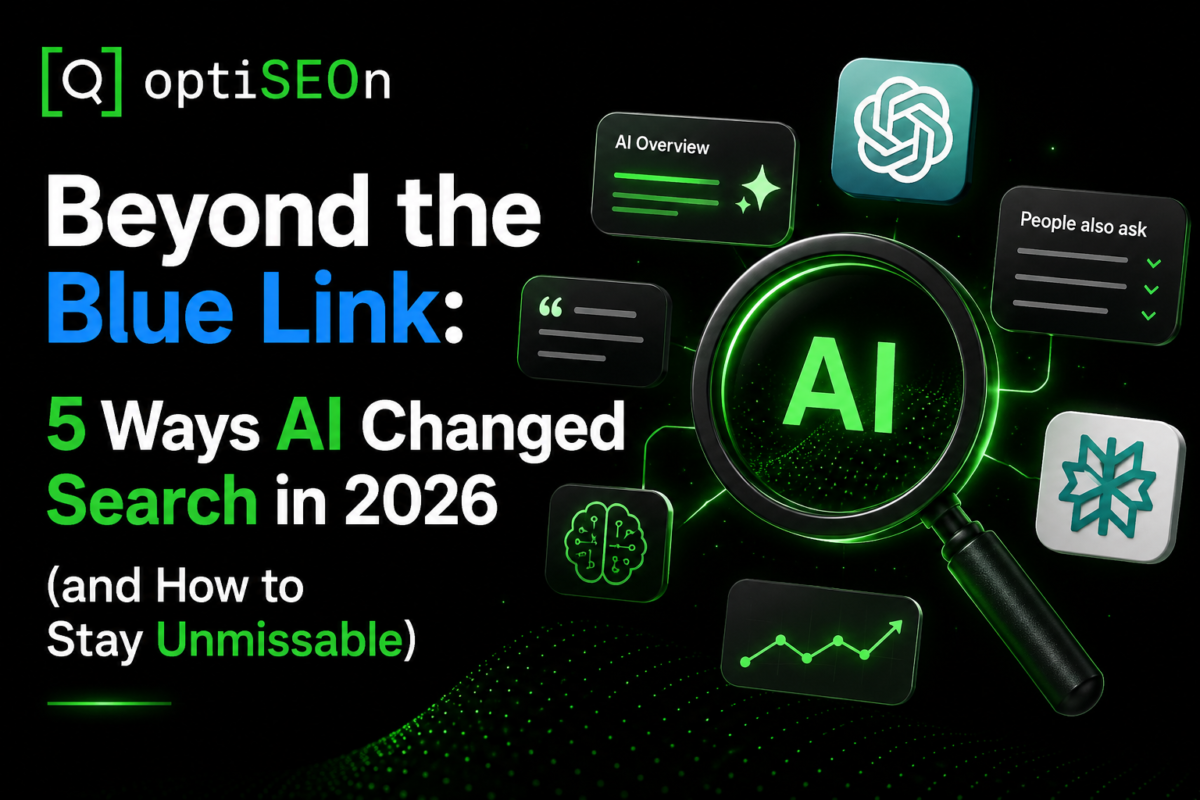
In 2019, search was a kingdom of blue links, and success meant one thing: getting the click. By 2026, that kingdom will have been redrawn. AI Overviews, ChatGPT, Perplexity, Gemini, and Claude now answer most questions on the spot — the “zero-click” reality, where a searcher gets a complete answer, and a short list of recommended brands, without ever visiting a website.
Ranking #1 is no longer the finish line. The new prize is being the cited answer inside the AI’s response. For a Dallas business, that’s the difference between showing up when a prospect asks ChatGPT, “who’s the best provider near me,” and being invisible to that prospect entirely.
Below are the five shifts reshaping discovery in 2026, and what each one means for staying unmissable instead of fading into AI invisibility. If you want the foundational vocabulary first, our Modern Search & AI Visibility Glossary and our breakdown of AEO vs SEO vs GEO vs LLM Optimization pair well with this piece.
1. The press release became an AI training asset
Quick answer: A press release is no longer just a media-relations tool. It is structured, factual, third-party-published data — exactly the kind of grounded source that large language models trust when deciding what to say about your brand.
Modern AI engines use retrieval-augmented generation (RAG): before answering, they pull in grounded, verifiable text to reduce hallucinations. Press releases fit that need almost perfectly. They follow a predictable, factual format, they get republished across trusted news domains, and they repeat your brand’s core facts — name, location, what you do — in clean, machine-readable language. That repetition across reputable sites is a strong entity signal.
To make a release AI-ready, write it so a machine can extract the facts without guessing. The old journalism “5 Ws” are now a technical checklist:
- Who — the exact entity name (company or person), spelled identically every time.
- What — the core news, stripped of marketing jargon so it extracts cleanly.
- When — precise dates (“February 1, 2026”), never “recently.”
- Where — an explicit location (e.g., Dallas, TX) that reinforces geographic relevance.
- Why — the significance and impact, which gives the AI context to summarize you accurately.
Done well, one release can seed consistent brand facts across dozens of domains that AI engines already crawl and trust.
2. Citations now have a “Tier 0” — and it isn’t Google
Quick answer: The classic local-citation pyramid (Google Business Profile at the top) still matters, but a new layer now sits above it for AI visibility: the community and entity sources that LLMs lean on most when they form an opinion about your brand.
Traditional citation building treats Google Business Profile, Apple Maps, and Yelp as Tier 1 — and they remain essential for local trust and Map Pack eligibility. But AI engines weigh a different set of sources when they decide who you are. We think of these as “Tier 0”: the places where your entity gets defined and disambiguated.
| Tier | Category | Example platforms | Why it matters in 2026 |
|---|---|---|---|
| Tier 0 | AI & entity sources | Reddit, Wikidata, Medium, G2, Crunchbase | Entity definition — where LLMs learn who you are |
| Tier 1 | Core local citations | Google Business Profile, Apple Maps, Yelp | Local trust and Map Pack eligibility |
| Tier 4 | Review platforms | Trustpilot, Capterra, Sitejabber | Trust and sentiment signals |
| Tiers 6–10 | Extended directories | Waze, Manta, Yellow Pages | Breadth and NAP consistency |
Two Tier 0 sources deserve special attention. Reddit is now one of the most-cited domains across AI engines, especially Perplexity — we wrote a full playbook on earning Reddit citations from ChatGPT and Perplexity. And Wikidata, the structured database behind many Knowledge Graphs, is the closest thing to an “official” entity record an AI can reference. For the broader strategy, see our guide to getting cited by ChatGPT, Perplexity & Gemini.
3. “GEO” now means two things at once
Quick answer: GEO used to mean geographic (local) SEO. In 2026, it also means Generative Engine Optimization. Both matter, and they reinforce each other.
- Geographic SEO — winning the Map Pack and “near me” / voice queries, the foundation of local foot traffic.
- Generative Engine Optimization — getting your content retrieved, synthesized, and cited by AI engines.
These aren’t separate services; they compound. Strong local signals and technical SEO build the trust and infrastructure; LLM optimization is the push that moves you from “a result” to “the recommended answer.” You can’t win global AI authority if your local signals are fragmented — and you can’t win the Dallas Map Pack if AI engines can’t verify you as a credible entity in the first place.
4. Schema is the bridge between humans and LLMs
Quick answer: Schema markup (in JSON-LD) is the machine-readable code that tells AI engines exactly what your page is, who you are, and whether you’re a source worth citing — no guessing required.
We’ve made the case before that schema is no longer just for Google rich results — it’s now a primary way ChatGPT, Perplexity, Gemini, and Claude understand your site. Structured data turns your business from a “string of text” into a “thing” with defined properties and relationships.
Two schema types do the heaviest lifting:
- Organization schema — the bedrock of your digital identity, connecting your name, logo, social profiles, and Wikidata entry.
- FAQPage schema — still the highest-leverage AEO tactic, because the question-and-answer structure is exactly what AI Overviews and voice assistants pull from.
This post uses both — you’ll find the ready-to-paste markup in the publish kit at the bottom of this page.
5. E-E-A-T is now a technical requirement, not just a guideline
Quick answer: Experience, Expertise, Authoritativeness, and Trust used to be editorial guidance. Now they are concrete signals that AI systems can verify in your code and across the web.
AI models are trained to tell expert-led content from generic AI-written filler, and they do it by looking for verifiable entities. To build that authority technically:
- Author & Person schema — link every article to a real, named author, and connect that author to LinkedIn and other profiles with
sameAsproperties so your expertise is verifiable across the web. - Consistent NAP data — keep your Name, Address, and Phone identical everywhere. Conflicting details create noise that erodes trust signals. (For us, that’s one Dallas address and one phone number, on every platform.)
- Topical depth — cover a subject thoroughly with topic clusters and internal links, so engines see contextual authority instead of a thin one-off page.
That’s exactly why this blog reads the way it does: a named author, a consistent Dallas business identity, and clusters of linked posts rather than scattered articles — including our deep dive on Google’s 200+ ranking factors and the technical foundation in Core Web Vitals for 2026.
Unmissable or invisible?
The defining shift of 2026 is the move from “ranking for keywords” to “being recognized as an entity.” If a prospect asks ChatGPT or Perplexity for a recommendation in your industry today, your visibility depends on whether you exist inside that answer. OptiSEOn can run a full AI visibility audit and build a focused 90-day roadmap across ChatGPT, Gemini, Perplexity, and Google. Get your AI visibility audit →
Frequently Asked Questions
What is the “zero-click” reality in search?
It’s the shift toward AI engines and search features answering a query directly on the results page, so the user gets their answer (and often a short list of recommended brands) without clicking through to any website. Visibility now means being the cited answer, not just owning a high-ranking link.
What’s the difference between an AI mention and an AI citation?
A mention means your brand name appears in the AI’s answer. A citation means the AI links to your website as a source. Citations carry more weight because they signal the engine trusts your content enough to reference it directly.
Does GEO mean geographic SEO or generative engine optimization?
In 2026, both. Geographic SEO wins the Map Pack and “near me” searches; Generative Engine Optimization wins citations inside AI answers. They reinforce each other — strong local signals make your entity easier for AI engines to verify, and AI visibility expands your reach beyond local search.
Why is schema markup important for AI search?
Schema markup (JSON-LD) removes the guessing game for AI engines by stating exactly what a page is, who published it, and how entities relate. Organization and FAQPage schema are the highest-leverage types for both Google rich results and AI-generated answers.
Do press releases really help AI visibility?
Yes, when written for extraction. A factual, well-structured release republished across trusted news domains gives retrieval-based AI engines consistent, verifiable facts about your brand — reinforcing your entity across the sources those engines already trust.
How do I check whether AI tools recommend my Dallas business?
Build a list of 20–40 real customer questions, test them weekly in ChatGPT, Perplexity, Gemini, and Claude, and record whether you’re mentioned, cited, or missing. Compare against competitors. If you’d rather not run it manually, OptiSEOn can audit this for you and map the gaps.
Leave a Reply