
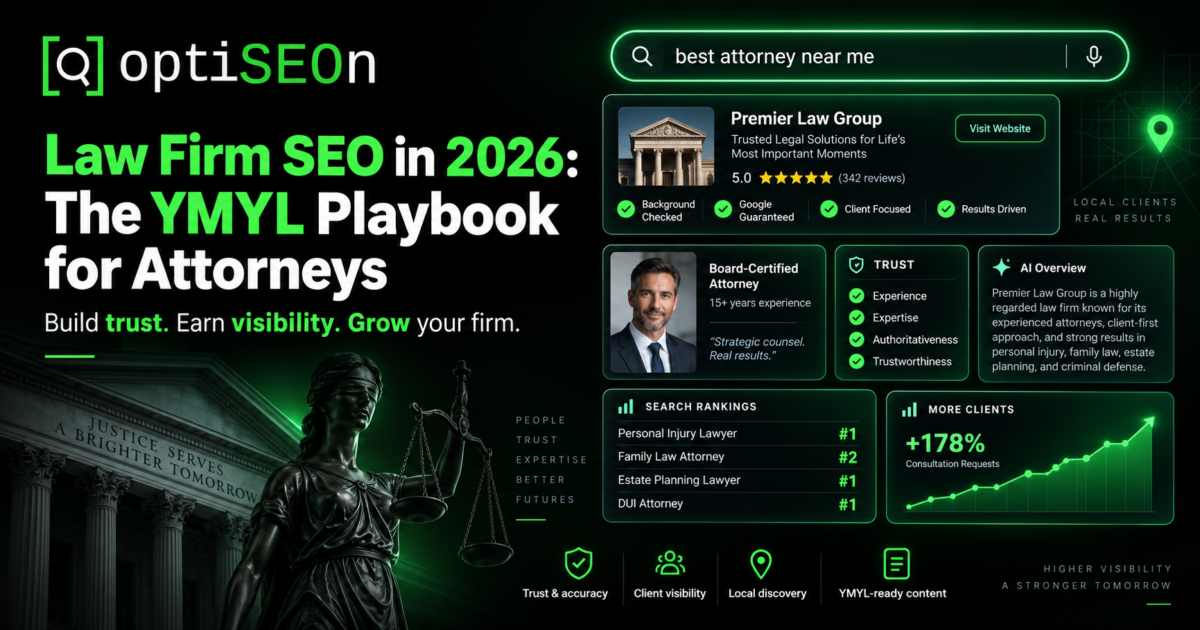
Legal is one of the most demanding verticals in all of SEO, and in 2026 it’s arguably the most demanding. It combines the strict YMYL scrutiny of healthcare (Google treats legal content as capable of affecting a person’s life, finances, and safety), a brutally competitive local landscape, state bar advertising rules that constrain what you can say, and — the newest pressure — the highest rate of AI Overviews of any major category.
That last point reshapes everything. According to SE Ranking research, legal queries trigger Google AI Overviews around 78% of the time — the highest of any high-stakes category. A prospective client searching “personal injury lawyer near me” now encounters an AI-generated answer, a local map pack, and traditional organic results, often before clicking anything. A firm that only optimizes for the blue links is competing for a shrinking slice of the page.
Here’s the realistic 2026 playbook.
TL;DR
Law firm SEO in 2026 has four fronts: the local map pack (which captures a large share of legal clicks and where proximity dominates), YMYL-grade E-E-A-T with genuine attorney authorship, AI Overview and AI-answer visibility (legal triggers AI Overviews more than any other category), and bar-compliant content. Practically: fully optimize each attorney’s and office’s Google Business Profile, publish attorney-authored practice-area and location content, build authoritative legal citations and links, and route everything through ethics review. Timelines are slow — legal is a 6–12 month compounding game.
→ Book a free law firm SEO audit
What makes law firm SEO different from regular SEO?
Law firm SEO combines YMYL content scrutiny, intense local competition, strict state bar advertising rules, and the highest AI Overview rate of any category — four constraints that stack on top of each other in a way most industries never face. Getting any one wrong undercuts the others.
The four differences in brief:
- YMYL scrutiny — Google applies its strictest quality standards to legal content, because bad legal information can genuinely harm people. Attorney expertise must be demonstrable. This is the same tier as healthcare, covered in our healthcare YMYL playbook.
- Local dominance — most legal searches are local and high-intent; the map pack captures a large share of clicks, and proximity to the searcher is the single strongest local ranking factor.
- Bar advertising rules — state bars regulate attorney advertising strictly, governing claims, testimonials, disclaimers, and specialization language.
- AI Overview intensity — at ~78% of legal queries, AI Overviews are nearly the default, making AI visibility non-optional.
Front 1: Win the local map pack
For most firms, the local map pack is the highest-ROI SEO target, because legal searches are overwhelmingly local and high-intent, and the map pack sits above organic results. Proximity is the dominant ranking factor — you can’t outrank distance — so the strategy is to maximize every other local signal.
The priorities, building on our Google Business Profile guide:
- Precise primary category — Google has added granular legal categories (e.g., “Probate Attorney,” “Estate Litigation Attorney”); using the exact right one is a ranking signal. “Personal Injury Attorney” beats “Lawyer.”
- A profile per attorney where appropriate, alongside the firm profile — many legal specialties support individual practitioner listings, multiplying map presence.
- Real team photos, not stock — firms using genuine team photos see materially more engagement; Google detects stock imagery and users distrust it.
- Reviews with disciplined, compliant responses — volume, recency, keywords in review text, and your responsiveness all influence local ranking. But responding to legal reviews carries confidentiality constraints (see Front 4).
- Accurate, consistent NAP across the firm’s website, Google Business Profile, and legal directories — even minor formatting variations suppress rankings.
Note that Google has been testing smaller local packs in some legal markets — sometimes showing only one or two firms and removing call buttons. That raises the stakes on every other signal (reputation, directory consistency, brand presence beyond Google), because there are fewer slots to win.
Front 2: YMYL E-E-A-T with genuine attorney authorship
Legal content must demonstrate real attorney expertise to rank — authored or reviewed by a named, licensed attorney, with credentials, bar admissions, and experience displayed. Anonymous or writer-only legal content consistently underperforms under YMYL scrutiny, and AI engines apply an even higher expertise bar to legal answers.
The authorship model that works:
- Attorney-authored or attorney-reviewed practice-area content, with the attorney named and credited
- Detailed attorney bio pages — bar admissions, jurisdictions, education, case experience, publications, speaking — with Person and, where appropriate, Attorney schema
- Citations to authoritative legal sources — statutes, case law, court rules, bar associations — not other marketing blogs
- Content freshness — law changes; visible review dates and updates matter, especially for statute-specific content
- Firm-level trust signals — office addresses, bar memberships, attorney rosters, clear contact paths
This is the legal application of our E-E-A-T framework. In legal, E-E-A-T isn’t a nice-to-have; it’s the threshold for being eligible to rank at all.
Front 3: Site architecture — practice areas and locations
Law firm sites rank on well-structured practice-area and location pages, not blog volume — one in-depth page per practice area, and unique location pages for each office or market served. This mirrors the service-line architecture that works in healthcare.
The architecture:
- Practice-area pages — one substantive page per practice area (personal injury, family law, estate planning, criminal defense), each attorney-authored, deep, and specific. These are your core commercial pages.
- Practice-area + location pages — for firms serving multiple markets, “Divorce Lawyer in [City]” pages with genuinely unique local content (local courts, local procedures, local considerations), not templated clones — the same duplicate-content discipline as multi-location SEO.
- Attorney profile pages — one per attorney, which rank for name searches and carry E-E-A-T weight.
- Educational content — client-focused FAQs and guides that answer real legal questions, structured for featured snippets and AI Overviews.
Pick your battles on content. You’ll lose “what is personal injury” to national legal publishers and directories; you can win “personal injury statute of limitations in [state]” and “[city] personal injury lawyer.”
Front 4: Bar compliance (review with your ethics counsel)
Attorney advertising is heavily regulated, and the rules vary by state bar. This is orientation, not advice — route everything through your ethics counsel.
Common areas where legal marketing diverges from standard SEO:
- Advertising disclaimers — many states require specific disclaimers on attorney advertising, sometimes including “Attorney Advertising” labels and disclaimers about results.
- Testimonials and endorsements — heavily regulated; some states require specific disclaimers, and rules on client testimonials vary significantly.
- Results and case outcomes — publicizing past results often requires disclaimers that past results don’t guarantee future outcomes, and some claims are restricted.
- Specialization language — words like “specialist,” “expert,” or “certified” in a practice area are restricted in many states unless you hold a recognized certification.
- Review responses — responding to a client review can implicate attorney-client confidentiality even when the client posted publicly; the safe pattern is a generic response that doesn’t confirm a representation relationship or reveal any case details.
- Solicitation rules — some outreach and intake practices are constrained.
Generalist agencies frequently create bar-compliance problems for firms because the default marketing playbook includes practices that specific state bars restrict. Legal marketing has to be built compliance-first.
Front 5: AI Overviews and AI answer visibility
Because legal queries trigger AI Overviews around 78% of the time — the highest of any category — appearing in AI-generated answers is essential, not optional, for law firms in 2026. The work that earns it overlaps heavily with YMYL E-E-A-T and structured content.
What earns legal AI visibility:
- Strong attorney E-E-A-T signals — AI engines heavily favor verifiable legal expertise on legal questions and apply elevated caution
- Question-format, well-structured content — client FAQs and practice-area explainers built with the answer-block structure from our featured snippets guide
- Complete legal schema — Attorney, LegalService, LocalBusiness, Person
- Presence on authoritative legal directories — AI engines frequently cite Avvo, Justia, FindLaw, and similar when recommending attorneys
- Consistent attorney entity data across bar records, directories, and your own site
The general framework is in how to get cited by ChatGPT, Perplexity & Gemini; legal applies it with a higher expertise bar and near-zero tolerance for inaccuracy. Measuring it matters too — see how to measure AI search traffic.
Front 6: Authoritative link building
Legal link building relies on authoritative, relevant sources — legal directories, bar associations, law schools, local community organizations, and genuine press — rather than volume. Given YMYL scrutiny, low-quality legal links are riskier than in other verticals.
What works:
- Legal directories — Avvo, Justia, FindLaw, Martindale-Hubbell verify existence and carry authority
- Bar association and legal organization memberships and profiles
- Law school and alumni connections where genuine
- Local sponsorships and community involvement — real local links
- Attorney commentary — providers quoted in local news and legal journalism
- Original legal content and data where publishable
The general framework is in our link building guide. Avoid the paid-guest-post ecosystem entirely — the risk is worse under YMYL scrutiny.
Technical foundation
Standard fundamentals apply, with legal emphasis: fast Core Web Vitals (a site slower than ~2 seconds loses high-intent clients who are often in urgent situations), mobile-first (legal searches skew mobile and urgent), HTTPS, clean architecture, and structured data throughout.
Realistic timelines
Legal is slow. Anyone promising fast organic results is selling ads or vanity metrics.
- 30–60 days: local map pack movement from GBP and review work
- 90–180 days: practice-area and location content begins ranking
- 9–12 months: organic and AI visibility compound into a primary intake channel
Legal’s competitiveness means the firms that win are the ones that commit through the slow middle months.
How OptiSEOn approaches law firms
We structure legal engagements compliance-first: attorney-authored/reviewed content workflows, legal schema, legal directory and citation building, compliance-aware review management, map-pack-weighted local work, and AI Overview visibility — because legal is where AI answers matter most. We’re not attorneys and we don’t give ethics advice; we work alongside your firm’s ethics counsel. See our services or book a free audit.
Frequently Asked Questions
Why is law firm SEO so competitive?
Legal combines high client value, urgent high-intent searches, and a crowded marketplace where firms compete not just with each other but with directories, aggregators, and AI-generated answers. Add YMYL scrutiny and strict bar advertising rules, and legal becomes one of the most demanding SEO verticals.
Do AI Overviews really appear on most legal searches?
Yes. According to SE Ranking research, legal queries trigger Google AI Overviews around 78% of the time — the highest rate of any high-stakes category. This makes AI visibility essential for law firms, not optional, and it’s why AI-answer optimization sits alongside traditional SEO in any serious 2026 legal strategy.
Can I respond to client reviews as an attorney?
You can respond, but responding may implicate attorney-client confidentiality even when the client posted publicly. The common safe pattern is a generic response that thanks the reviewer without confirming a representation relationship or revealing any case details. Confirm your approach with your state bar’s rules and your ethics counsel.
Does my law firm need blog content or a better Google Business Profile first?
For most firms, Google Business Profile and local optimization deliver faster, higher-ROI results than blog content, because legal searches are overwhelmingly local. Content becomes more valuable for competitive practice-area terms and AI Overview visibility, but the map pack is usually the first priority.
What schema markup do law firms need?
Attorney and LegalService schema for the firm and practice areas, LocalBusiness for each office, and Person schema for each attorney’s bio. Together these build the entity profile Google and AI engines use to evaluate and recommend firms. Generate valid JSON-LD with our free schema generator.
How long does law firm SEO take to work?
Local map pack improvements typically appear in 30–60 days with focused GBP and review work. Practice-area and location content generally takes 90–180 days to rank. Full compounding, where organic and AI visibility become a primary client-intake channel, usually arrives between 9 and 12 months.
Want a law firm SEO audit that accounts for YMYL, the map pack, AI Overviews, and bar compliance risk? OptiSEOn is a Dallas-based SEO, AEO, GEO, and LLM optimization agency. Book a free audit — we’ll assess your local visibility, attorney E-E-A-T signals, and AI-answer presence, and flag anything that looks like an advertising-compliance risk for your counsel to review.
Leave a Reply