Category: SEO

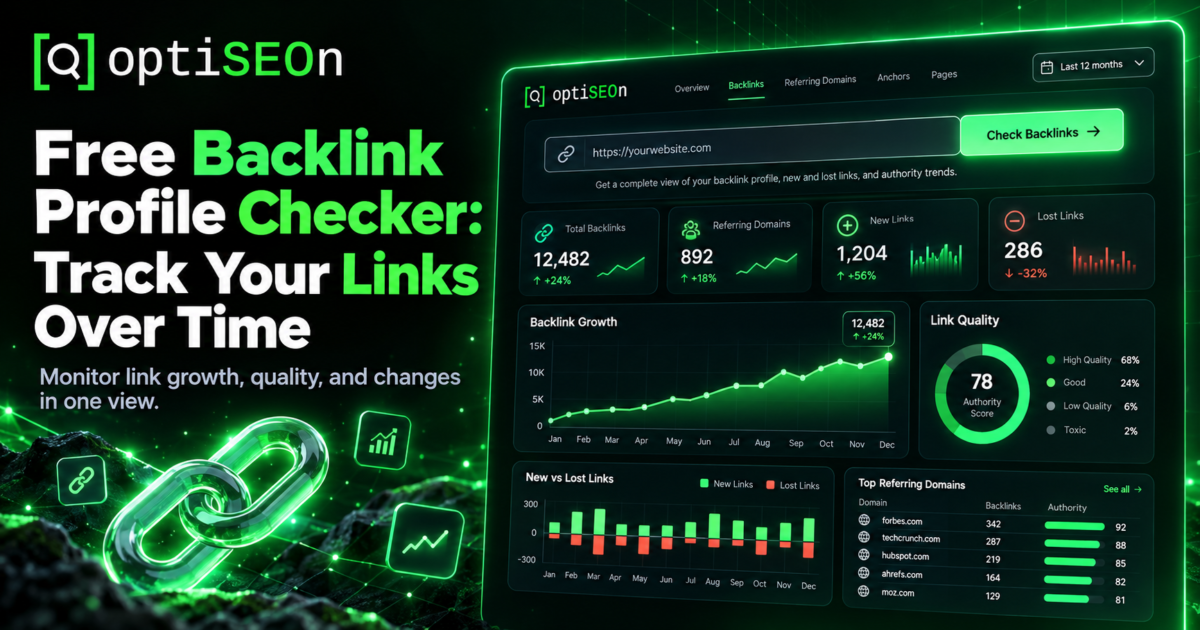
  • Free Backlink Profile Checker: See Your Links, and Whether They’re Improving

    Free Backlink Profile Checker: See Your Links, and Whether They’re Improving

    Most backlink tools answer one question: how many links do you have right now? That’s a snapshot, and a snapshot is a surprisingly weak thing to make decisions from.

    The question that actually matters is whether your profile is getting stronger. Are new referring domains arriving? Is quality improving or is the growth all low-value noise? Is too much of your authority concentrated in a handful of domains that could disappear? A single number can’t tell you any of that.

    So our free Backlink Profile Checker is built around progress rather than snapshots. It scores your profile out of 100, breaks down the quality mix and concentration risk, and shows you exactly what changed between checks.

    TL;DR

    A backlink profile checker analyses the links pointing to your site: how many referring domains you have, their quality mix, your spam score, and how concentrated your authority is. The free OptiSEOn Backlink Profile Checker scores all of this out of 100 and tracks progress between checks, so you can see whether your link building is actually working. No signup.

    → Run the free Backlink Profile Checker

    What is a backlink profile?

    Your backlink profile is the complete picture of links pointing to your site. This includes how many distinct domains link to you, their authority, topical relevance, and how links are distributed across your pages. Quality and distribution matter far more than raw link counts.

    The components that matter:

    • Referring domains: The number of distinct sites linking to you. This is far more meaningful than total link count, as 50 links from 50 sites build a stronger profile than 500 links from just 5 sites.
    • Quality mix: The spread of authority across your referring domains.
    • Spam score: The proportion of links coming from low-quality or spammy sources.
    • Concentration risk: How much of your overall authority relies on a small cluster of domains.
    • Growth trend: Whether your link profile is growing, holding steady, or losing ground.

    What does the OptiSEOn Backlink Profile Checker show?

    It returns your referring domains, link quality mix, spam score and concentration risk, scored out of 100, plus progress tracking that shows exactly what changed since your last check. Enter a domain and it runs; no signup required.

    Progress tracking is central to how this tool works. Effective link building takes time, as outlined in our link building guide. A single snapshot can’t show if a campaign is making steady progress or stalling out, but tracking changes over time clarifies your actual trajectory.

    Note on the data: like most free checkers, this tool uses third-party index data via an API rather than crawling the entire web directly. Because no backlink index is exhaustive and providers measure differently, treat absolute figures as estimates. The real value lies in tracking relative changes for the same domain over time using consistent data.

    Why do referring domains matter more than total backlinks?

    Search engines place much higher weight on unique websites linking to you than on total individual links. A hundred links from one site count as a single endorsement. Broad source diversity signals genuine authority.

    This is also why “we’ll build you 500 backlinks a month” offers are meaningless at best. Volume from a narrow set of low-quality sources doesn’t move the metric that matters, and in 2026 it carries real penalty risk. Google’s SpamBrain evaluates link patterns across your profile rather than links in isolation.

    What is concentration risk?

    Concentration risk measures how dependent your site is on a handful of referring domains. If a major share of authority comes from just three or four sites, losing any of them directly harms your profile. It evaluates profile vulnerability rather than raw quality.

    High concentration typically comes from a single viral piece picked up by one publisher network, a long-standing directory or partner relationship carrying most of your links, or an over-reliance on one guest-posting outlet. None of those are bad in themselves; depending on them is.

    The fix is straightforward and slow: diversify sources. Original research, digital PR, expert commentary, podcast appearances, and genuine community presence spread your profile across more domains.

    What is a good backlink profile score?

    There is no universal score to aim for. Look at your profile relative to competing sites ranking for your target terms, and focus on whether your score trends upward over time. Benchmarks vary widely by industry.

    Run the checker on your top three competitors alongside your own domain. That comparison tells you more than any score in isolation: if they have four times your referring domains, you know the gap you’re closing. If you’re comparable and still outranked, links aren’t your problem and you should look at content, technical health, or entity signals instead.

    Should I disavow links the checker flags as spammy?

    In most cases, no. Google advises against disavowing links unless you face a manual penalty or clear manipulation. Search engines generally ignore low-quality links automatically. Disavowing valid links risks removing genuine authority.

    Disavow when: you have a manual action for unnatural links, you previously bought links or used a PBN, or you’re facing a clear negative SEO attack. Otherwise, leave it alone and spend the effort earning better links instead.

    How does this fit with the rest of your SEO?

    Links are one input among several. A strong profile won’t rescue thin content, and a weak one won’t sink genuinely excellent content in a low-competition niche. Check your backlink profile alongside:

    • Domain Rating: A relative authority metric rather than an official ranking factor.
    • Entity signals: How clearly search engines and AI models identify your brand.
    • Core Web Vitals: Page performance and technical site health.
    • Content quality and structure: The foundational content that backlinks serve to amplify.

    For businesses that need authority built rather than measured, our citation and authority building service handles consistent listings and entity signals across 260+ platforms.

    Frequently Asked Questions

    How do I check my backlinks for free? 

    You can use a free backlink checker like OptiSEOn’s. Enter your domain to review referring domains, quality distribution, spam score, and concentration risk without creating an account. Google Search Console also provides a sample of indexed backlinks in its Links report.

    What’s the difference between backlinks and referring domains? 

    Backlinks are individual links, while referring domains are the distinct websites providing those links. Referring domains carry much more weight because multiple links from a single site act as one overall endorsement.

    How many backlinks do I need to rank? 

    There is no single target number. Compare your referring domain count against competitors ranking for your target terms to set a practical baseline.

    Why do different backlink tools show different numbers? 

    Each tool relies on its own web crawler and index. Crawl frequencies and filtering rules vary by provider, so treat raw counts as estimates and focus on performance trends over time.

    Should I remove or disavow bad backlinks? 

    Usually no. Google recommends disavowing links only if you have a manual penalty or clear evidence of unnatural link building. Most low-quality links are ignored automatically.

    How often should I check my backlink profile? 

    Checking monthly is sufficient for most sites since link profiles change gradually. Monitor more frequently during active outreach or PR campaigns when new link acquisition is expected.


    See where your backlink profile stands and track its progress over time. Run the free Backlink Profile Checker, then compare your domain against top competitors. If you need help closing the gap, book a free audit with our team.
  • Internal Linking & Site Architecture: The 2026 Guide

    Internal Linking & Site Architecture: The 2026 Guide

    Internal linking is the highest-leverage SEO work that most sites can do right now. You don’t need outreach, extra budget, or approval from anyone else. It’s simply a decision about how your own pages connect to each other.

    It’s also the work people skip most often because it feels routine and works behind the scenes. Nobody puts “restructured our internal links” in a case study headline. But when we audit sites, this is usually where the biggest wins are hiding: orphaned pages nobody can reach, homepage authority going nowhere, and multiple pages competing for the same keywords.

    Here’s how to do it properly.

    TL;DR

    Internal linking distributes authority between your pages and tells search engines which are most important and how they relate. Good site architecture keeps every important page within about three clicks of the homepage, groups related content into topic clusters, and uses descriptive anchor text. Common problems include orphaned pages, over-linked navigation that dilutes authority, and keyword cannibalization from multiple pages targeting one query.

    → Book a free site architecture audit

    What is internal linking and why does it matter?

    Internal linking is the practice of linking between pages on your own site, and it matters because those links help search engines discover pages, understand relationships between them, and distribute ranking authority across your site. External links bring authority in; internal links decide where it goes.

    Three distinct jobs:

    • Discovery. Crawlers follow links. A page with no internal links pointing at it may never be found.
    • Context. Anchor text and surrounding content tell search engines what the linked page is about.
    • Authority distribution. Link equity flows through internal links. Your best-linked page can pass authority to pages that have none.

    That third job is the one most sites waste. A homepage with strong external links that only connects to top-level navigation holds authority it could route to the pages that actually need to rank.

    What does good site architecture look like?

    A good architecture is shallow and logical: every important page reachable within about three clicks of the homepage, content grouped into thematic clusters, and a clear hierarchy from broad hub pages down to specific ones. Deep site structures hurt performance. Pages buried five or six clicks down get crawled less often and struggle to rank.

    The standard structure that works:

    Homepage
    
    ├── Service/Category hub
    
    │   ├── Specific service page
    
    │   └── Specific service page
    
    ├── Location hub (for local/multi-location)
    
    │   └── Individual location pages
    
    └── Blog
    
        ├── Topic cluster hub ("pillar")
    
        │   ├── Supporting post
    
        │   └── Supporting post
    
        └── Topic cluster hub

    For multi-location businesses, this maps directly onto the locations-hub pattern described in Multi-Location & Franchise SEO.

    What is a topic cluster?

    A topic cluster is a group of related pages organized around one comprehensive “pillar” page, with every supporting page linking up to the pillar and the pillar linking back down to each of them. It signals topical authority and concentrates relevance on the page you most want to rank.

    In practice: a pillar page covering a broad topic comprehensively, five to fifteen supporting posts each covering one sub-topic in depth, bidirectional links between pillar and supporting pages, and lateral links between closely related supporting pages.

    This blog is built that way. AEO vs SEO vs GEO vs LLM Optimization functions as a definitional pillar that dozens of more specific posts link back to.

    What is keyword cannibalization and how do I fix it?

    Keyword cannibalization happens when multiple pages on your site target the same search intent, splitting ranking signals so none performs as well as a single consolidated page would. The fix is consolidation: merge the overlapping pages into the strongest one and 301-redirect the rest.

    How to find it:

    • Search site:yourdomain.com “target keyword” and see how many of your pages surface.
    • In Search Console, filter by query and check whether different pages rank for it on different days. That constant back-and-forth is a clear sign of cannibalization.
    • Look for near-duplicate titles across your content.

    We’ll be direct about this: auditing this blog turned up three cannibalization clusters of our own — several posts covering “how AI changed search,” two covering ranking factors, and two covering terminology. Publishing a guide to a problem while having the problem is a good reason to fix it, which we’re doing. The framework is in Content Refresh & Pruning.

    How should I write anchor text?

    Use descriptive, natural anchor text that tells readers and search engines what to expect on the target page. Avoid generic terms like “click here,” skip raw URLs, and don’t repeat exact-match anchors across every link. Natural writing varies; repetitive linking looks unnatural.

    Practical guidance:

    • Descriptive beats generic. “Our Core Web Vitals guide” beats “click here.”
    • Vary phrasing across links to the same page.
    • Keep it natural. Anchor text that feels forced usually signals over-optimization.
    • Link from relevant context, mid-content, not just from a footer block.
    • Front-load important links. Links early in the body carry more weight than ones buried at the bottom.

    What are orphaned pages?

    An orphaned page is one with no internal links pointing to it, meaning crawlers can only find it via the sitemap and it receives no authority from the rest of your site. They’re extremely common on older sites and easy to fix.

    Find them by crawling your site (Screaming Frog or similar), exporting all URLs, comparing against your XML sitemap and analytics, and flagging any page with zero inlinks. Then link to each from a relevant hub or related content page.

    While running your crawl, check for internal 404s and redirect chains where links point to missing or moved URLs. These waste crawl budget and accumulate quietly whenever page slugs are updated. If you’ve ever renamed a URL without setting up a redirect, you likely have a few.

    How many internal links should a page have?

    There’s no hard limit, but every link on a page divides the authority it passes, so a page with 200 links passes far less through each one than a page with 20. Prioritize relevance over volume.

    A good rule of thumb is three to ten contextual links in a standard blog post. Hub pages can naturally include more, but keep your primary navigation clean. Including 150 links in a mega-menu across every page dilutes authority significantly.

    Sensible defaults: three to ten contextual links in a typical blog post, more on hub pages where linking out is the point, and navigation kept lean — a mega-menu linking to 150 pages from every page on the site dilutes considerably.

    How internal linking affects AI visibility

    Internal links help AI systems the same way they help crawlers: they establish which pages matter, how topics relate, and what your site is authoritative about. A well-structured cluster makes it substantially easier for a model to identify your site as a coherent source on a topic rather than a scattering of unrelated pages.

    Pair this with clear structured data — our free schema markup generator produces the JSON-LD, and 10 Schema Markup Types covers which to use where. Architecture and schema together are how a site becomes machine-legible.

    A practical internal linking audit

    1. Crawl the site and export your internal links, inlink counts, and click depth.
    2. Find orphans with zero inlinks and connect them from relevant pages.
    3. Find deep pages that sit more than three or four clicks from home and bring them closer.
    4. Export internal 404s and redirect chains, and fix every one.
    5. Identify cannibalization and consolidate.
    6. Map your clusters to make sure every supporting post links to its main pillar and back.
    7. Check your money pages’ inlink counts. Your highest-value commercial pages should be among your most internally linked. Usually they aren’t.
    8. Review anchor text for generic or over-repeated patterns.

    Point 7 catches the most value in our experience. Most sites link heavily to their blog and barely at all to the pages that generate revenue.

    Frequently Asked Questions

    How many internal links should a page have? 

    There’s no fixed limit, but each link divides the authority a page passes, so relevance matters more than volume. Three to ten contextual links in a typical blog post is reasonable; hub pages legitimately carry more. Avoid bloated navigation that links to every page from every page.

    Do internal links help SEO? 

    Yes. They help search engines discover pages, understand topical relationships through anchor text and context, and distribute ranking authority around your site. Internal linking is one of the few meaningful ranking levers entirely within your own control.

    What is keyword cannibalization? 

    Keyword cannibalization happens when multiple pages on your site compete for the same search intent, splitting ranking signals so none performs at its best. Find it by searching site:yourdomain.com “keyword” or watching for different pages ranking for the same query on different days, then consolidate into one page and redirect the others.

    How deep should my site structure be? 

    Keep important pages within about three clicks of the homepage. Pages buried deeper get crawled less frequently and receive less internal authority. If a valuable page sits five clicks deep, add links from relevant hub pages to shorten the path.

    What’s the difference between a pillar page and a cluster? 

    A pillar page covers a broad topic comprehensively and acts as the hub. The cluster is the pillar plus its supporting pages, each covering one sub-topic in depth, all linking to the pillar and linked from it. The structure concentrates topical relevance on the pillar.

    Should I use nofollow on internal links? 

    Generally no. Nofollow on internal links was once used to sculpt PageRank, but that approach hasn’t worked as intended for years and mostly just wastes the link. Use it only for genuinely untrusted internal destinations, such as user-generated content areas.


    Think your site structure might be holding you back? Book a free architecture audit. We’ll crawl your site to locate orphaned pages, broken links, and keyword cannibalization so you can put your site authority to work.

  • Should You Use AI to Write Your Content? The Honest Answer for 2026

    Should You Use AI to Write Your Content? The Honest Answer for 2026

    This question gets two loud, equally unhelpful answers. One camp says AI content is free traffic and anyone not mass-producing it is leaving money on the table. The other says Google will penalize you for touching it.

    Both points of view miss the mark, and that confusion gets expensive. We’ve seen businesses avoid a genuinely helpful tool out of fear, while others get their entire site demoted because they followed the wrong advice.

    Here’s where the line actually sits in 2026, why two major spam updates this year made it sharper, and how to use AI in a way that doesn’t put your site at risk.

    TL;DR

    Google does not penalize content just for being AI-generated. Instead, it penalizes scaled content abuse: mass-producing pages mainly to manipulate rankings. Its policy explicitly applies regardless of how the content was created. AI-assisted content that a knowledgeable person has reviewed, fact-checked, and enhanced with original value stays well within policy. On the other hand, auto-published, unreviewed AI content produced at volume breaks the rules. Enforcement in 2026 has been severe, directly affecting AI citation eligibility alongside traditional search rankings.

    → Book a free content audit

    Does Google penalize AI-generated content?

    No. Google’s spam policy targets scaled content abuse, which means producing lots of pages primarily to manipulate search rankings instead of helping users. This policy applies no matter how the content is created. Human-written spam and AI-generated spam face the exact same consequences. The tool itself is not the violation.

    This has remained Google’s clear public position, and real-world data backs it up. For instance, a widely cited Ahrefs study of around 600,000 pages showed that most top-ranking pages use some AI assistance, with virtually no connection between AI use and ranking penalties. (It’s worth double-checking the original Ahrefs research before quoting it, as secondhand stats can easily get distorted.)

    In practical terms, asking “will AI content rank?” is the wrong framing. The real question is “is this content helpful enough to deserve to rank?”, which is the same standard search engines have always used.

    What is scaled content abuse?

    Scaled content abuse refers to Google’s rule against pumping out numerous pages mostly to manipulate search rankings rather than assist readers. The main trigger is high volume paired with low value and ranking manipulation, not the specific tool used. It applies equally to AI drafts, scraped material, stitched-together text, repetitive templates, and low-quality human writing.

    Typical patterns that fall inside it:

    • Auto-generated category or location pages with no unique insight
    • Q&A pages mass-produced from “People Also Ask” queries without original expertise
    • Thin affiliate or comparison pages generated at volume
    • Programmatic pages that restate existing search results without adding anything
    • Any large batch of pages published without human review

    There’s no published page-count threshold. It’s a judgement about pattern and intent, which is why “how many AI pages can I get away with?” has no answer.

    What changed in 2026?

    Two key shifts happened: overall enforcement became much stricter, and the rules expanded to cover AI-driven search answers alongside standard rankings. Scaled content abuse moved from a secondary rule to Google’s top enforcement priority this year.

    The sequence:

    • March 2026 core update named scaled content abuse as a primary enforcement target, establishing that content volume without quality is an active negative rather than neutral.
    • May 2026 saw Google extend its spam rules to cover AI Overviews and AI Mode. This means scaled content abuse now impacts whether you can be cited inside AI answers, not just where you rank in search. SpamBrain screens for both at the same time.
    • August 18–21, 2026 spam update rolled out global enforcement of the existing policy, with reports of publishers running large volumes of AI-generated or programmatic content losing rankings across tens of thousands to over a million queries.

    That May update is the crucial detail many site owners missed. A scaled-abuse issue now damages your reach in traditional search and in AI-generated answers at the same time. As we’ve highlighted throughout this blog, these two search channels can no longer be recovered separately.

    One more detail worth knowing: reports from the August update describe sites with a small volume of thin automated pages alongside otherwise strong editorial content suffering collateral losses on their legitimate pages once the site crossed a scaled-abuse threshold. The risk isn’t confined to the bad pages.

    So how should you actually use AI?

    Feel free to use AI for research, structuring ideas, drafting, and editing. But always add hands-on expertise, original insights, and thorough fact-checking before publishing. The key difference comes down to whether a real expert shaped the piece for actual readers, not whether an AI model helped along the way.

    Where AI genuinely helps:

    UseRiskWhy
    Research and summarising sourcesLowYou verify before using
    Outlining and structuringLowStructure isn’t the value
    First drafts you substantially rewriteLowHuman expertise is added
    Editing, tightening, headline variantsLowImproves human work
    Generating FAQ candidates from real queriesLowYou write the answers
    Publishing lightly-edited drafts at volumeHighScaled content abuse
    Programmatic pages with templated AI textHighScaled content abuse
    Auto-publishing without reviewHighUnhelpful content

    The practical test: could someone with genuine expertise in your field read this and learn something they couldn’t get from the first three results? If not, it doesn’t matter who or what wrote it.

    What AI simply can’t replace

    This brings us to the core limitation of AI, and it’s precisely why relying on AI purely as a high-volume shortcut keeps failing.

    A language model cannot supply:

    • Proprietary data. Your own numbers, survey results, internal benchmarks.
    • Genuine opinion with something at stake. A real position you’d defend.
    • Original examples from work you actually did.

    These elements are what truly set standout content apart in 2026, and AI models cannot generate them out of thin air. Instead of seeing that as a drawback, view it as the specific value you bring to the table.

    How we use AI at OptiSEOn, specifically

    Since this post is partly a position statement, here’s ours plainly: we use AI for research, outlining, and first drafts. Every piece is then rewritten with our own client experience, fact-checked against primary sources, and reviewed by a named human before it publishes. We don’t auto-publish, we don’t run programmatic content operations, and we don’t produce content at volumes that would put a client’s site near a scaled-abuse threshold.

    That’s also why we publish fewer posts than some agencies promise. Four to eight genuinely useful pieces a month beats forty thin ones, and after the 2026 updates the maths on that isn’t close.

    What to do if you’ve already published a lot of AI content

    Audit it against the quality bar rather than deleting it reflexively — identify which pages add genuine value, improve the salvageable ones, and consolidate or remove the rest. The process is the same as any content audit.

    Practical sequence:

    1. Inventory every page and its traffic, rankings, links, and conversions.
    2. Improve the salvageable by adding real expertise, original data, examples, and named authorship.
    3. Consolidate overlapping pages and 301 them to the survivor.
    4. Remove genuine filler, redirecting where there’s a relevant target.
    5. Stop the pipeline that produced it.

    If your site was hit by a penalty, recovery won’t happen overnight. Core update recoveries usually take effect during subsequent updates, so focus on consistently improving actual content quality in the meantime.

    Frequently Asked Questions

    Does Google penalize AI-generated content in 2026? 

    No. Google’s policies target scaled content abuse, which means churning out pages mainly to manipulate search rankings. This rule applies regardless of how the content was produced. AI-assisted content that is thoroughly reviewed, accurate, and genuinely helpful is fully compliant. In contrast, unreviewed AI content published in bulk violates guidelines.

    What is scaled content abuse? 

    Generating many pages primarily to manipulate search rankings rather than help users. It applies whether the pages come from AI, scraping, templates, or human writers producing bulk filler. The trigger is volume combined with low value and manipulative intent, and there’s no fixed page-count threshold.

    Can AI-written content rank on Google? 

    Yes, if it’s genuinely useful. Independent analyses in 2026 suggest a large share of top-ranking pages involve some AI assistance, with negligible correlation between AI involvement and penalties. What determines ranking is whether the content answers the query better than what already ranks.

    Does AI content affect AI Overview citations? 

    Yes, and this changed in 2026. Google extended its spam policies in May 2026 to cover AI Overviews and AI Mode, meaning scaled content abuse now affects eligibility to be cited in AI answers as well as organic rankings. A scaled-abuse problem costs you visibility in both channels at once.

    How much AI content is too much? 

    Google hasn’t set a specific page-count limit. Instead, it evaluates patterns, value, and overall intent. A more helpful way to look at it: any page that doesn’t offer unique value to the reader is a liability, and publishing many of those pages magnifies the risk.

    How much AI content is too much? 

    There’s no published threshold — it’s a judgement about pattern, value and intent rather than a count. The more useful framing: any page that doesn’t add something a reader can’t get elsewhere is a liability regardless of how it was produced, and volumes of such pages compound that liability.

    Should I disclose that I use AI in my content? 

    Google doesn’t require AI disclosure. What matters for E-E-A-T is clear human authorship and accountability — a named author with real credentials who stands behind the content. Many publishers disclose anyway as a trust signal; it’s a brand decision rather than an SEO requirement.


    Published a lot of AI content and worried about exposure? Book a free content audit. We’ll tell you honestly whether you have a scaled-abuse risk, which pages are salvageable, and what recovery would realistically involve.

  • Why Did My Organic Traffic Drop? A Diagnostic Guide for 2026

    Why Did My Organic Traffic Drop? A Diagnostic Guide for 2026

    Few things cause panic quite like opening Analytics to find organic traffic down 40% with no obvious explanation. The instinct is to start changing things immediately, such as rewriting pages, building links, or publishing more content.

    That instinct is usually wrong, and it can turn a recoverable dip into a six-month issue. You cannot fix a drop you haven’t diagnosed, and the most common causes look very different. A tracking bug, a noindex pushed by a developer, an algorithm update, a competitor’s new content, and normal seasonality all show up as the same downward line on a chart.

    Run your diagnosis in order, starting with the simplest and most reversible checks. Here is the exact sequence we use at OptiSEOn when a client’s traffic drops.

    TL;DR

    Diagnose an organic traffic drop in this order: confirm the data is real, rule out technical issues, check for manual actions, check algorithm update timing, then review competitive and seasonal factors. Most drops stem from measurement errors, technical breakage, penalties, algorithm updates, or increased competition. Figure out which category you are dealing with before touching anything, because the fixes are completely different and applying the wrong one will cost you months.

    → Book a free traffic-drop diagnostic

    Step 1: Is the traffic drop even real?

    Before investigating anything else, confirm the decline is real and not a reporting glitch. Broken tracking, tag manager edits, consent banner changes, or filter and date-range errors cause a large portion of apparent drops. Taking ten minutes to double-check your data can save you weeks of wasted effort.

    Check, in order:

    • Is the tracking code still firing? A site update or plugin conflict can strip it. Check real-time reports.
    • Did anything change in your tag manager or consent banner? Stricter consent defaults reduce measured traffic without reducing actual traffic.
    • Are you comparing like with like? Month-over-month comparisons across months with different day counts, or a period containing a holiday, distort badly.
    • Does Google Search Console agree with Analytics? GSC measures clicks independently. If GSC shows stable clicks while Analytics shows a collapse, your problem is measurement, not search.
    • Was there a bot-filtering or data-retention change? These shift historical baselines.

    If GSC clicks are stable, stop here. You have an analytics problem, not an SEO problem.

    Step 2: Did something break technically?

    If the drop was sudden and steep, particularly overnight, a technical issue is far more likely than an algorithm shift. Core updates roll out over days and rarely hit a site so abruptly. Technical bugs are also usually the fastest problems to fix.

    The checklist, in rough order of frequency:

    • Accidental noindex. A staging environment setting gets pushed to production. In WordPress, check Settings → Reading for “Discourage search engines.”
    • robots.txt blocking. A Disallow: / left behind after a launch. Check yours and see if AI crawlers are blocked too with our free robots.txt AI Crawler Checker.
    • Broken or mis-set canonicals pointing pages at the wrong URL.
    • A migration or redesign that changed URLs without 301s. If the drop coincides with a site change, this is almost certainly it.
    • Server errors or downtime during a crawl window — check GSC’s Crawl Stats.
    • Core Web Vitals regression from a new script, plugin, or theme. See Core Web Vitals in 2026.
    • HTTPS or certificate problems, which can deindex pages quickly.
    • Hacked content or injected spam. Check GSC Security Issues.

    The single most useful signal here: timing. Overnight cliff = technical or penalty. Gradual slide over weeks = algorithmic or competitive.

    Step 3: Do you have a manual action?

    Check Google Search Console → Security & Manual Actions. A manual action means a human reviewer penalized your site for a guideline violation, and it will be explicitly listed there. If nothing appears, you do not have a manual action.

    Common triggers: unnatural links (bought links or PBNs), thin or scaled content, cloaking, structured data that doesn’t match visible content, or user-generated spam.

    If you have one, the path is: fix the underlying violation genuinely, document what you did, then file a reconsideration request. Expect weeks, not days. If the cause was link-related, our link building guide covers what legitimate practice looks like.

    Step 4: Did an algorithm update hit?

    Compare the start date of your decline against confirmed Google update dates. If your drop began within a day or two of a core or spam update rollout, that is your most likely cause. Google confirms major updates publicly, and the SEO industry tracks them closely.

    2026 has been an unusually active year. The March 2026 core update named scaled content abuse as a primary enforcement target, and the August 18–21 spam update expanded that enforcement further, with reports of publishers running large volumes of AI-generated or programmatic pages losing rankings across tens of thousands of queries. Notably, some sites with only a small volume of thin automated content alongside otherwise solid editorial work reported collateral losses once the site crossed a scaled-abuse threshold.

    If an update is your cause:

    • Don’t panic-rewrite everything. Updates take days or weeks to fully roll out, and rankings often move again before it settles.
    • Identify which pages lost, not just that traffic fell. Use GSC’s page-level comparison over the update window.
    • Look for a pattern in the losers — thin pages, older content, a particular template, pages without author attribution.
    • Fix the pattern, not individual pages.

    Recovery from a core update typically arrives at the next update, not immediately, which is why the work has to be substantive.

    Step 5: Did you lose ground competitively?

    If technical setups are sound and no update matches your timeline, competitors likely improved by publishing stronger content, earning links, or taking SERP features you used to hold. This pattern shows up as a gradual decline on specific search terms rather than a site-wide crash.

    How to check:

    • Pull GSC query data for the affected period and compare position changes on your top commercial terms.
    • Search those queries manually. Who’s above you now who wasn’t before? What did they publish?
    • Check whether you lost a featured snippet or AI Overview citation. Losing position zero can cut clicks sharply while your blue-link ranking stays identical — a drop with no ranking change at all. See Featured Snippets & AI Overviews.
    • Check for SERP layout changes. Additional ads, a new local pack, or an expanded AI Overview will all lower organic clicks even if your ranking position stays unchanged.

    That last point matters more every year. Your position can hold perfectly while your clicks fall, purely because the page above you changed shape.

    Step 6: Is it just seasonality?

    Compare performance against the same period last year rather than last month. Many businesses have predictable annual cycles that look alarming month-over-month but normal year-over-year. Always verify seasonality before assuming something broke.

    Year-over-year comparison in GSC or Analytics resolves most of these in minutes. Genuine seasonality shows the same shape in prior years.

    A diagnostic table

    SymptomMost likely causeFirst check
    Overnight cliff, all pagesTechnical (noindex, robots.txt)GSC Coverage + robots.txt
    Overnight cliff, GSC stableTracking / measurementAnalytics tag, consent banner
    Sharp drop matching a known update dateAlgorithm updateUpdate timeline + page-level losers
    Explicit notice in GSCManual actionGSC Manual Actions
    Gradual slide on specific queriesCompetitiveQuery-level position data
    Clicks fell, positions heldSERP layout / lost snippetManual SERP inspection
    Repeats annuallySeasonalityYear-over-year comparison

    What not to do while diagnosing

    • Don’t make many changes at once. You’ll never learn what worked.
    • Don’t disavow links reflexively. Without a manual action or clear evidence of spam, disavowing can backfire and lower rankings further.
    • Don’t delete content in a panic. Content pruning requires a strategic review, not a hasty deletion. Read our guide on Content Refresh & Pruning.
    • Don’t assume it’s a penalty. Genuine manual actions are rare; most drops are technical, competitive, or measurement.
    • Don’t expect same-week recovery. Technical fixes can recover fast once recrawled; algorithmic recovery usually takes until the next update.

    Frequently Asked Questions

    Why did my website traffic suddenly drop overnight? 

    Overnight drops usually point to technical issues or tracking problems rather than search algorithm changes, as updates roll out over several days. Check for an accidental noindex, a robots.txt block, broken canonical links, a migration missing redirects, server downtime, or a broken analytics tag in that order.

    How do I know if a Google update caused my traffic drop? 

    Compare the exact start date of your decline against confirmed Google update dates. If your drop begins within a day or two of a core or spam update rollout, that’s likely the cause. Then examine which specific pages lost traffic and look for a shared pattern among them.

    How long does it take to recover from a Google algorithm update? 

    Recovery usually occurs during a subsequent update rather than right away, so plan for weeks to several months depending on how thoroughly you address the underlying issues. Surface-level tweaks rarely fix anything; you need to solve the core content or quality problem.

    My rankings are the same but traffic dropped. Why? 

    Usually a SERP layout change: an AI Overview, expanded ads, a local pack, or a competitor taking a featured snippet you held. Your blue-link position can be unchanged while the clicks available at that position fall substantially. Inspect the live SERP for your key queries.

    Should I disavow backlinks if my traffic dropped? 

    Not reflexively. Google recommends against disavowing unless you have a manual action or genuine reason to suspect link manipulation. Disavowing good links removes real authority and can worsen a drop that had nothing to do with links.

    Is a traffic drop always bad? 

    Not always. If you pruned low-value pages, lost rankings on non-converting queries, or improved bot filtering in analytics, total traffic may drop while leads remain steady or grow. Always measure conversions alongside traffic. Learn more in our guide on how to measure SEO ROI.


    Traffic down and not sure why? Book a free diagnostic. OptiSEOn is a Dallas-based SEO, AEO, GEO, and LLM optimization agency. We will run through this checklist with your site and identify what happened, even if the answer is simply normal seasonality.

  • How to Choose an SEO Agency in 2026 (and the Red Flags That Should End the Conversation)

    How to Choose an SEO Agency in 2026 (and the Red Flags That Should End the Conversation)

    Let’s start with the obvious conflict of interest: we are an SEO agency, and this is an article about choosing one. You should weigh everything below accordingly.

    We’re writing it anyway because the buying experience in this industry is genuinely bad. Most agency websites say the exact same things: “data-driven,” “proven results,” and “custom strategy.” They offer no real way to distinguish a competent operator from someone who’ll take your money for a year and show you a meaningless chart of impressions. Businesses get burned regularly, usually because they lack the background to evaluate technical sales pitches.

    So here’s the honest version: what to ask, what should end the conversation immediately, and how to read a proposal. Some of it makes agencies, including us, look less appealing. That’s the point.

    TL;DR

    Choose an SEO agency by evaluating four things: whether they diagnose before prescribing, whether their deliverables are specific and verifiable, whether their claims are honest about timelines and uncertainty, and whether their contract lets you leave. The immediate red flags: guaranteed rankings, secret proprietary methods, refusal to explain tactics, pressure for long contracts, and suspiciously cheap pricing. The best single filter is asking what they won’t do and what could go wrong.

    → Book a free, no-pitch audit

    What should I look for in an SEO agency?

    Look for an agency that diagnoses your specific situation before proposing a solution, describes its deliverables specifically enough that you could verify them, sets honest timelines, and offers contract terms that don’t trap you. Those four things filter out most of the bad actors without requiring you to evaluate technical claims you’re not equipped to judge.

    The four in more detail:

    1. They diagnose first. A competent agency asks about your business, market, competitors, and current state before quoting. An agency that sends a standard package in response to a first email is selling a product, not solving your problem.
    2. Deliverables are specific. “Content optimization” means nothing. “8–12 pages optimized per month, with title tags, meta descriptions, heading structure, and internal links” is something you can check.
    3. Claims are honest. Realistic timelines, acknowledged uncertainty, no guarantees about things nobody controls.
    4. The contract lets you leave. Month-to-month, or a short initial term with a clear exit. Long lock-ins mostly protect agencies from the consequences of underperforming.

    What are the biggest SEO agency red flags?

    Guaranteed rankings, secret methods they won’t explain, pressure to sign long contracts, prices far below market, and reporting built on vanity metrics. Any one of these is reason enough to walk away.

    The red flags, and why each one matters:

    Red flagWhy it’s disqualifying
    “We guarantee #1 rankings”Nobody controls Google’s algorithm. Google itself says no one can guarantee rankings. This claim is either ignorance or dishonesty.
    “Our proprietary method is confidential”You’re entitled to know what’s being done to your website. Secrecy usually conceals either nothing or something risky.
    Long mandatory contracts12-month lock-ins with no exit protect the agency, not you. Short terms force agencies to earn renewal.
    Suspiciously cheap$199/month can’t fund real work. It funds automated reports and low-quality links that may actively harm you.
    Reporting only on impressions/trafficIf they never show conversions or leads, there’s a reason.
    Vague deliverables“Ongoing optimization” is not a deliverable.
    No questions about your businessIf they don’t understand what you sell and who buys it, they can’t target the right terms.
    They won’t name what they don’t doEvery honest operator has scope limits.
    Buying links / PBNsDirect violation of Google’s guidelines with real penalty risk. Ask explicitly how they build links.

    On that last point: link building is where the most damage gets done. Ask directly whether they buy links or use private blog networks. An agency doing this will usually euphemize it (“we have publisher relationships”). Press until you get a clear answer. Our link building guide covers what legitimate practice looks like in 2026.

    What questions should I ask an SEO agency?

    Ask what they won’t do, what could go wrong, how they’d measure success, what specifically they’d do in the first 90 days, and who actually does the work. These questions are hard to answer well without genuine competence, which makes them good filters.

    The questions worth asking, roughly in order of diagnostic value:

    • “What won’t you do?” Every competent agency has scope limits and tactics they refuse. An agency that claims to do everything is either lying or spread too thin.
    • “What could go wrong with this engagement?” Honest answers exist: your market may be too competitive, your site may need development work you’re not budgeted for, results may take longer than you want. An agency that says nothing could go wrong isn’t thinking.
    • “How will we measure success, and what’s the first metric that will move?” Look for conversions and leads, not impressions. See our guide to measuring SEO ROI.
    • “What exactly happens in the first 90 days?” Specific deliverables with a sequence, not “we’ll start optimizing.”
    • “Who does the work, and where?” Whether it’s in-house, freelance, or offshore isn’t automatically good or bad, but evasiveness about it is.
    • “How do you build links?” Listen for outreach, digital PR, and earned placements. Walk away at anything resembling purchased links.
    • “Can I talk to a current client in a similar situation?” References from current clients matter more than testimonials.
    • “What happens if I want to leave?” Who owns the content, the accounts, the data? You should own all of it.

    How much should SEO cost?

    Legitimate SEO retainers for small and mid-sized businesses generally run from several hundred to several thousand dollars monthly, scaling with scope, market competitiveness, and content volume. Anything under roughly $300/month is unlikely to fund meaningful work. Price alone doesn’t indicate quality, but implausibly cheap pricing reliably indicates the absence of it.

    What actually drives cost: how much content is produced, how competitive your market is, how much technical work your site needs, whether local/multi-location work is involved, and how much link building and citation building is included.

    The useful question isn’t “is this expensive?” but “what specifically am I getting for this, and is that plausible at this price?” If someone offers 20 blog posts, full technical SEO, and 30 backlinks for $400/month, the arithmetic doesn’t work. Something in that list isn’t real.

    For transparency on our own model, our pricing is published rather than quote-on-request.

    Should I hire a specialist or a generalist agency?

    Hire a specialist when your situation has genuine domain constraints: YMYL verticals like healthcare and legal, multi-location systems, or AI search visibility. Choose a generalist when your needs are broad and conventional. Specialization matters most where getting it wrong carries specific risk.

    Where specialization genuinely matters:

    • Healthcare (YMYL scrutiny plus HIPAA constraints). A generalist can create compliance problems. See our healthcare playbook.
    • Legal (YMYL plus state bar advertising rules). See our law firm playbook.
    • Multi-location / franchise (duplicate content risk at scale). See the multi-location playbook.
    • AI search visibility, a genuinely new discipline most agencies haven’t built capability in yet.

    Where a competent generalist is fine: standard local businesses, straightforward B2B, most eCommerce.

    How do I evaluate an SEO proposal?

    Check that the proposal reflects your specific situation, lists countable deliverables, states realistic timelines, explains measurement, and doesn’t promise outcomes nobody can control. A proposal that could have been sent to any business tells you it was.

    A practical checklist:

    • Does it reference your site, competitors, and market specifically?
    • Are deliverables countable (pages, posts, links, citations) rather than adjectival?
    • Are timelines realistic — months, not weeks, for meaningful results?
    • Does it explain how success will be measured, in business terms?
    • Does it acknowledge any risk or uncertainty at all?
    • Are contract terms and exit conditions clear?
    • Does it avoid guarantees about rankings or traffic?

    The honest caveats about this article

    Since we’re an agency writing about choosing agencies, a few things worth stating plainly:

    • We are not the right fit for everyone. We don’t do paid ads, social media, web development, email, or video. If you need an integrated marketing partner, you need someone else.
    • Some businesses shouldn’t hire any agency yet. If you need revenue in 30 days, SEO isn’t your answer. If your budget can’t sustain six months, starting and stopping wastes it entirely.
    • In-house is sometimes better. If you have someone with capacity and aptitude, a lot of foundational SEO is learnable. Our free tools and this blog exist partly for that reason.
    • The advice above applies to us. Ask us what we won’t do. Ask what could go wrong. Ask to leave. Our plans are month-to-month specifically so that question has an easy answer.

    Frequently Asked Questions

    Can an SEO agency guarantee first-page rankings? 

    No. Nobody controls Google’s algorithm, and Google explicitly states that no one can guarantee rankings. Any agency offering a ranking guarantee is either uninformed or being dishonest — and it’s one of the clearest signals to end the conversation.

    How much does an SEO agency cost per month? 

    Legitimate retainers for small and mid-sized businesses generally range from several hundred to several thousand dollars monthly, depending on content volume, market competitiveness, technical scope, and link building. Pricing under roughly $300/month rarely funds meaningful work because the arithmetic of what’s promised doesn’t hold up.

    What questions should I ask before hiring an SEO agency? 

    Ask what they won’t do, what could go wrong in the engagement, how success will be measured, exactly what happens in the first 90 days, who does the work, how they build links, and what happens if you want to leave. These are difficult to answer well without genuine competence, which makes them effective filters.

    How long should an SEO contract be? 

    Prefer month-to-month or a short initial term with clear exit conditions. Long mandatory contracts primarily protect agencies from underperformance. That said, expect to commit 6–12 months of investment for results. The point is that continuing should be your choice, not contractually forced.

    How do I know if my SEO agency is doing anything? 

    Ask for specific monthly deliverables you can verify — which pages were optimized, what content was published, which links were earned, what technical fixes were made. Check the work yourself. If reporting only shows impressions and traffic without conversions or a list of completed work, that’s a warning sign.

    Should I hire a local SEO agency or does location not matter? 

    For most work, location doesn’t matter because SEO is done remotely. It matters more when you need genuine local market knowledge (such as a Dallas agency understanding DFW’s geographic spread and seasonal patterns) or when you strongly prefer in-person meetings. Judge on competence first, proximity second.


    If you’re evaluating agencies, evaluate us the same way. Book a free audit with no pitch and no pressure. We’ll tell you what we’d do, what we wouldn’t, what could go wrong, and whether we’re honestly the right fit. Sometimes the answer is no, and we’d rather say so.

  • Free AI Citation Tester: Does ChatGPT Actually Recommend Your Brand?

    Free AI Citation Tester: Does ChatGPT Actually Recommend Your Brand?

    Here is a question many business owners haven’t considered yet: if a potential customer asks ChatGPT to recommend a company in your industry, will your business appear in the response?

    Beyond your Google search rankings or content quality, consider whether an AI assistant would actively suggest your brand when answering a buyer’s question.

    Many businesses don’t know the answer, which creates a significant blind spot. Potential buyers regularly consult AI platforms like ChatGPT or Perplexity for recommendations before visiting traditional search engine results. If your company isn’t included in those responses, you miss out on potential leads without seeing any lost traffic in your analytics.

    The free OptiSEOn AI Citation Tester helps solve this. It creates prompt sets based on actual buyer queries, lets you run them in ChatGPT, Perplexity, Claude, and Google AI with one click, and tracks your citation rate over time. Below, we explain how it operates, the design choices behind it, and how to use the findings.

    TL;DR

    An AI citation test checks if AI tools mention your business when answering common questions from potential customers. The free OptiSEOn AI Citation Tester generates a custom prompt set, connects you to ChatGPT, Perplexity, Claude, and Google AI, and helps track your citation rate using live responses you review directly without relying on simulated data. Results stay stored in your browser. If competitors are featured instead of your brand, strengthening entity signals, citable content, and external authority can help close the gap.

    → Build your free prompt set

    What is an AI citation test?

    An AI citation test evaluates whether AI assistants reference or cite your brand in response to customer questions, helping you track your visibility rate over time. It functions much like tracking keyword rankings in traditional search, but focuses on measuring brand inclusion within generated answers.

    Two outcomes worth distinguishing:

    • Mention when an AI includes your brand name in its output (for example, listing your company alongside competitors)
    • Citation when an AI links directly to your website as a source for its answer

    Both outcomes are valuable. A brand mention ensures you are considered during a buyer’s evaluation, while a direct citation can drive referral traffic and demonstrate that the AI views your site as an authoritative reference. We cover these distinctions further in our guide on getting cited by ChatGPT, Perplexity, and Gemini.

    What does the OptiSEOn AI Citation Tester do?

    The tool constructs realistic buyer prompts, lets you launch them into ChatGPT, Perplexity, Claude, and Google AI with one click, and calculates your brand mention rate based on live responses. Prompts are not submitted automatically by the site; you run each query and record the output you observe.

    The workflow:

    1. Build your prompt set. The tool generates the questions your buyers would realistically ask an AI assistant — the conversational, full-sentence kind, not keywords.
    2. Launch each prompt into ChatGPT, Perplexity, Claude, and Google AI with one click per platform.
    3. Log your results to track whether your brand was mentioned or cited, and note which competitors appeared.
    4. Track your citation rate over time as you do the work to improve it.

    Your results are stored in your browser only. No signup, nothing sent anywhere.

    Why do you make me run the prompts myself?

    Running automated queries across AI platforms incurs API costs, and platform terms restrict re-distributing answers as an automated ranking product. As a result, tools offering instant results often generate simulated responses rather than checking live AI models. Relying on simulated outputs can lead to misleading conclusions when planning strategy.

    This approach is central to how the tool was designed. Some AI monitoring software pays for direct API access, while other tools produce estimated outputs that model what an AI might say rather than pulling a live answer.

    Baseing strategic decisions on estimated data risks optimizing for simulated metrics while real-world visibility stays unchanged.

    We designed the tool so you can check live answers directly on each platform within minutes, giving you accurate feedback on what prospective customers see.

    This matches the approach of our Entity Signal Checker, which only scores signals verified against live sources.

    What prompts should I test?

    Focus on full-sentence queries that buyers naturally ask, including category questions, problem descriptions, product comparisons, and branded searches. Natural language prompts often differ significantly from traditional search keywords.

    The difference in practice:

    Google queryActual AI prompt
    dallas seo agencyWho’s a good SEO agency in Dallas for a small B2B company?
    best crmWhat CRM should a 12-person sales team already using HubSpot switch to?
    plumber near meMy water heater is leaking in North Dallas. Who should I call?

    The four prompt types worth covering:

    • Category prompts such as “Best [category] in [location]” or “Best [category] for [audience]” measure your market share of voice.
    • Problem prompts focus on how customers describe an issue before identifying specific service providers.
    • Comparison prompts evaluate queries like “Option A vs Option B” or “alternatives to [competitor].”
    • Branded prompts such as “Is [your brand] reliable?” measure how AI models describe your business specifically, covering both visibility and reputation.

    Branded searches often highlight unexpected issues. If an AI system misrepresents your services, location, or company details, that inaccuracy can impact potential sales. Incomplete or inconsistent entity signals are frequently the root cause.

    For additional strategies on building prompt banks alongside keyword research, see our 2026 keyword research guide.

    How often should I test?

    We recommend running tests weekly while actively optimizing for AI search, or monthly for ongoing monitoring. AI responses evolve as models update and competitor content changes, so tracking ongoing trends provides the clearest picture. Focus on overall performance over time rather than single test runs.

    Regular testing is especially helpful for two reasons:

    • Model updates alter outputs. An AI platform that mentions your business today might adjust its answers after an update, even if your site content stays the same.
    • Generative answers vary. The same query can yield slightly different responses across separate runs. A single test represents a point in time rather than a permanent result.

    Establish a baseline over a few weeks to track long-term progress. For details on setting up GA4 tracking for AI referral traffic, review our guide on measuring AI search traffic from ChatGPT, Perplexity, and Gemini.

    What do I do if competitors are named and I’m not?

    When AI platforms feature competitors over your brand, it usually stems from three areas: weak entity signals, unstructured content, or limited third-party mentions. Addressing these elements in order helps improve overall brand visibility.

    Diagnosing which one is your problem:

    • Weak entity signals make it harder for AI models to verify your business details. Run a test with our Entity Signal Checker to review Organization schema, sameAs links, NAP consistency, and Wikidata profiles.
    • Unstructured content can prevent AI models from extracting direct answers. Formatting content with clear question-based headings helps; see our guide on getting cited by ChatGPT, Perplexity, and Gemini along with our featured snippets guide.
    • Limited third-party mentions can restrict how often AI models reference your business. If AI responses in your industry pull data from review platforms, directory sites, or forum discussions, building an active presence on those channels can help. Read our guide on using Reddit for AI citations and explore our citation building services.

    First, verify that AI web crawlers can access your site. If your robots.txt file blocks bots like GPTBot or PerplexityBot, AI engines will not index your content. Test your file using our free robots.txt AI Crawler Checker.

    It is also helpful to review which external sources AI platforms cite when recommending competitors. This highlights key directories and publications in your industry.

    Understanding what an AI citation test reveals

    A citation test shows how your brand performs for specific prompts at a given moment, rather than providing a single fixed “AI rank.” AI answers are generated dynamically for each prompt, vary over time, and differ across platforms.

    The test offers useful insights by establishing a practical baseline, tracking visibility trends over time, highlighting featured competitors, and revealing how AI platforms describe your brand. Tracking these directional trends helps guide strategy effectively.

    Frequently Asked Questions

    How do I check if ChatGPT mentions my business?

     Query ChatGPT using natural prompts that your buyers might use, including category searches like “best [category] in [city]” and branded questions like “is [brand] reliable?” to see if your company appears. The free OptiSEOn AI Citation Tester generates relevant prompt sets and connects you directly to ChatGPT, Perplexity, Claude, and Google AI.

    What is the difference between an AI mention and an AI citation?

     An AI mention occurs when a platform includes your business name in a response. An AI citation happens when the platform links directly to your website as a source. Citations can drive referral traffic and demonstrate domain authority, while brand mentions help keep your business on a buyer’s shortlist.

    Why doesn’t the tool run AI queries automatically?

     Running automated API queries across AI platforms adds service costs, and platform terms restrict redistributing answers in automated rank-tracking products. Tools promising automated instant data often rely on simulated answers rather than live checks. Reviewing real prompts directly provides reliable data you can trust.

    How often should I test my AI citation rate?

     We suggest testing weekly if you are actively working on AI optimization, or monthly for ongoing monitoring. Because generative outputs can shift as platform models update, establishing a baseline over several weeks offers a clearer picture than relying on a single test run.

    Why do competitors show up in ChatGPT while my brand doesn’t?

     This typically relates to three factors: weak entity signals that make your brand harder to verify, content that is not formatted for direct extraction, or limited presence on third-party platforms referenced by AI models. Reviewing entity signals, content structure, external mentions, and your robots.txt access can help address these gaps.

    Can I improve my brand’s AI citation rate?

     Yes. Improving AI visibility involves strengthening entity signals (such as schema and directory profiles), formatting content for easy extraction, and building mentions across external sources trusted in your industry. Initial improvements often appear within 60 to 90 days, with broader gains taking 6 to 12 months.

    Is the OptiSEOn AI Citation Tester free?

     Yes, it is free with no registration required. The tool builds prompt sets, connects you to ChatGPT, Perplexity, Claude, and Google AI, and saves your findings locally in your browser. It is part of our collection of free SEO tools.


    See if AI platforms recommend your business using live responses. Build your free prompt set. If competitors are featured over your brand, OptiSEOn can help close the visibility gap. We are a Dallas-based agency offering SEO, AEO, GEO, and LLM optimization services. Schedule a free GEO strategy session.

  • How to Measure SEO ROI in 2026: The KPIs That Actually Matter

    How to Measure SEO ROI in 2026: The KPIs That Actually Matter

    Every SEO engagement eventually arrives at the same conversation: is this working?

    It’s a fair question and a surprisingly hard one to answer well, because SEO’s returns are delayed, partially attributable, and easy to dress up with metrics that look impressive and mean nothing. An agency can show you a chart of rising keyword rankings while your phone doesn’t ring any more than it did last year. Both facts can be true simultaneously.

    So here is how to measure SEO returns honestly. We’ll look at what to track, what to ignore, how to handle attribution without pretending it’s simple, and what a good report should actually cover.

    We have an obvious stake in this: we’re an agency, and we produce these reports for clients. Read accordingly. But the framework below is the one we’d want applied to our own work, including the parts that make agencies look worse.

    TL;DR

    SEO ROI is measured by tracking organic-attributed revenue or qualified leads against total SEO investment over a long enough timeframe for compounding to show (typically 6 to 12 months minimum). The KPIs that matter include organic conversions, qualified leads, revenue by landing page, and cost per acquisition compared to other channels. Meanwhile, metrics to deprioritize include raw keyword rankings, total traffic, impressions, and domain authority scores. Attribution is rarely perfect, and good reporting acknowledges that rather than hiding it.

    → Book a free SEO audit

    What is SEO ROI and how do you calculate it?

    SEO ROI is the return generated by organic search relative to what you spent on it, calculated as (organic-attributed revenue − SEO investment) ÷ SEO investment, expressed as a percentage. The inputs are simple; the difficulty is in measuring the revenue side honestly.

    The basic formula:

    SEO ROI = (Organic Revenue − SEO Cost) ÷ SEO Cost × 100

    For a lead-generation business where revenue attribution is less direct, the practical version:

    Organic Leads × Lead-to-Customer Rate × Average Customer Value = Organic Revenue

    The variables you need: organic conversions, your close rate on those leads, your average customer value (ideally lifetime, not first sale), and your full SEO spend including agency fees, tools, and internal time.

    Which SEO KPIs actually matter?

    The KPIs that reflect business outcomes: organic conversions, qualified leads from organic, revenue by landing page, organic cost per acquisition, and share of revenue from organic. Everything else is diagnostic — useful for understanding why the business metrics moved, but not a substitute for them.

    The hierarchy we’d use:

    Tier 1 — business outcomes (report these first):

    • Organic conversions (form fills, calls, bookings, purchases)
    • Qualified leads from organic — not raw leads, qualified ones
    • Revenue attributed to organic
    • Cost per acquisition from organic vs. other channels
    • Organic share of total pipeline or revenue

    Tier 2 — leading indicators (they predict Tier 1):

    • Rankings for commercial-intent keywords specifically
    • Click-through rate from search
    • Conversions by landing page
    • Branded vs. non-branded search volume
    • Map Pack visibility and calls for local businesses

    Tier 3 — diagnostics (useful, not reportable as success):

    • Total organic sessions
    • Impressions
    • Pages indexed, crawl stats
    • Core Web Vitals
    • Backlink counts and domain authority

    The failure mode in agency reporting is presenting Tier 3 as if it were Tier 1. A chart of rising impressions is not evidence of ROI.

    Which metrics are vanity metrics?

    Total traffic, raw keyword counts, impressions, and third-party authority scores are the most commonly over-reported vanity metrics — they can all improve substantially while revenue stays flat. They’re worth tracking as diagnostics, not presenting as results.

    Why each one misleads:

    • Total organic traffic: Traffic from non-buying informational queries inflates numbers without touching revenue. A post that attracts 10,000 students researching a definition is not a business result.
    • Keyword count (“we now rank for 4,000 keywords”): Most of those are irrelevant long-tail variations picking up incidental impressions.
    • Impressions: You can gain impressions by ranking on page 4 for more terms, but that is hardly real progress.
    • Domain Rating / Domain Authority: These are third-party proprietary metrics, not Google ranking factors. They are useful for comparing link profiles, but meaningless as a core success measure. We make this point onour own DR checker as well, because a free tool that overstates its own metric isn’t doing anyone a favor.
    • Average position: This is an aggregate number that often moves for reasons completely disconnected from your commercially important terms.

    None of these are useless. They’re just not ROI.

    How long before SEO shows measurable ROI?

    Most businesses see leading indicators within 60 to 90 days and genuine ROI between months 6 and 12, because SEO compounds rather than switching on overnight. Measuring ROI at month two and concluding that it failed is the most common way businesses waste their SEO investment, as they quit right before the curve turns.

    A realistic progression:

    • Month 1–2: Technical fixes, indexing improvements, baseline established. No meaningful traffic change expected.
    • Month 3–4: Early ranking movement on lower-competition terms; leading indicators begin moving.
    • Month 5–8: Conversions become measurable; the trend direction becomes clear.
    • Month 9–12: Compounding is visible; ROI calculation becomes meaningful.
    • Beyond 12 months: At this stage, the compounding advantage kicks in. This is where SEO’s cost per acquisition typically drops well below paid channels.

    This is also why the comparison “SEO vs paid ads” is usually framed wrong. Paid delivers immediately and stops when you stop paying. SEO delivers slowly and keeps delivering. They’re different instruments, and most businesses want both.

    How do you handle the attribution problem?

    Honestly, start by acknowledging that organic search is under-credited by last-click attribution, and use a combination of analytics, call tracking, and direct customer questions rather than trusting any single source. Anyone claiming perfect SEO attribution is overstating what is actually measurable.

    The specific difficulties:

    • Long consideration cycles. Someone finds you organically in March and converts in July via a direct visit. Last-click credits “direct.”
    • Multi-touch journeys. Organic, then an ad, then an email, then a direct visit. Which gets the credit?
    • Offline conversions. Phone calls, walk-ins, and referrals that started with a search.
    • Zero-click discovery. Someone sees you in an AI Overview or AI assistant answer, learns your name, and searches for you directly later. Organic did the work; branded search gets the credit.
    • Dark social. Your content shared in a Slack or WhatsApp group appears as direct traffic.

    What actually helps:

    • Call tracking with dynamic number insertion for organic sessions is essential for local and home services businesses.
    • “How did you hear about us?” on every form and intake call. Imperfect, but it catches what analytics can’t.
    • Branded search volume as a proxy: Rising branded searches usually mean your other marketing work is effectively building awareness.
    • Assisted conversions in GA4, not just last-click
    • Cohort comparison: Compare performance across distinct periods rather than trying to attribute every individual conversion perfectly.

    When measuring AI search specifically (such as tracking referrals from ChatGPT, Perplexity, and Gemini, or monitoring brand mentions), check out our guide to measuring AI search traffic.

    What should a good SEO report contain?

    Focus on business outcomes first, leading indicators second, and diagnostics third, along with a plain-language explanation of what moved, what didn’t, and what changes as a result. A report that only highlights success is a sales pitch, not an honest review.

    What we’d expect in any competent monthly report:

    • Conversions and leads from organic, compared to prior period and prior year
    • Revenue or pipeline attributed to organic where measurable
    • Commercial keyword movement: Focus on the terms that actually matter to your bottom line, not just all terms.
    • What was actually done that month, specifically
    • What didn’t work and what’s changing because of it
    • Next month’s priorities and why

    That fifth point is the one that separates useful reporting from theater. Every month contains things that underperformed. A report that never mentions them isn’t being honest with you.

    Is SEO worth it for my business?

    SEO is worth it when your customers actively search for what you offer, your average customer value justifies a 6–12 month payback horizon, and you can sustain the investment long enough to reach compounding. It’s a poor fit for businesses needing leads next week, or in categories where nobody searches.

    Honest cases where SEO isn’t the right first investment:

    • You need revenue within 30 days. In this case, run paid ads first and build organic search in parallel.
    • Your category genuinely has no search volume, which sometimes happens with brand-new product types.
    • Your average order value is low and your margins cannot absorb the initial setup period.
    • You cannot sustain 6 or more months of investment. Starting and stopping early wastes your budget entirely.

    We’d rather say this up front than take on an engagement that cannot succeed. It is also why our plans are month-to-month with no long-term contracts. If it isn’t working, you shouldn’t be locked in.

    How OptiSEOn reports

    Every client receives a monthly written report alongside a live Looker Studio dashboard covering rankings, traffic, conversions, and AI citation data. The written commentary explains what moved, what didn’t, and what we are changing (including during months where something underperformed). That is the standard we expect of ourselves.

    Frequently Asked Questions

    How do you calculate SEO ROI? 

    Use (Organic Revenue − SEO Cost) ÷ SEO Cost × 100. For lead-generation businesses, derive organic revenue as organic leads × lead-to-customer rate × average customer value. Include all SEO costs (such as agency fees, tools, and internal time) rather than just the primary invoice.

    What is a good ROI for SEO? 

    It varies widely by industry, margin, and customer lifetime value, so any universal benchmark should be treated skeptically. The more useful comparison is your organic cost per acquisition against your other channels: if organic CPA is meaningfully below paid CPA and trending down as content compounds, SEO is working.

    How long does it take to see ROI from SEO? 

    Leading indicators typically appear within 60 to 90 days, with genuine, measurable ROI developing between months 6 and 12. Because SEO compounds over time rather than acting like an instant switch, measuring at month two and concluding failure is premature. It is the most common reason businesses waste their SEO investment.

    Are keyword rankings a good measure of SEO success? 

    Only for commercial-intent keywords, and only as a leading indicator. Total keyword counts and average position function as vanity metrics, as you can rank for thousands of irrelevant terms without generating a single qualified lead. Track rankings for the specific terms your buyers use, then measure whether those rankings convert.

    Why doesn’t my analytics show SEO driving conversions? 

    Usually attribution, not performance. Last-click models under-credit organic when customers discover you via search and convert later through direct visits or other channels. Long consideration cycles, offline conversions, and zero-click AI discovery all hide organic’s contribution. Use call tracking, “how did you hear about us” questions, assisted conversions, and branded search volume to fill the gap.

    Should I invest in SEO or paid ads? 

    They solve different problems. Paid ads deliver leads immediately and stop when spending stops, while SEO takes 6 to 12 months to build momentum and then compounds (typically at a much lower cost per acquisition). Most businesses benefit from running both: paid for immediate revenue, and organic for long-term economics.


    Want an honest assessment of whether SEO will pay off for your business, including if the answer is no? Book a free audit. OptiSEOn is a Dallas-based SEO, AEO, GEO, and LLM optimization agency, and we’d rather tell you up front than take on an engagement that can’t work.

  • Home Services & Trades SEO in 2026: The Local Lead Playbook

    Home Services & Trades SEO in 2026: The Local Lead Playbook

    Home services is the vertical where local SEO either proves its value or quietly wastes your money. The search intent is immediate, the decision window is minutes, and a single top-three Map Pack position in a decent-sized metro can be worth more annually than most contractors spend on marketing in five years.

    It’s also the vertical where the competitive bar is far higher than most contractors realize before they start. Recent 2026 market analysis puts the median review count needed to crack the top three in Google Maps at roughly 2,084 for HVAC, which is the highest of any trade category. Plumbing sits around 1,343 and pest control is near 803. If you’re a plumber with 40 reviews wondering why you can’t break into the Map Pack in a competitive metro, that’s your answer.

    The good news is that demand has never been stronger. Emergency-intent search volume has surged dramatically. For instance, one 2026 analysis tracked “emergency plumber” rising from roughly 18,100 to 74,000 monthly searches (a 309% jump), with emergency HVAC repair and “24 hour plumber near me” showing even steeper climbs. The homeowners are looking for help. The real question is whether you’re the business they find.

    Here’s the 2026 playbook.

    TL;DR

    Home services SEO rests on three pillars: an actively managed Google Business Profile, sustained review velocity, and genuinely local service-area pages. Emergency intent dominates searches for terms like “near me,” “open now,” and “24 hour,” so speed to answer matters just as much as ranking. In fact, research suggests a large majority of homeowners hire whoever responds first. Review thresholds in competitive metros are high, with the HVAC median around 2,084 for top-three Maps placement. Most contractors should run Google Local Services Ads for immediate leads while building organic visibility over a 6 to 12 month horizon.

    → Book a free local SEO audit

    Why is home services SEO different?

    Because the intent is urgent, the decision is fast, and the searcher is usually in a tough spot. When a pipe bursts at 7:00 AM, nobody sits around carefully comparing five different contractors. That compresses the entire sales funnel into a single search and one or two quick phone calls.

    Three consequences follow:

    • The Map Pack captures the overwhelming majority of the value. Homeowners tap one of the top three listings and call. Organic results below the fold see a fraction of that action.
    • Response speed is part of your conversion rate. Industry research consistently finds that a large majority of homeowners hire the first contractor who actually answers. Ranking first and missing the call is the same as not ranking.
    • Seasonality is extreme. HVAC spikes in Dallas summers, plumbing during freezes, roofing after storms. Your content and budget should anticipate the calendar, not react to it.

    Pillar 1: Google Business Profile as a live channel

    Your Google Business Profile is the single most influential signal in home services SEO, and it rewards active management rather than a one-time setup. One 2026 case study tracked sustained profile management from November 2025 through March 2026. It reported an 86% increase in profile views and a 177% increase in customer interactions from profile activity alone, even without making any website changes.

    Treat it as a channel you work weekly, not a listing you claimed once. The priorities specific to trades:

    • Precise primary category. “HVAC Contractor” versus “Air Conditioning Repair Service” versus “Furnace Repair Service” are different signals. Pick the one matching the work you most want, and add secondary categories for the rest.
    • Service area configured honestly. This is the mistake we see most often. Setting your service area to the entire metro — or the whole state — dilutes your relevance signal for the neighborhoods where you actually win jobs. Set it to where you genuinely want to rank and realistically serve.
    • Photos of real work. Your team, your trucks, actual completed jobs. Stock imagery is detectable and users distrust it. Refresh monthly.
    • Services fully populated with descriptions matching how homeowners phrase problems (“AC not cooling,” “water heater leaking”), not how you’d describe them on an invoice.
    • Weekly Google Posts for seasonal offers, recent jobs, and maintenance reminders. Most local competitors ignore these entirely.
    • Q&A pre-populated with the questions you get on every call: pricing ranges, emergency availability, service areas, financing.

    Our complete Google Business Profile guide covers the full field-by-field process.

    Pillar 2: Review velocity (and the real numbers)

    Reviews are the dominant prominence signal in trades, and the bar in competitive metros is much higher than most contractors expect. In fact, 2026 data puts the median for top-three Maps placement around 2,084 reviews for HVAC, 1,343 for plumbing, and 803 for pest control. What matters isn’t just total volume, but recency, velocity, keyword content, and your response rate.

    Before those numbers discourage you, keep in mind that they are metro-market medians for the most competitive categories. In smaller markets and less saturated trades, far fewer reviews will get you there. The point isn’t that you automatically need 2,000 reviews, but rather that you should know your actual local bar before deciding whether the investment makes sense. Pull up the top three competitors in your city and count their reviews. That’s your target.

    A review system that works for trades:

    • Ask on-site, at completion, while the customer is standing in front of the fixed problem. Text a direct review link from the tech’s phone before leaving.
    • Build it into the job close as a standard step, not an occasional afterthought. Consistency produces velocity.
    • Never gate reviews (asking only satisfied customers violates platform policy) and never incentivize them.
    • Respond to every review, positive and negative. Response rate is a visible signal to both Google and the next homeowner reading.
    • Handle negatives calmly and publicly. Keep in mind that you’re writing for the hundred future customers reading your response, not just the one upset reviewer.

    Pillar 3: Genuinely local service-area pages

    Each city or neighborhood you serve needs its own page with real local content, rather than the exact same page with the city name swapped out. Templated location pages act as doorway pages, which Google demotes and has enforced against more aggressively since the June 2026 spam update.

    What makes a trades service-area page genuinely local:

    • Local job examples and photos from that specific area
    • Area-specific conditions such as older housing stock in one neighborhood, slab foundations in another, hard water, common HVAC unit ages, or typical panel types
    • Local reviews from customers in that city
    • Response time and coverage details specific to that area
    • Directions, service radius, and genuine local references

    A Dallas-area HVAC company’s Plano page should discuss something structurally different from its Oak Cliff page, such as housing age, typical system types, or common failure modes. If you could swap the city names without anyone noticing, the pages aren’t unique enough.

    For contractors serving many cities, the discipline is the same as multi-location SEO: scale without duplication.

    Emergency and “near me” intent

    Emergency-intent searches have grown sharply and convert at the highest rate of any home services query. Optimizing for phrases like “near me,” “open now,” and “24 hour” is where immediate revenue comes from. These searchers are simply not comparison shopping.

    Practical optimization:

    • Accurate hours, including genuine after-hours availability. If you answer calls at 2:00 AM, say so, and then make sure you actually answer.
    • Emergency service pages targeting “emergency [trade] [city]” and “24 hour [trade] near me”
    • Click-to-call prominence on mobile, above the fold, everywhere
    • Fast mobile pages. A distressed homeowner on a phone won’t wait. See our Core Web Vitals guide.
    • Voice-query phrasing in your content, since a large share of emergency searches are spoken

    AI search and the trades

    Homeowners increasingly ask assistants directly: “my AC stopped working in Richardson, who should I call?” Those answers pull from Google Business Profile data, review platforms, directories, and structured data on your site.

    What earns visibility:

    • Consistent NAP everywhere — the foundation of entity recognition. Check yours with our free Entity Signal Checker.
    • LocalBusiness schema with accurate service areas and hours — generate it with our schema markup generator
    • Presence on the directories AI systems cite in home services, such as Angi, Thumbtack, Yelp, BBB, and trade-specific platforms. This is what our citation and authority building handles.
    • Question-format content answering the problems homeowners describe before they know the fix

    The general framework is in how to get cited by ChatGPT, Perplexity & Gemini. You can test whether assistants currently recommend you with our free AI Citation Tester.

    Should contractors run paid ads alongside SEO?

    For most home services businesses, the answer is yes. Google Local Services Ads generate leads immediately while organic SEO compounds over 6 to 12 months, and the two strategies together outperform either one alone. Indeed, 2026 analyses report LSA book rates near 44% and a meaningfully lower cost per acquisition when LSAs run alongside organic SEO rather than instead of it.

    The sequencing that makes sense for most contractors: run LSAs from day one for immediate cash flow, build organic simultaneously on a 6–12 month horizon, then reduce paid dependence as organic matures. The contractors who struggle are the ones who never start the organic work and watch their cost per lead climb every year.

    A quick note on scope: OptiSEOn doesn’t run paid advertising because it falls outside what we do. We’ll happily tell you when LSAs make sense and work alongside whoever manages them, but we won’t pretend paid ads are our lane.

    Realistic timelines

    • Weeks 1–6: GBP optimization and review system launch, which is the fastest-moving lever in trades
    • Weeks 6–12: Map Pack movement in less saturated categories and neighborhoods; service-area pages begin indexing
    • Months 3–6: Review volume compounds; competitive category rankings improve
    • Months 6–12: Organic becomes a primary lead channel and paid dependence can be reduced

    Home services compounds faster than most verticals because GBP and reviews move quickly. It still isn’t instant.

    How OptiSEOn works with trades businesses

    We handle home services as Geographic SEO engagements with citation building. That includes GBP management, review systems, genuinely local service-area pages, schema, and AI visibility. We’re based in Dallas and know the DFW market well: the summer HVAC spike, the freeze events, and the sprawl across Plano, Frisco, Richardson, Irving, and Arlington that makes service-area configuration matter so much.

    Frequently Asked Questions

    How many reviews does a contractor need to rank in the Map Pack?

     It depends heavily on your trade and market. Data from 2026 puts median review counts for top-three Google Maps placement around 2,084 for HVAC, 1,343 for plumbing, and 803 for pest control in competitive metros, though smaller markets require far fewer. The practical approach is to check the top three competitors in your specific city and use their counts as your target.

    What’s the fastest way for a plumber or HVAC company to get more leads from Google?

     Optimizing and actively managing your Google Business Profile, then launching a systematic review request process. These move faster than anything else in home services. In fact, one documented 2026 case study showed an 86% increase in profile views and a 177% increase in customer interactions from sustained GBP management alone without any website changes.

    Should I set my service area to my whole metro?

     No. Overextending your service area weakens your relevance signal for the core neighborhoods where you actually win jobs. Set it to where you genuinely want to rank and can realistically serve quickly. This is especially important for emergency work, where response time determines whether you get the job.

    Do I need separate pages for each city I serve?

     Yes, if you want to rank in those cities. However, each page needs genuinely unique local content rather than the same template with the city name changed. Templated location pages are treated as doorway pages and get demoted. Be sure to include local job examples, area-specific conditions, and local reviews.

    Are Local Services Ads or SEO better for contractors?

     They serve different purposes and work best together. LSAs generate leads immediately and charge per lead rather than per click, making them ideal for cash flow from day one. SEO compounds over 6–12 months and eventually lowers your cost per lead substantially. Most contractors should run both, then reduce paid spend as organic matures.

    How long does home services SEO take to work?

     Google Business Profile and review improvements often show results within 4 to 8 weeks. Map Pack movement in competitive categories typically takes 3 to 6 months. Having organic become a primary lead channel usually takes 6 to 12 months. Home services compounds faster than most verticals because GBP and reviews move quickly.


    Want to know your actual competitive bar, such as review counts, Map Pack gaps, and what it would take to reach the top three in your city? Book a free local SEO audit. OptiSEOn is a Dallas-based SEO, AEO, GEO, and LLM optimization agency, and we’ll give you the honest number rather than just an encouraging one.

  • Free Entity Signal Checker: Can AI Systems Actually Identify Your Brand?

    Free Entity Signal Checker: Can AI Systems Actually Identify Your Brand?

    There is a common issue in AI search that frequently gets misdiagnosed. A business might do everything right, including creating strong content, setting up clean technical SEO, and achieving high search rankings, yet still get passed over when someone asks ChatGPT or Perplexity for a recommendation in their industry. The default reaction is to assume the content needs work, but that is rarely the underlying issue.

    The real issue is that the AI cannot confidently figure out what your brand is. Beyond what a specific webpage states, AI models need to understand your company as a distinct, verifiable organization. If an AI system is unsure whether your business is legitimate or fits the requested category, it simply will not recommend you. It has no reason to risk giving an inaccurate answer based on an unverified brand.

    That confidence comes from entity signals: your Organization schema, your linked profiles, your Wikipedia and Wikidata presence, your consistent name-address-phone data. Most businesses have never audited them, because there was never an obvious reason to.

    To address this, we built a free Entity Signal Checker that checks these signals against real data sources and highlights which gaps to address first. Below, we break down what entity signals are, why AI platforms rely on them so heavily, and how to evaluate your results.

    TL;DR

    Entity signals are verifiable data points, such as Organization schema, sameAs links, Wikipedia and Wikidata entries, and consistent NAP details, that allow search engines and AI models to identify your brand as a real, distinct entity. The free OptiSEOn Entity Signal Checker verifies each signal against live sources (including site markup and the Wikipedia and Wikidata APIs), prioritizes fixes, and avoids scoring signals that cannot be verified. It requires no signup and runs live lookups.

    → Run the free Entity Signal Checker · Try stripe.com, notion.so, or your own domain.

    What is entity SEO?

    Entity SEO focuses on establishing your brand as a distinct, verifiable entity for search engines and AI systems, rather than treating your website as merely a collection of keyword-rich pages. It marks the difference between a search engine recognizing that your pages mention “Dallas SEO agency” and recognizing that your company actually is one.

    Search engines have operated on this principle since Google launched the Knowledge Graph in 2012, organizing the web around connected real-world entities like people, places, organizations, and concepts instead of standalone documents. Modern AI systems have expanded on this approach, since delivering direct recommendations requires far greater certainty than presenting a standard list of links.

    What are entity signals?

    Entity signals are specific, machine-verifiable data points that confirm your brand’s identity online. These include structured data defining your business, authoritative external references, linked profiles, and consistent NAP details across directory listings. While single signals are small on their own, combined they form a fully verified digital identity.

    The signals that matter most, and what each one does:

    SignalWhat it establishes
    Organization schemaDeclares in machine-readable terms who you are, what you do, and how to identify you
    sameAs linksConnects your website to your LinkedIn, X, Crunchbase, and other profiles as one entity
    Wikipedia presenceThe single strongest third-party confirmation available (if you meet notability rules)
    Wikidata entryStructured, machine-readable entity data — heavily used by AI systems
    Consistent NAPName, address, phone matching everywhere confirms you’re a real, locatable business
    llms.txtAn emerging format that outlines your site structure for AI crawlers (currently carries low impact, as noted below)

    Why do AI systems care about entity signals?

    Because AI systems provide direct recommendations rather than simple link lists, recommending a business requires confidence that the company exists, is legitimate, and fits the user’s intent. Entity signals build that confidence by enabling independent verification across multiple sources.

    For instance, when a user asks for “a good SEO agency in Dallas,” an AI model must verify which organizations are real businesses, located in Dallas, offering SEO services, and backed by sufficient evidence to justify a recommendation. A brand with complete Organization schema, a Wikidata page, consistent NAP listings, and linked profiles is straightforward to verify. Conversely, a brand lacking those signals looks like unverified text on a page, making it hard to distinguish from a personal blog or an inactive business.

    This is also why ambiguity is so costly. If your brand name is shared with other companies, or you use different name variations across platforms, AI systems can’t confidently attribute anything to you. Entity clarity isn’t a nice-to-have; it’s the precondition for being recommended at all.

    How does the OptiSEOn Entity Signal Checker work?

    The tool analyzes key identity signals, including Organization schema, sameAs links, Wikipedia, Wikidata, NAP details, and llms.txt, validating each against live sources and ranking issues by priority. Data is pulled directly from your site’s markup or via official Wikipedia and Wikidata APIs, offering real-time checks with no account required.

    What it does specifically:

    • Reads your site’s schema markup to confirm Organization schema is present and properly formed
    • Checks your sameAs links to ensure your website properly links to your official profiles
    • Queries the Wikipedia and Wikidata APIs to verify real presence rather than guessing
    • Checks NAP details for the consistency AI systems rely on
    • Checks for llms.txt as a supplementary signal
    • Prioritizes missing elements so you can focus on the most impactful fixes first

    Why doesn’t the tool score everything?

    Certain signals, such as Google Knowledge Panels or Crunchbase listings, cannot be verified without automated scraping. The tool highlights these for manual review instead of generating arbitrary scores. Presenting estimated data as verified fact can lead to misinformed decisions.

    We chose this approach intentionally. Many tools estimate or approximate unverified signals and bundle them into an overall score without clarifying which data points are actually confirmed. That can give a false impression of accuracy based on partial guesswork.

    We prefer to focus on verified data. Signals that can be confirmed directly are included in the score, while unverified items are flagged for manual review to keep the analysis clear and reliable.

    This same focus on accuracy applies to our AI Citation Tester, which lets you run live prompts directly instead of relying on simulated responses, as well as our robots.txt AI Crawler Checker, which evaluates crawler precedence rules accurately.

    How do I improve my entity signals?

    Start by implementing Organization schema and sameAs links on your website, establish consistent NAP details across web directories, create a Wikidata entry, and evaluate Wikipedia eligibility if applicable. Following this order lets you complete quick, controllable setup tasks before moving on to longer-term authority building.

    The practical sequence:

    1. Add complete Organization schema across your entire site, including your brand name, URL, logo, description, contact details, and address. You can generate JSON-LD markup with our free schema generator and review our schema guide for best practices.
    2. Include sameAs links in your Organization schema pointing to your official profiles on platforms like LinkedIn, X, Facebook, Instagram, Crunchbase, G2, and YouTube. This simple step helps connect your web presences into a single recognized entity.
    3. Standardize NAP details across all platforms. Use a single format for your business name, address, and phone number across your website, Google Business Profile, and directories. Minor variations, such as switching between “Suite 100” and “Ste 100,” can create confusion. Check our GBP guide for local optimization tips.
    4. Use one canonical brand name. Alternating between your full legal name, an abbreviation, and a stylized variant actively confuses entity recognition. Pick one and use it consistently everywhere.
    5. Create a Wikidata entry if your business does not have one yet. Wikidata has accessible entry guidelines, allows community contributions, and is regularly referenced by AI engines, making it an efficient way to strengthen your entity signals.
    6. Build out supporting profiles on sites like Crunchbase, G2, Capterra, industry directories, and review platforms. Having multiple independent sources confirm your details reinforces your brand identity. Learn more about how our citation and authority building services manage this process.
    7. Explore Wikipedia creation only if your business meets notability guidelines. While a Wikipedia page provides strong validation, strict editorial standards mean many smaller businesses will not qualify initially.

    How long does entity building take?

    Setting up schema and sameAs links can be done in a single day, while updating directory listings across the web takes several weeks. Establishing long-term authority so AI tools consistently recognize your brand develops over several months. Entity trust relies on multiple independent sources confirming your details over time.

    Here is a typical timeline: Technical updates like schema, sameAs links, and standardizing brand names can be completed right away. Cleaning up directory listings usually takes 30 to 90 days, depending on how many existing profiles need updates. Setting up a Wikidata entry can be completed quickly once prepared. Over 6 to 12 months, accumulating consistent references builds solid authority that AI engines recognize.

    While this process takes time, it also creates a strong competitive advantage. Established entity authority is difficult for competitors to replicate quickly.

    Entity signals are the foundation, not the whole building

    Clear entity signals make your brand eligible for recommendations, but getting recommended also requires structured content that addresses user queries along with solid overall domain authority. Proper entity setup verifies identity, but compelling content completes the picture.

    The rest of the system:

    Entity optimization is an ongoing effort that serves as a core foundation for OptiSEOn’s LLM optimization services.

    Frequently Asked Questions

    What is an entity in SEO? 

    An entity is a distinct, verifiable item, such as a person, place, organization, or concept, that search engines and AI systems recognize independently. Entity SEO focuses on helping search platforms identify your brand as a real-world organization rather than just a collection of keyword-focused pages.

    How do I check if AI can recognize my brand? 

    You can check your domain using OptiSEOn’s free Entity Signal Checker, which evaluates Organization schema, sameAs links, Wikipedia, Wikidata, and NAP data against live sources to prioritize improvements. You can also evaluate live brand recommendations with our AI Citation Tester.

    Do I need a Wikipedia page to be recognized by AI? 

    No. While Wikipedia is a strong signal, its strict notability requirements mean many businesses will not qualify. Wikidata offers a practical alternative with accessible entry guidelines and wide use across AI platforms. Implementing Organization schema, linking sameAs profiles, and keeping NAP details consistent are generally higher priorities for most companies.

    What are sameAs links and why do they matter? 

    sameAs links are schema properties that connect your website to your official profiles on platforms like LinkedIn, X, and Crunchbase. They confirm to AI platforms and search engines that these separate profiles belong to one organization, uniting your brand signals into a single recognized entity.

    Why does NAP consistency affect AI visibility? 

    Consistent Name, Address, and Phone data helps systems verify that your business is real and active. Inconsistent information across web directories can confuse algorithms, lowering confidence in your brand identity and impacting both local search rankings and AI recommendations.

    How long does entity building take to work? 

    On-page updates like schema and sameAs links can be completed quickly. Standardizing directory listings usually takes 30 to 90 days, while building sustainable entity authority for consistent AI recommendations develops over 6 to 12 months.

    Is the OptiSEOn Entity Signal Checker really free? 

    Yes, it is completely free with no registration required. Every check runs against live data sources like site markup or official APIs, and unverified signals are noted separately for manual review. It is part of our suite of free SEO tools.


    Check if AI systems can identify your brand. Run the free Entity Signal Checker to review your signals in seconds and highlight priority fixes. If you want expert support building your entity presence, OptiSEOn is a Dallas-based agency specializing in SEO, AEO, GEO, and LLM optimization. Schedule a free entity audit.

  • Content Refresh & Pruning: How to Update Old Content for 2026 (and AI Search)

    Content Refresh & Pruning: How to Update Old Content for 2026 (and AI Search)

    Most businesses treat content as a one-way assembly line: write it, publish it, forget it, and move on to the next piece. That approach quietly wastes significant SEO value because content naturally decays over time. Rankings drop as competitors release updates, information goes stale, search intent evolves, and, crucially for 2026, AI engines stop citing pages that appear outdated.

    In our client work, we consistently find that updating existing content offers a higher ROI than producing brand-new pieces. A page that already holds domain authority, backlinks, and search history can often move from position 8 to position 3 faster and more cost-effectively than building a page from scratch. Likewise, an outdated page that hurts performance can be pruned quickly.

    Here is the 2026 step-by-step process for auditing, refreshing, and pruning content for both Google and AI search platforms.

    TL;DR

    Content refreshing updates existing pages to recover and grow rankings, while content pruning removes or consolidates pages that no longer add value. Both practices counter content decay, which is the steady loss of rankings and traffic over time. In 2026, freshness is critical because AI engines like Perplexity favor recently updated sources, and Google continues to reward well-maintained pages. The strategy is straightforward: audit your metrics, bucket each page (keep, refresh, consolidate, prune), update the high-potential content, and retire the rest.

    → Book a free content audit

    What is content refresh and pruning?

    Refreshing content involves updating an existing page with current details, stronger structure, and deeper insights to boost its rankings. Pruning content means removing, consolidating, or redirecting pages that no longer serve your audience or goals. Working together, these tasks maintain a healthy, effective content library.

    These actions address a core reality: content quality changes over time. Some pages need minor updates, while others need to be retired. Managing both on a clear schedule helps build a focused content library rather than an oversized, underperforming one.

    Why do I need to update old content?

    Because content loses traction over time. Competitors publish updated material, facts and pricing change, search habits evolve, and AI engines deprioritize older pages. A page that ranked near the top two years ago can easily slip if left untouched, even if its core content remains accurate.

    Three forces drive decay:

    • Competitive decay, where competitors publish fresher, more thorough content and take your position
    • Informational decay, where statistics, references, and recommendations become outdated
    • Intent decay, where the goal of the search query changes, leaving older content misaligned

    In 2026, there is also AI freshness preference. Platforms like Perplexity prioritize recently updated content when selecting sources, meaning older pages can lose citations even if their search ranking stays steady. We explored this trend further in how to get cited by ChatGPT, Perplexity & Gemini.

    Step 1: Audit performance

    Review performance metrics first by evaluating traffic, keyword rankings, impressions, and user engagement over the past 6 to 12 months. Google Search Console and your primary analytics tools will provide the necessary data.

    What to look at per page:

    • Traffic and ranking trends, noting whether performance is growing, steady, or dropping
    • Impressions vs. clicks in Google Search Console, as high impressions with low clicks point to title or meta description fixes
    • Keyword positions, targeting pages ranking between 5 and 20 for quick wins
    • Engagement metrics, including bounce rates, time on page, and conversion rates
    • Backlink profile, since pages with established inbound links should be updated rather than removed
    • Publication and edit dates to track content age

    Step 2: Categorize every page

    Place each URL into one of four actions: keep as-is, refresh, consolidate, or prune. Organizing your pages this way brings clarity and efficiency to the optimization process.

    The four buckets:

    • Keep: performing well, accurate, and needs ongoing tracking
    • Refresh: ranks in positions 5–20, shows traffic loss, or contains outdated information with solid potential
    • Consolidate: overlapping pages targeting similar terms; combine them into a primary resource and set up 301 redirects
    • Prune: no traffic, links, or strategic value; safely delete or redirect

    Step 3: Refresh the high-opportunity pages

    A proper refresh involves meaningful updates: refreshing facts, expanding thin sections, adapting content structure for search intent, and updating the published date. Changing the date stamp without updating the core content does not yield lasting results and can damage credibility.

    A real refresh includes:

    • Update key facts, figures, and examples to reflect current standards
    • Format for Answer Engine Optimization (AEO) by using clear heading questions and concise answers to capture featured snippets and AI Overviews
    • Expand thin sections to address modern user queries
    • Align with search intent if target search results favor a new format
    • Improve internal linking by pointing to newer posts and receiving links from recent content
    • Update schema markup so structured data reflects recent edits (you can use our schema generator)
    • Revise the visible updated date after completing substantial improvements

    Prioritize by opportunity: pages ranking 5–20 with commercial intent, pages declining from former highs, and pages with existing backlinks. These give the fastest returns.

    Step 4: Consolidate overlapping content

    When multiple pages target the same intent, they compete with one another and dilute search signals. Consolidate them into a single comprehensive page and implement 301 redirects for the remaining URLs. Unifying your content focuses authority onto one page, often driving quick gains in visibility.

    Start by designating the strongest page as your primary URL. Incorporate the best sections from duplicate pages, set up 301 redirects to the main URL, and update internal links across your site accordingly.

    Step 5: Prune the dead weight

    Pruning removes low-performing pages that lack traffic, links, and strategic value, which improves overall site quality and crawl efficiency. Cleaning up weak content strengthens domain-wide quality signals and helps your best pages perform better.

    How to prune safely:

    • Verify the page offers no remaining value, checking for minimal traffic, inbound links, and conversions
    • Use 301 redirects when relevant to transfer remaining authority to a related page
    • Apply a 410 or 404 status if there is no suitable replacement page or external backlink value
    • Avoid deleting pages with valuable backlinks without implementing proper redirects
    • Keep a record of pruned pages in case you need to reference or restore content later

    Pruning is effective, but it should be done carefully. Always verify your metrics first. Pages with valuable links or context should usually be updated or redirected rather than permanently removed.

    Step 6: Establish a refresh cadence

    Maintain a regular schedule for updates, such as quarterly reviews for high-value pages and annual audits for the entire library, to keep your content competitive. Successful sites manage their content as an evolving asset rather than a static archive.

    A practical cadence:

    • Quarterly: Review and update your top 10 to 20 key pages, making adjustments as traffic shifts.
    • Annually: Conduct a full content audit to categorize all site pages.
    • Event-driven: Update content immediately when industry facts change, rankings drop, or search intent shifts.

    We use this exact routine for our own blog, ensuring our articles stay up to date as search trends evolve.

    How OptiSEOn approaches content refresh

    Content auditing, refreshing, and pruning are core components of our SEO services at OptiSEOn. For many businesses, updating existing pages is the fastest way to increase organic traffic. We help pinpoint high-opportunity content, optimize for search engines and AI platforms, resolve overlapping topics, and prune underperforming URLs. You can book a free content audit with us to uncover hidden opportunities across your site.

    Frequently Asked Questions

    How often should I update old blog posts? 

    Update high-value pages every quarter and audit your entire library annually. You should also update content whenever industry details change, rankings decline, or search intent shifts. In 2026, freshness impacts AI citations, as platforms like Perplexity prefer recently updated sources.

    Does updating old content actually help SEO? 

    Yes, and it often yields faster results than publishing new posts. Pages with existing authority, established links, and ranking history can climb search results more efficiently when updated with fresh data, clear formatting, and thorough insights.

    Will changing the date on my content improve rankings? 

    No. Simply changing the date without updating the content does not improve performance and can harm user trust. Search engines measure freshness through actual content improvements, such as added sections, updated statistics, and structural edits.

    What is content pruning and is it safe? 

    Content pruning involves removing, consolidating, or redirecting underperforming pages to strengthen overall site authority and crawl efficiency. It is safe when handled carefully. Always redirect URLs with backlinks and ensure a page lacks traffic and strategic value before removing it.

    How do I know which pages to refresh first? 

    Start with pages ranking between positions 5 and 20, content experiencing traffic loss, commercial pages, and articles with strong backlink profiles. These pages usually offer the quickest returns on effort.

    What is keyword cannibalization and how does refreshing fix it? 

    Keyword cannibalization occurs when multiple pages target the same intent, causing search engines to split ranking authority between them. Consolidating those pages into one comprehensive resource and setting up 301 redirects resolves the issue and concentrates ranking signal strength.


    Is your content library losing traffic and visibility? 

    Book a free content audit with OptiSEOn, a Dallas-based agency specializing in SEO, AEO, GEO, and LLM optimization. We will help you identify quick-refresh targets, fix overlapping content, and prune low-value pages.